Microsoft Copilot AI Projects Cardano (ADA) Price Targets Through End of 2026
Key Takeaways
- •Microsoft's Copilot AI projects ADA could reach $1.00 to $1.25 in a bullish scenario driven by the Ouroboros Leios upgrade and potential regulatory catalysts including CME futures and ETF approval.
- •Under a bearish scenario, ADA may remain in the $0.20 to $0.30 range if Cardano's DeFi total value locked stays stagnant around $180 million and adoption continues trailing competitors like Solana.
- •ADA is currently trading near $0.164, representing an approximately 88% decline from its December 2024 peak of $1.32 following a sharp selloff that began in October 2025.
- •For the bullish case to gain traction, ADA would need to first reclaim the $0.29 resistance level it has not closed above since May 2026.
- •Copilot AI separately highlighted LiquidChain, a Layer 3 cross-chain interoperability protocol whose presale has raised over $900,000 at $0.01454 per LIQUID token.
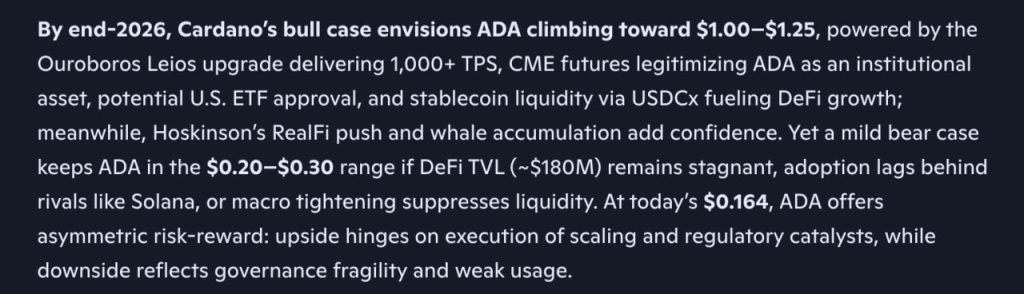
Microsoft's Copilot AI has issued a price forecast for Cardano (ADA) through the end of 2026, delivering one of the more conservative predictions among current analyst calls in the cryptocurrency space. As an AI assistant that synthesizes publicly available data rather than conducting independent research, Copilot's forecast reflects an aggregation of existing analyst sentiment and on-chain metrics. The bullish scenario envisions ADA climbing to a range of $1.00 to $1.25, driven primarily by the Ouroboros Leios upgrade to Cardano's proof-of-stake consensus protocol, which is expected to deliver throughput exceeding 1,000 transactions per second.
Copilot identifies CME futures as a key step toward legitimizing ADA as an institutional-grade asset, alongside the potential approval of a US exchange-traded fund (ETF). CME Group already lists regulated futures for Bitcoin and Ethereum, making it a benchmark venue for institutional crypto derivatives, and spot ETFs for both BTC and ETH have already received US regulatory approval—establishing a precedent that ADA proponents frequently cite. On the decentralized finance front, stablecoin liquidity via USDCx is expected to support DeFi growth across the Cardano network. Cardano founder Charles Hoskinson's RealFi initiative and continued whale accumulation are both cited as factors reinforcing confidence in the bullish case. The integration of real-world assets through a specifically named initiative adds a layer of concreteness that purely technical roadmaps often lack.
The bearish scenario is comparatively modest but grounded in measurable data. Under a mild bear case, ADA could remain in the $0.20 to $0.30 corridor if total value locked (TVL) in Cardano DeFi—currently around $180 million—stays stagnant, adoption trails competitors such as Solana, or macroeconomic tightening constrains broader market liquidity. Cardano's DeFi TVL has consistently lagged behind several Layer 1 peers, with Solana and other competing networks maintaining meaningfully higher liquidity levels, underscoring the adoption gap Copilot references. With ADA trading near $0.164 at the time of assessment, Copilot frames the current setup as offering asymmetric risk-reward. Upside potential hinges on execution of the scaling roadmap and the materialization of regulatory catalysts, while downside risk largely reflects existing governance fragility and persistently low network usage.
ADA Down Roughly 88% From Late 2024 Peak
ADA closed at $0.162562, up 0.53%, in a session ranging between $0.160380 and $0.168970. That modestly positive day comes at the tail end of one of the longest sustained declines in Cardano's recent trading history.
Looking at the broader picture, ADA peaked near $1.32 in December 2024 before entering a choppy range between approximately $0.55 and $0.95 through most of 2025. The defining structural break occurred in October 2025, when price gapped down sharply from above $0.85 to below $0.55 over a matter of weeks, and the decline continued largely uninterrupted thereafter.
Since that October 2025 crash, ADA has fallen in a protracted, stepwise pattern, with only a brief stabilization attempt in May 2026 that topped near $0.29 before rolling over again. The current price sits just above the lowest level of the entire post-crash decline, having hovered near $0.16 for the past two months.
Immediate support is located at $0.16, a level ADA has tested repeatedly. Below that threshold, there is limited recent chart history before price enters territory not visited during the current window. Resistance levels are stacked at $0.20—the ceiling identified in Copilot's own bear case—followed by $0.29 from the failed May recovery, and then the heavier resistance zone near $0.55 established earlier in 2025. Momentum remains flat, with price moving along its lows rather than forming a meaningful base.
For Copilot's bullish case to gain traction, ADA would need to first reclaim $0.29, a level it has not closed above since May 2026. Until that occurs, the current chart pattern aligns with the bear scenario—reflecting stagnant price territory rather than a buildup toward the $1 mark.
Copilot AI Points to LiquidChain as Potential High-Growth Project
Copilot AI has also highlighted LiquidChain, a Layer 3 protocol designed to address structural inefficiencies in cross-chain interoperability. The project operates above Bitcoin, Ethereum, and Solana, aiming to consolidate their isolated liquidity systems into a single unified execution environment. Cross-chain interoperability remains one of the most actively pursued problems in blockchain infrastructure, with numerous projects—including Cosmos's IBC, Polkadot's XCM, and various bridge protocols—competing to solve fragmentation across networks. According to the project's framework, a single deployment can reach all three networks simultaneously without fragmented codebases or bridging overhead.
LiquidChain targets four specific failure points in current cross-chain architecture: the Unified Liquidity Layer collapses fragmented liquidity silos; Single-Step Execution removes multi-transaction cost overhead; Verifiable Settlement eliminates trust assumptions that create counterparty risk; and the Deploy-Once model enables a single codebase to reach all target networks. The LiquidChain presale is reported to be live at $0.01454 per LIQUID token, with over $900,000 raised to date. Presale-stage projects carry elevated risk, as token economics, audit status, and mainnet readiness typically remain unproven at this phase.

