Carriers Push Ahead With Red Sea Transits as Container Spot Rates Split
Key Takeaways
- •Asia-U.S. West Coast spot rates rose 9% to $7,422 per FEU, while Asia-U.S. East Coast rates climbed 3% to a record $9,422 per FEU.
- •Asia-North Europe rates fell about 20% from their July high to roughly $4,700 per FEU, and Asia-Mediterranean rates dropped 30% to about $5,000 per FEU.
- •The U.S.-Iran memorandum aimed at reopening the Strait of Hormuz expired without progress, and Houthi attacks on merchant vessels have resumed.
- •Maersk, Hapag-Lloyd, CMA CGM and Cosco plan to resume Red Sea transits despite the war, persistent port congestion and a German labor strike.
- •Bunker prices have climbed 15% since the ceasefire collapse, and carriers will impose Panama Canal surcharges of $200-$1,000 per FEU as draft limits are reduced.
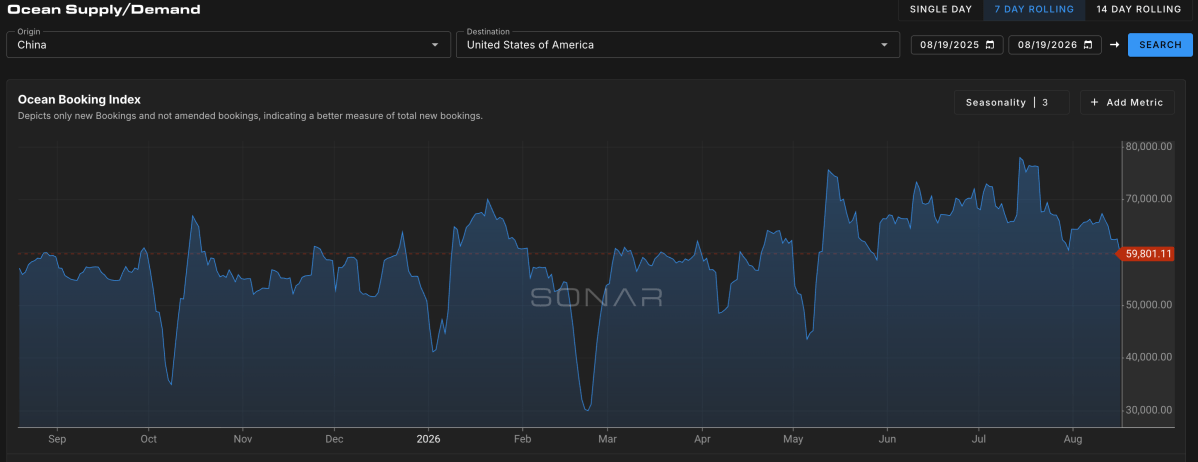
Container spot rates are moving in opposite directions, and that divergence amounts to most of the good news currently on offer in ocean shipping.
Trans-Pacific lanes climb as Asia-Europe cools
Spot rates — the price of moving a box on short notice outside long-term contracts — are the market's fastest-moving gauge in a sector that carries the vast majority of world merchandise trade by volume, which is why the current split matters beyond the carriers themselves.
Asia-U.S. West Coast prices jumped 9% to $7,422 per forty-foot equivalent unit (FEU) in the most recent data from SONAR contributor Freightos (NASDAQ: CRGO), while Asia-U.S. East Coast prices rose 3% to a new high of $9,422 per FEU. Asia-Europe lanes, by contrast, are cooling off from their mid-July peaks as an early peak season unwinds ahead of schedule.
Behind the rate moves is a geopolitical backdrop that remains unresolved, and a carrier calculus that is shifting in spite of it.
Hormuz diplomacy stalls
The U.S.-Iran Memorandum of Understanding, signed 60 days ago to reopen the Strait of Hormuz and kick off negotiations to end the war, expired Tuesday. With Iranian attacks continuing and the American blockade still in place, a reopening of the strait looks no closer than it did before the agreement was signed.
Published sources continue to cite higher insurance premiums to cross the Bab el-Mandeb Strait, which guards the southern end of the Red Sea. At the same time, higher fuel costs stemming from the Hormuz closure are making diversions away from the Suez Canal route and around Africa's Cape of Good Hope — a detour of several thousand miles that adds roughly two weeks of steaming versus Suez, a canal that normally handles about 30% of global container traffic — far more expensive than they were from late 2023 through the start of the war.
Even worse, the Houthis have recently resumed attacks on merchant vessels as their simmering dispute with Saudi Arabia boiled over.
Carriers press ahead
Despite the war and the renewed Red Sea attacks, Maersk (OTC: AMKBY) and its Gemini partner Hapag-Lloyd — the vessel-sharing alliance the two carriers launched in February 2025 — along with CMA CGM and Cosco, are determined to resume Red Sea transits. Where earlier threats triggered U-turns, changed market conditions, including stubborn port congestion, may be behind the new resolve. On its recent earnings call, Maersk singled out congestion as a major new component of container dynamics, with growing demand deepening the headhaul/backhaul imbalance — the gap between heavily loaded outbound legs and lightly booked return legs. A German labor strike is adding to the delays.
On the pricing side, Asia-North Europe rates slipped to about $4,700 per FEU this week, down 20% and more than $1,000 per FEU since the July high, according to Freightos, though they remain 60% higher than in May. Asia-Mediterranean rates fell to about $5,000 per FEU, a 30% slide from their peak.
Fuel and Panama costs pile up
Bunker prices have climbed 15% since the collapse of the ceasefire, and some carriers have raised emergency fuel surcharges of about $90 per FEU in mid-September. The Panama Canal Authority, meanwhile, is cutting daily transits and lowering Neopanamax draft to 48 feet this month and 47.5 feet in early September — caps that limit how deeply ships may be laden and therefore how much cargo each crossing can carry — with carriers announcing canal transit surcharges of $200-$1,000 per FEU starting in mid-September.
For shippers, the near-term markers are whether the resumed Red Sea sailings hold, and how the new fuel and canal surcharges settle into the next round of published rates.

