On-Time Container Shipping Performance Posts Sharpest Drop in Five Years, Sea Intelligence Data Shows
Key Takeaways
- •Global container schedule reliability fell 6.1% month over month to 56.4% in July 2026, the largest single-month drop since January 2021.
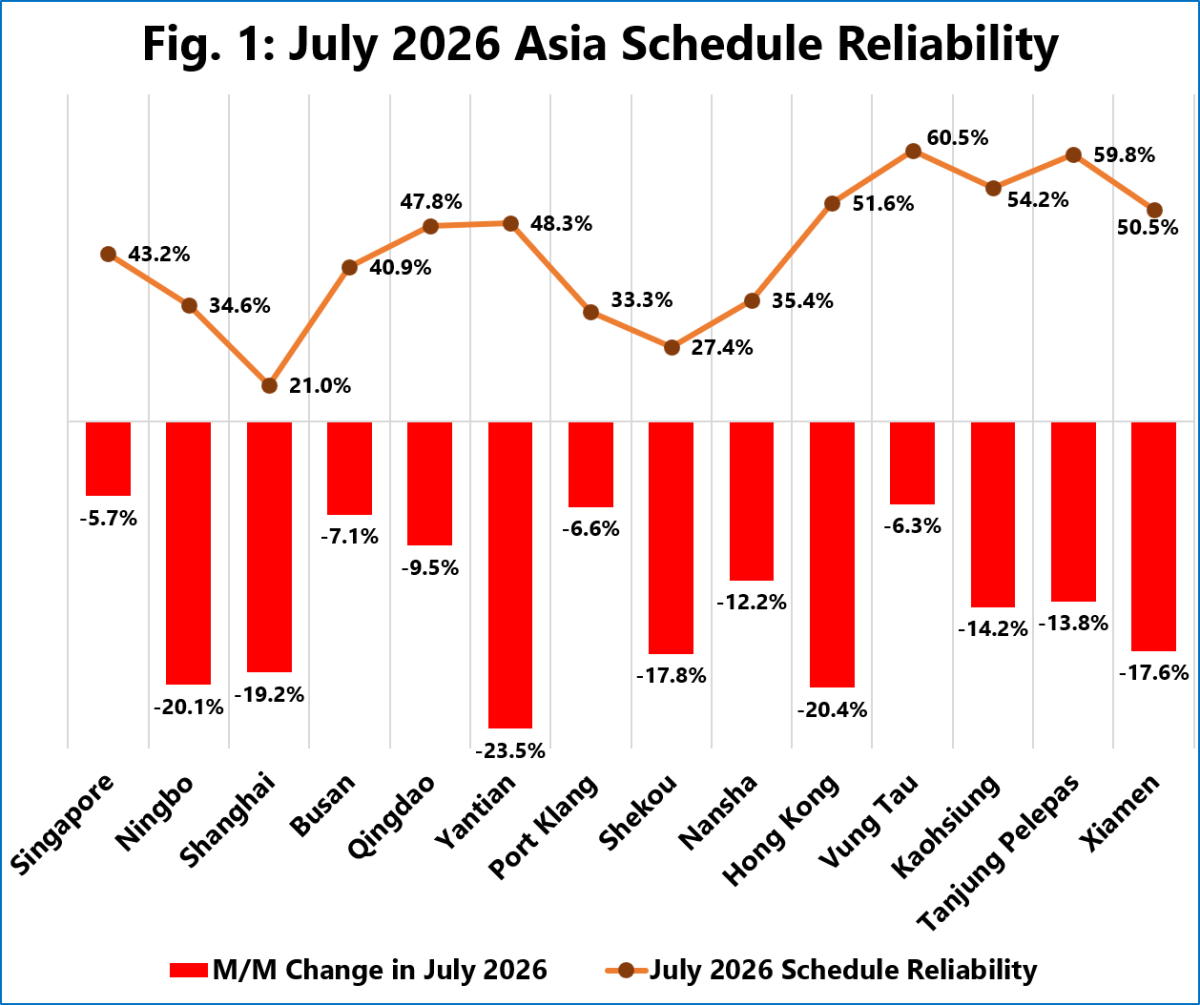
- •Congestion at Asian ports was the main driver, with all 14 of the region's busiest ports seeing declines in on-time vessel arrivals.
- •Shanghai recorded only 21% on-time arrivals, its lowest level outside pandemic-era disruptions in 14 years of recorded data.
- •Average delays for late vessels increased to 6.06 days, up more than half a day from June.
- •The report expects the backlog to cascade through the maritime network and trigger new delays on headhaul trade lanes to Europe and North America.
Severe weather disruptions across Asia took a heavy toll on global container shipping's on-time performance in July 2026, according to a new report from Sea Intelligence.
Global container vessel schedule reliability fell to 56.4% in July 2026, a 6.1% decline from June, the Copenhagen-based analyst reported. It marks the sharpest single-month drop since January 2021. Schedule reliability is a closely watched indicator in the container shipping industry because late vessels ripple through supply chains: shippers face missed transshipment connections, longer inland transit planning windows, and less predictable inventory replenishment, while carriers must rework vessel rotations and often omit port calls to recover time.
At the same time, the average delay for late vessel arrivals climbed to 6.06 days, an increase of more than half a day month over month.
Congestion across major Asian ports was the primary driver of the pronounced decline, according to Alan Murphy, CEO of Sea-Intelligence. "All 14 of the region's busiest ports experienced a decrease in on-time vessel arrivals," Murphy said. Asia's major container gateways anchor the headhaul trade lanes carrying exports toward Europe and North America, so deterioration there tends to propagate across the wider maritime network rather than staying a regional issue.
Yantian took the hardest hit, with schedule reliability plummeting 23.5 percentage points (pp) to 48.3%. Hong Kong dropped by 20.4 pp to 51.6%, and Ningbo saw reliability fall by 20.1 pp to 34.6%.
The report described the situation in Shanghai as "particularly alarming." After a steep decline of 19.2 pp, only 21% of container vessels arrived on time at the world's busiest port in July 2026.
"Outside of extreme pandemic-era supply chain disruptions, schedule reliability in Shanghai has never dropped this low in 14 years of recorded data," Murphy said.
Schedule unreliability, while less severe, also spread to other Asian hubs in July. Singapore posted on-time reliability of just 43.2% after a 5.7 pp drop from June. Port Klang, Malaysia, was weaker at 33.3%, and Busan, South Korea, fell to 40.9%.
The report noted that with the region's busiest ports now handling incoming vessels that are more than half delayed, the backlog is expected to cascade through the maritime network, likely triggering a new wave of delays on critical headhaul trade lanes in the coming months.
Source: FreightWaves

