Community banks sue OCC over national trust charters for crypto firms
Key Takeaways
- •The ICBA filed a lawsuit in the District of Columbia arguing that the OCC overstepped its jurisdiction when it granted national trust bank charters to cryptocurrency companies.
- •National trust charters allow firms to manage customer funds and process transactions but prohibit taking cash deposits or issuing loans, a boundary at the center of the dispute.
- •ICBA President and CEO Rebeca Romero Rainey said digital assets held by crypto firms under national trust charters lack the federal protections consumers expect from a federally chartered bank.
- •Senator Elizabeth Warren stated in a May 18 letter that the OCC had granted least nine national trust charters to crypto firms since December 2025, while the ICBA separately opposed Payward's charter application submitted on May 8.
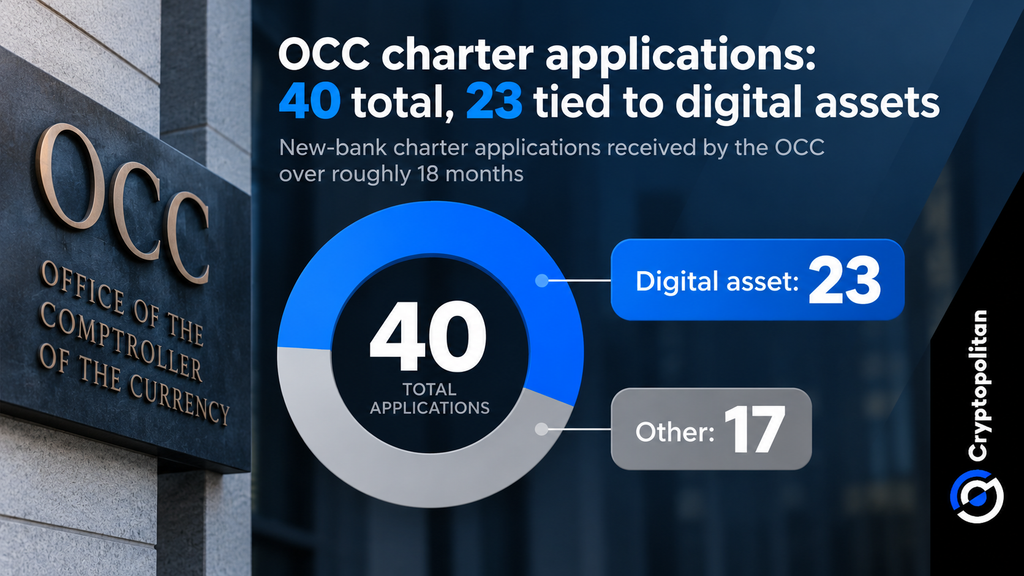
- •The OCC says its chartering rules, effective April 1, neither expanded nor contracted its authority, yet Comptroller Jonathan Gould reported 40 charter applications in roughly 18 months with 23 involving digital assets, and a Bank for International Settlements study projects stablecoins could exceed $300 billion by 2026 with 98% tied to the US dollar.
A trade organization representing community banks in the United States has filed a lawsuit against the Office of the Comptroller of the Currency (OCC), alleging that the regulator overstepped its jurisdiction when it granted national trust bank charters to cryptocurrency companies.
The Independent Community Bankers of America (ICBA) initiated the case in the District of Columbia, challenging a recent OCC action and its related guidance. The group argues that crypto companies receive the credibility of a US bank charter without complying with all of the requirements that apply to regular banks. Under national trust charters, companies are permitted to manage customer funds and process transactions, but they cannot take cash deposits or issue loans. Trust charters are traditionally tied to fiduciary work such as managing assets on behalf of customers rather than deposit-taking — a boundary that sits at the center of this fight.
A lawsuit aimed at the OCC's chartering authority
The ICBA contends that extending these charters to crypto companies stretches the OCC's mandate too far, according to a report by Reuters. The filing moves the dispute from regulatory comment letters into judicial review, where a judge, rather than the agency itself, will decide whether the chartering practice fits within the OCC's legal authority.
“American consumers reasonably expect a federally chartered bank to carry federal protections.” — ICBA President and CEO Rebeca Romero Rainey, in an ICBA statement on the lawsuit against the OCC
Romero Rainey said digital assets held by crypto firms operating under national trust charters do not come with the same protections. An OCC spokesperson declined to comment to Reuters.
Warren and community banks were already pushing back
The dispute has been building for months. In May, the ICBA opposed the charter application of Payward, the parent company of cryptocurrency exchange Kraken. OCC records indicate that the application for Payward National Trust Company was submitted on May 8.
Senator Elizabeth Warren of Massachusetts had raised these concerns before. She issued a letter in May stating that since December 2025 the OCC had granted at least nine national trust charters to crypto firms — a stretch of approvals in under six months — and questioning whether some of their activities can be classified under the activities allowed for a trust company.
“These companies are effectively crypto banks that want to evade the fundamental safeguards and obligations that come with being a bank.” — Senator Elizabeth Warren, in a May 18 letter Comptroller Jonathan Gould
The OCC says it only clarified existing powers
The OCC, an independent bureau of the US Treasury Department that charters and supervises national banks, views the matter differently. Its final chartering rules, which took effect on April 1, state that the agency “would neither expand nor contract” its chartering authority. Instead, the rules explain that trust-limited national banks may perform a range of non-traditional functions related to the activities of trust companies. That gap between “clarification” and “exp” is the legal question the ICBA's lawsuit now puts before the court.
The statistics shed light on the reasons behind the fierce debate surrounding the issue. Comptroller Jonathan Gould has said that the OCC has received 40 applications for new bank charters in roughly 18 months, and that 23 of these are for digital assets. That figure is eight times as high as in the preceding four years, according to earlier Cryptopolitan reporting. With that many digital-asset applications still in the queue, how a court reads the OCC's chartering authority matters to far more than the firms already chartered.
Why the charter fight reaches the global crypto market
The dispute has implications that reach beyond US banking. A study by the Bank for International Settlements indicates that the volume of stablecoins on the market could exceed the $300 billion mark by 2026, with a staggering 98% of the total linked to the US dollar. Stablecoins are digital tokens designed to maintain a stable value against reference assets, most commonly the US dollar.
At the same time, according to the Financial Stability Board, different jurisdictions have major gaps in the way they implement regulations, allowing for regulatory arbitrage to occur — the practice of structuring activity to fall under the most permissive available rulebook. The OCC lawsuit could help define the extent to which the US trust company charter applies in the crypto area, and indicate the weight of the federal charter in the global market.
Source: Cryptopolitan

