Solana Pokémon Packs Rake In $18.3M: Cards Keep Spinning
Key Takeaways
- •Collector Crypt generated $18.3 million in October fees, 4.3 times its year-earlier level, placing it alongside Polymarket and pump.fun among consumer crypto apps challenging stablecoin issuers and exchanges in fee rankings.
- •Token Terminal's fee metric adds full pack sales and marketplace royalties while subtracting only buyback payments, so it overstates what the company keeps because card acquisition, vaulting, and restocking costs are not deducted.
- •Cards sold back re-enter their original machine pool and can be pulled and sold repeatedly, meaning rising fee totals may reflect faster inventory recycling rather than growth in new collectors.
- •The instant buyback pays 85% to 93% of an insured value that Collector Crypt assigns at its discretion, carries no actual insurance cover despite the name, and remains available for only three days after a pull.
- •Packages are declared at the card's insured value for customs purposes, so international recipients bear import charges on a figure Collector Crypt sets, with EU import VAT applying from the first euro since the €22 exemption ended in July 2021.
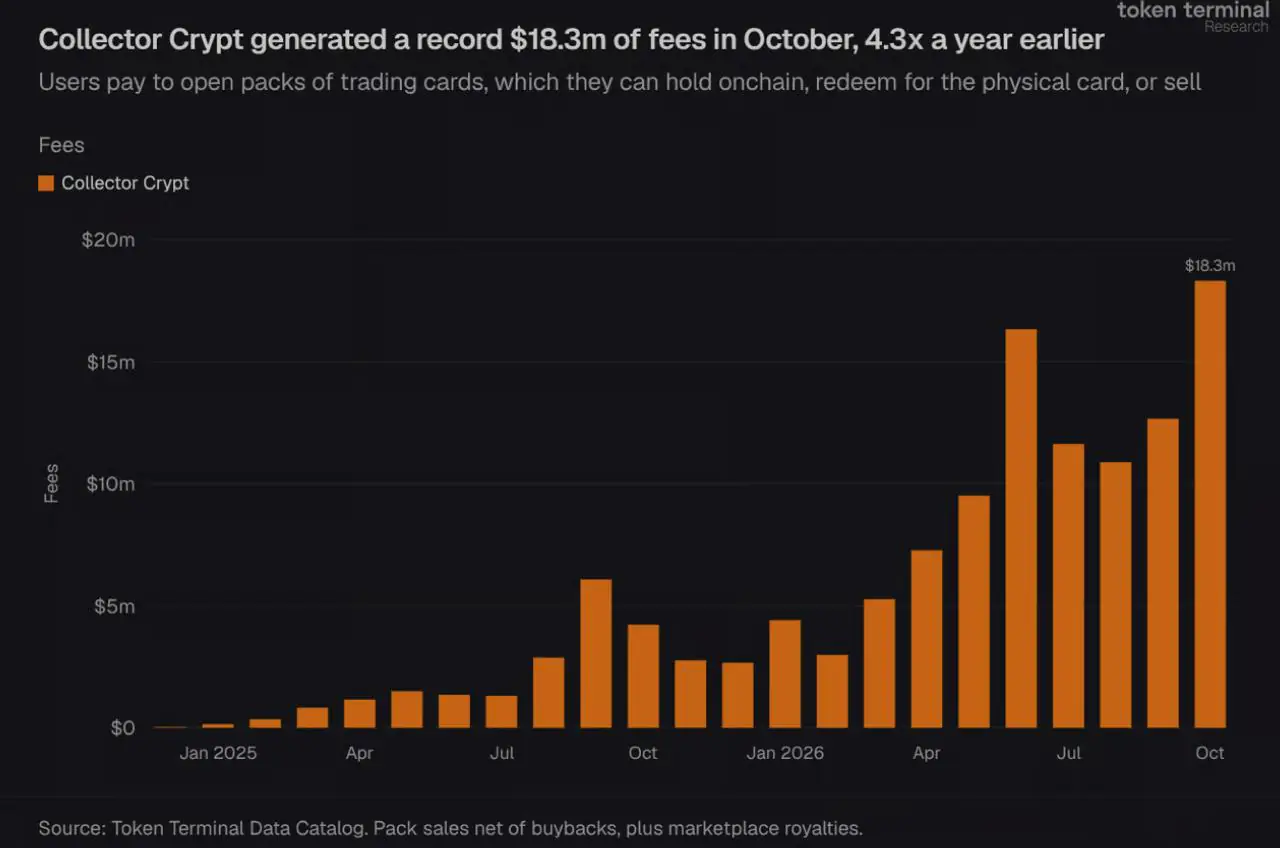
Collector Crypt, a Solana-based platform that tokenizes graded trading cards — mostly Pokémon — generated $18.3 million in fees in October. Token Terminal's November 5 newsletter put the total at 4.3 times the level of a year earlier, which implies roughly $4.3 million in October 2025. The same edition grouped Collector Crypt with Polymarket, which took $126.7 million in October, and pump.fun, at $62.5 million, as consumer apps now challenging stablecoin issuers and exchanges near the top of crypto's fee rankings.
Collector Crypt tokenizes graded trading cards, mostly Pokémon, that sit with vaulting partners such as PSA Vault and OmniVault. Most of its business runs through packs, a format borrowed from gacha games: the buyer pays a fixed USDC price on Solana, receives a random card, then keeps it onchain, ships it home, or sells it back. On Jupiter's Gacha storefront, Collector Crypt packs run from $25 to $5,000, and October brought a wave of new releases, including the Lucky and Angels Pokémon packs, a mixed-franchise Black Magic pack, and a three-pack Dragon Ball line.
Fees Count the Spread, Not the Cost of Cards
Token Terminal builds its Collector Crypt fee figure by adding pack sales and marketplace royalties, then subtracting the buybacks paid when users sell pulled cards back. A pack sale enters the fee line in full; only the cash that flows back out through a buyback comes off it.
That construction explains why fees overstate what the company keeps. When a buyer holds on to the card, the entire pack price counts as fees, yet Collector Crypt had to acquire the graded slab, vault it, and restock the machine afterward — costs the metric carries no line for. The same construction shows why fees cannot stand in for collector losses either, since that buyer exchanged cash for a card they still own.
The sell-back side is where the company's fee line and the buyer's result meet. On every pull that goes straight back, the fee recorded is the share of the pack price the buyer did not recover.
One Card Can Earn Fees Again and Again
Jupiter's buyback guide says Collector Crypt cards sold back go to the machine pool of the pack they came from, where other users can pull them again. The slab stays in its vault the whole time, so the sell-back-and-repull cycle can repeat for as long as the card keeps getting pulled and sold.
The interface is built to shorten that loop. A "Sell & rip again" button sells a fresh pull and opens another pack of the same tier in two wallet approvals. Turbo mode sells every Common pull back at the machine's rate the moment it appears. When a machine runs short of Common cards, Turbo becomes mandatory until it is restocked, according to Jupiter's pack guide, so every low-tier pull from that machine returns to it automatically.
That changes how fee growth should be read. A rising total can come from more collectors and more cards, or from the same inventory turning faster, and Token Terminal's figure does not separate the two. The pattern runs across the sector: in CoinGecko's second-quarter industry report, Collector Crypt held 62.8% of tokenized-collectibles volume in June, while gacha packs generated over 98% of transaction volume on these platforms on average.
The Buyback Pays on a Number Collector Crypt Sets
On Collector Crypt packs, the instant buyback pays 85% to 93% of a card's insured value, with the rate set per machine and the value fixed at the moment of the pull. Jupiter's collection guide describes insured value as a reference figure Collector Crypt assigns at its discretion. It carries no insurance cover despite the name, and a card can trade above or below it on the open market.
Because the rate applies to that assigned value rather than to the price paid, recovering the cost of a pack takes a pull insured well above it. Jupiter's own example uses a $50 pack at 85%: a card insured at $80 returns $68, with USDC counted at $1 and Solana network fees excluded.
Most pulls stop short of break-even. Jupiter warns that on most packs the majority of pulls land in the lowest rarity tier, below the pack price, and describes the buyback as a floor rather than a profit. Each pack displays fixed odds per tier and an expected value averaged across the machine's current contents. On the $100 Degen pack, chase cards valued around $10,000 share the pool with what Jupiter calls a higher risk of low-value pulls — which is how an attractive average and a disappointing typical result can coexist.
The strongest argument for the design is liquidity. A cash bid seconds after the reveal is something most graded-card sellers never get, and a holder who thinks the insured value is too low can skip the buyback and list the card at their own price. Terms also vary on the same storefront: Phygitals packs on Jupiter currently buy back at 100% of Phygitals' own fair-market estimate, paid over seven days. The two valuations come from different providers, so the rates cannot be compared one for one.
After Day Three, the Floor Becomes an Offer
The instant buyback on a Collector Crypt pull lasts three days and cannot be extended or reopened, according to Jupiter. It belongs to the wallet that made the pull, so a card sent to another wallet loses it. If Collector Crypt later revises insured values, Jupiter does not adjust buyback amounts and refers any discrepancy to Collector Crypt support.
After the window closes, the card stays vaulted at no storage cost, and the holder can ship it or list it at a chosen price. Collector Crypt's April 30 marketplace update added a direct buyback request with no expiry. That route runs on different terms: the holder submits a request, receives an offer, and decides, and the announcement publishes no percentage. The 85-93% band applies only during the first three days.
Insured Value Also Sets the Customs Bill
Taking the card home starts with a burn. In Jupiter's shipping guide, the token burn and the shipping fee are signed in a single wallet prompt, and from that point the request sits with Collector Crypt, which decides whether a cancellation is still possible.
Collector Crypt published its shipping rates on April 30. Prices are quoted per first card, each additional card adds $3 in every zone, and insurance cover is included up to $5,000 — above that it costs 0.5%. Jupiter's current guide lists Australia and New Zealand as a separate zone, and the exact fee appears before a shipment is confirmed.
For buyers outside the U.S., the shipping fee is only part of the cost. Each package is declared at the card's insured value at redemption, never as a gift or at a lower value, and any customs or import charges fall on the recipient. The same discretionary figure that sets the buyback also sets the tax base. For a buyer in the EU receiving a card from a vault outside the bloc, import VAT has applied from the first euro since the €22 exemption ended in July 2021.
Timing adds another gap. Collector Crypt estimates around two to three weeks for U.S. deliveries and about five weeks internationally, mostly vault processing, and shipments cannot be expedited. Cards held in different vaults arrive as separate packages, and insurance on a parcel sent to a forwarding service ends at the forwarder. The same divide between holding a token and taking delivery of the asset behind it shapes tokenized copper.
November's Total Is the Next Test
November closes on the 30th, and its fee total on Token Terminal is the first read on whether October's record outlasted a month crowded with new pack launches. The next figure will appear on the same Token Terminal explorer page that carries October's total.
Even a higher number would leave the main question open. Separating new demand from faster recycling takes two figures that appear neither in Token Terminal's fee metric nor in Jupiter's Gacha documentation: how many times the average card is pulled, and what share of pulls ends in a shipment rather than a sale back. Without them, $18.3 million shows how hard the machines worked in October — not how many collectors came to stay.

