Coinbase Joins U.S. and UK Crackdown on West Africa Scam Networks
Key Takeaways
- •Coinbase is cooperating with U.S. and UK authorities in an active effort to identify and disrupt scam networks connected to West Africa.
- •The fraud schemes in scope, such as romance scams, advance-fee fraud, and business email compromise, increasingly use cryptocurrency to move illicit proceeds from victims in the United States and Europe.
- •No specific agencies, suspects, arrests, or asset seizure figures have been confirmed, since the effort is ongoing rather than a concluded enforcement case.
- •As a U.S.-registered exchange, Coinbase must comply with anti-money laundering obligations, including filing suspicious activity reports and answering lawful information requests from investigators.
- •The reporting indicates that no Coinbase customer accounts, funds, or data have been affected, as the action is directed at scam operators rather than platform users.
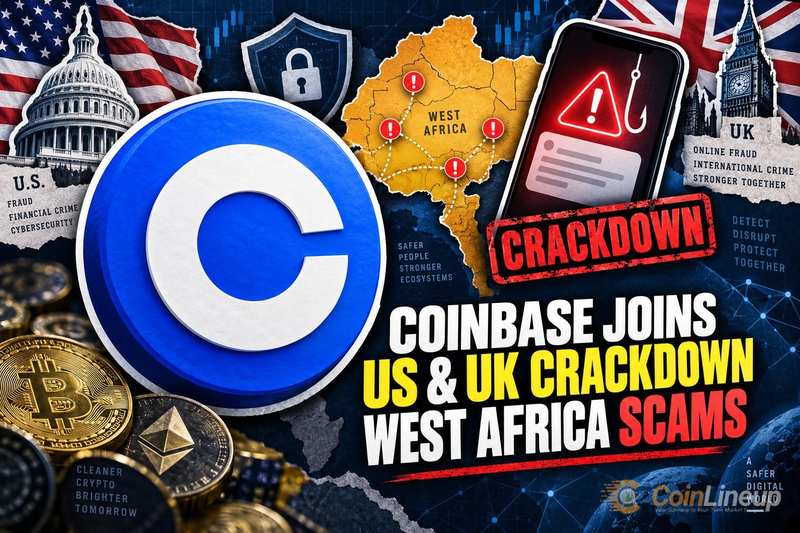
Coinbase, the largest cryptocurrency exchange in the United States, is working alongside American and British authorities in a coordinated effort to identify and disrupt scam networks linked to West Africa. The collaboration pairs a major crypto platform with two governments in a cross-border consumer protection push.
Coinbase joins coordinated U.S. and UK action against West Africa scams
According to available reporting, the effort brings together Coinbase, U.S. law enforcement or regulatory authorities, and their UK counterparts. The stated focus is scam activity connected to West Africa, a region long associated with online fraud schemes — from romance and advance-fee scams to business email compromise — that increasingly use cryptocurrency as a payment method. Online fraud operations linked to the region have historically targeted victims in the United States and Europe, and digital assets have become an increasingly common channel for moving illicit proceeds. Fraud of this kind has drawn repeated public warnings from law enforcement agencies in the United States and Europe, particularly around business email compromise and romance schemes that can build trust over months before a payment is ever requested.
No specific agencies, individual suspects, dollar loss figures, arrests, or asset seizures have been confirmed in the available reporting. The action appears to be an active, ongoing effort rather than a concluded enforcement case. Because the effort remains open-ended, any concrete specifics — named agencies, charges, or seizure figures — would ordinarily surface through official channels such as agency announcements, court filings, or company disclosures.
Coinbase has previously worked alongside U.S. government agencies on financial matters. In one notable instance, the U.S. government moved $470 million in BTC, WBTC, and USDT to Coinbase Prime, a transfer that illustrated the existing operational relationship between the exchange and federal authorities. The company has also been expanding its regulatory footprint, recently receiving approval from the U.S. Commodity Futures Trading Commission (CFTC) for a clearinghouse serving U.S. derivatives markets — a development that underscores its deepening ties to official financial oversight. Regulatory moves such as the SEC's revised quorum rule likewise signal a broader shift toward formal coordination between crypto firms and government bodies.
Why crypto exchanges play a role in scam investigations
When fraud involves cryptocurrency, exchanges sit at a critical point in the money trail. Victims are often directed to send funds through platforms like Coinbase, which means the exchange holds account data, records, and identity verification information that investigators cannot obtain from the blockchain alone.
Like all U.S.-registered exchanges, Coinbase operates under anti-money laundering rules that require it to file suspicious activity reports and respond to lawful information requests. Cooperation with law enforcement in fraud cases falls squarely within these existing obligations.
Cross-border cases add further complexity. U.S. and UK authorities generally need mutual legal assistance to share evidence and coordinate action against suspects operating across jurisdictions. Involving a crypto platform with visibility into both markets can help bridge that gap.
What this means for Coinbase users and scam prevention
The available information does not indicate that any individual Coinbase user accounts, funds, or data have been affected. The effort appears directed at scam operators, not at customers of the platform.
At the same time, online scams that rely on cryptocurrency payments remain a genuine and growing threat to ordinary people. Scammers frequently pose as romantic partners, investment advisors, or tech support agents before persuading victims to send crypto to wallets under the scammer's control.
Consumers can reduce their exposure by following basic precautions. Never share a wallet recovery phrase with anyone, and never send cryptocurrency to a person who has not been verified in person or through an official, trusted channel. Unsolicited messages urging crypto investments or payments to unfamiliar wallets should be treated as red flags. Legitimate companies, government agencies, and financial institutions will not demand payment in cryptocurrency as a condition of doing business or releasing funds. Anyone who suspects they have been targeted should cut off contact with the counterpart and report the incident to the relevant authorities — in the United States, through the FBI's Internet Crime Complaint Center (IC3), and in the UK, through Action Fraud, the national reporting service for fraud and cybercrime.
Disclaimer: This article is for informational purposes only and does not constitute financial or investment advice. Cryptocurrency and digital asset markets carry significant risk. Always do your own research before making decisions.

