Coinbase Shares Drop 14% After Q2 Revenue Misses Estimates
Key Takeaways
- •Coinbase stock fell approximately 14% to $140 following its second-quarter earnings report, which missed analyst consensus estimates.
- •The company reported Q2 revenue of $1.22 billion against expectations of approximately $1.29 billion, along with a net loss of $359.5 million.
- •Spot trading volume declined 25% during the quarter, contributing to a 20% drop in transaction revenue to $452 million.
- •Stablecoin-related revenue reached a record $292 million, providing a partial offset to weakness in core trading activity.
- •Analysts project Coinbase's revenue will decline approximately 36% sequentially to around $1.19 billion in the current quarter as the crypto winter persists.
Key Takeaways
- Coinbase stock dropped toward a key support level following its second-quarter earnings report.
- Revenue declined 19% as weaker cryptocurrency trading activity weighed on transaction income.
- Subscription and services revenue provided a partial offset but also fell year over year.
Coinbase extended its slide on Friday, July 31, after the company reported second-quarter results that fell short of Wall Street expectations. Shares of COIN fell approximately 14% to $140 during the session, marking the stock's lowest level since late June. The drop followed a 5.6% decline during Thursday's extended-hours trading.
Coinbase reported $1.22 billion in total revenue for the quarter, below the analyst consensus estimate of approximately $1.29 billion. The company also posted a net loss of $359.5 million, or $1.36 per share. For context, Coinbase went public via direct listing on the Nasdaq in April 2021 at a reference price of $250, and the stock's post-IPO trajectory has closely tracked sentiment in the broader cryptocurrency market.
Revenue Downtrend Driven by Crypto Winter
As the largest cryptocurrency exchange in the United States, Coinbase has faced significant headwinds throughout the year amid a prolonged crypto winter. Bitcoin and most major altcoins have posted double-digit declines year to date, with the total market capitalization of all cryptocurrencies falling from over $4 trillion to roughly $2.1 trillion. The downturn has also coincided with heightened regulatory scrutiny of the digital asset industry, with the SEC pursuing actions against multiple crypto entities during this period, adding an additional layer of uncertainty for market participants.
The decline in digital asset prices has adversely affected Coinbase and competing exchanges. BitMart announced its closure amid the broader downturn. Despite operating a more diversified business model, Coinbase has not been immune to the sector-wide sell-off.
The latest earnings report confirmed that Coinbase's revenue continued to contract in the second quarter. The company generated over $1.2 billion in Q2, extending a downward trajectory that began in the third quarter of the prior year, when revenue stood at $1.86 billion. Quarterly revenue has declined in every subsequent period.
Coinbase attributed the deterioration to several factors, including a 15% quarter-over-quarter decline in total trading volume. Spot trading volume on the platform fell 25% during the quarter — a trend that could persist if the crypto winter deepens.
Transaction revenue dropped 20% to $452 million, while institutional transaction revenue declined 26% to $100 million.
Diversification Provides Partial Buffer
On a more positive note, Coinbase's diversified business structure has offered some resilience, with stablecoin-related revenue playing a particularly important role. Stablecoin revenue reached a record $292 million during the quarter, driven by income generated from the company's USDC holdings through the bond market. Rising interest rates throughout 2022 have boosted yields on the short-duration government and corporate bonds backing USDC reserves, partially explaining why this revenue line reached new highs even as overall trading activity declined.
However, a key risk is that the overall USDC supply is not expanding. According to CoinMarketCap data, USDC's market capitalization has fallen from nearly $80 billion earlier this year to approximately $71 billion. This contraction could eventually weigh on stablecoin revenue.
Coinbase has also invested in expanding its subscription and services offerings. Revenue from this segment now accounts for roughly 48% of total business, and its continued growth is expected to reduce the company's dependence on transaction-based income over time.
Another positive factor is Coinbase's relatively strong balance sheet and ongoing cost management. The company ended the quarter with over $10 billion in available resources, including $2.4 billion in cash held at banks, $3 billion in money market funds, $2.9 billion in stablecoins, and $94 million in cash held at other venues.
The company has also been actively reducing expenses, most recently through staff layoffs, and is mitigating shareholder dilution through share repurchases. Outstanding shares stood at 264 million at the end of the quarter, down from a peak of 269 million in the prior year.
Analysts broadly expect Coinbase's revenue to remain under pressure as the crypto winter persists. The current consensus estimate projects a 36% sequential revenue decline to approximately $1.19 billion for the current quarter. Beyond near-term quarterly results, market observers are also watching whether regulatory developments — including potential rulemaking affecting staking, lending, and stablecoin oversight — could reshape the revenue mix Coinbase has been building to offset transaction declines.
Technical Analysis: COIN Tests Key Support
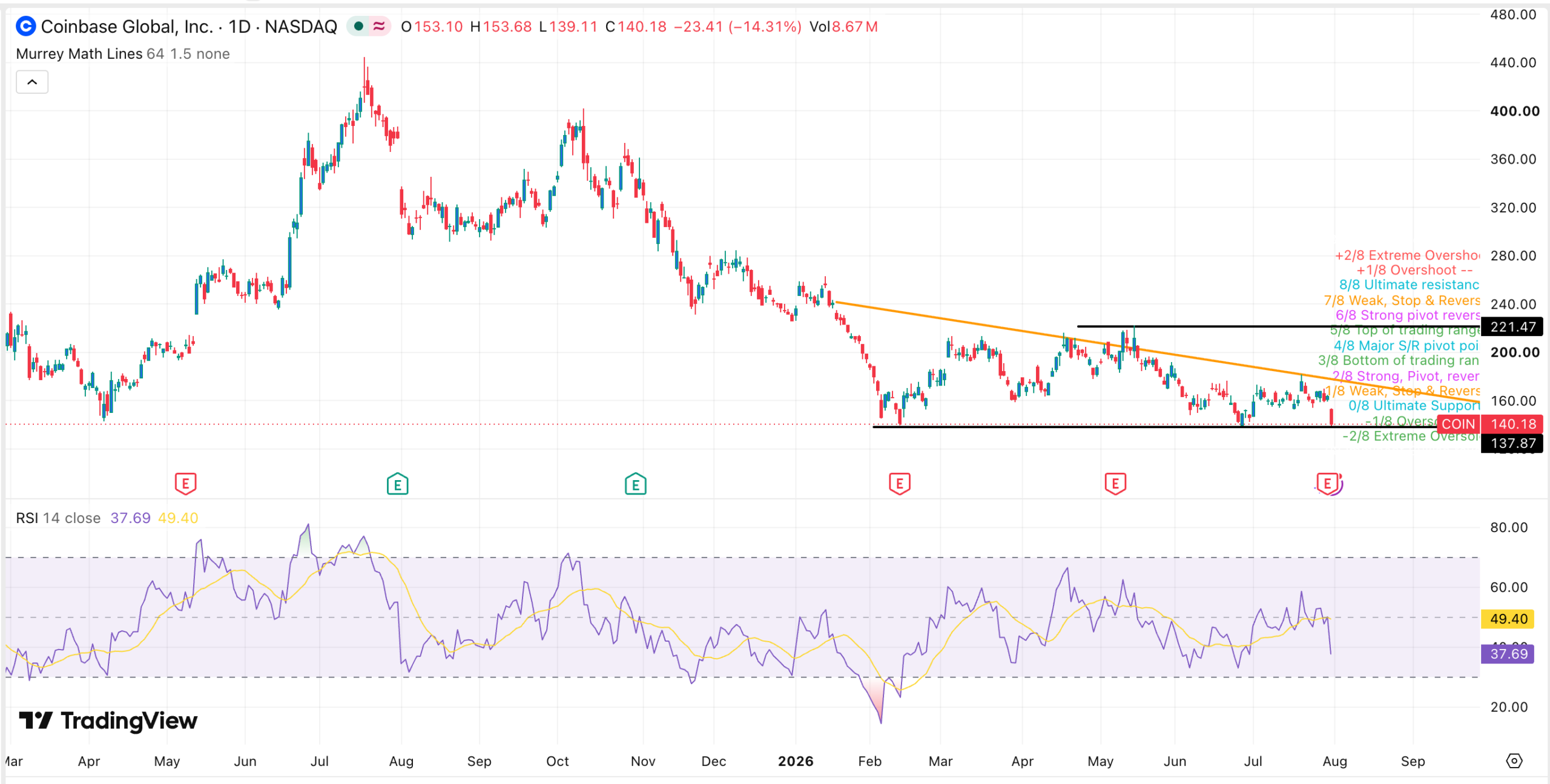
COIN stock fell sharply after reaching an approximate high of $221.47 on May 14, pushing the share price toward the $140–$143 support region. This zone previously served as support during February and June, lending it additional technical significance.
The chart pattern showed a descending triangle formation, characterized by a series of lower highs above a relatively flat support line. Traders typically view a descending triangle as a bearish signal once price closes below the horizontal boundary. However, the pattern remained near its support line and required a confirmed breakdown.
COIN also traded below its major moving averages. The Relative Strength Index (RSI) remained below its neutral midpoint and continued trending lower. The Murrey Math Lines indicator placed the stock in an oversold zone. Oversold readings can reflect strong selling pressure, but they can also precede a temporary rebound as traders cover short positions or buyers step in to defend support.
This technical analysis is based on historical chart patterns and indicator readings and does not guarantee future price performance. Equity and cryptocurrency-related stocks remain volatile, and investors should conduct independent research before making financial decisions.
A daily close below the $140–$143 range would confirm a break of the current support zone. Such a move could expose the next psychological level near $120, followed by the broader $100 target. However, a move toward $100 remains conditional rather than a probable outcome.
Conversely, a recovery above $160 would reduce immediate selling pressure. To improve the broader technical structure, COIN would need to reclaim its key moving averages and the $175 region.
Following the post-earnings decline, Coinbase stock remained in a bearish posture. The next directional move hinges on whether buyers can hold the $140–$143 support zone.

