Coinbase Q2 2026 Earnings: COIN Stock Faces the Everything-Exchange Test
Key Takeaways
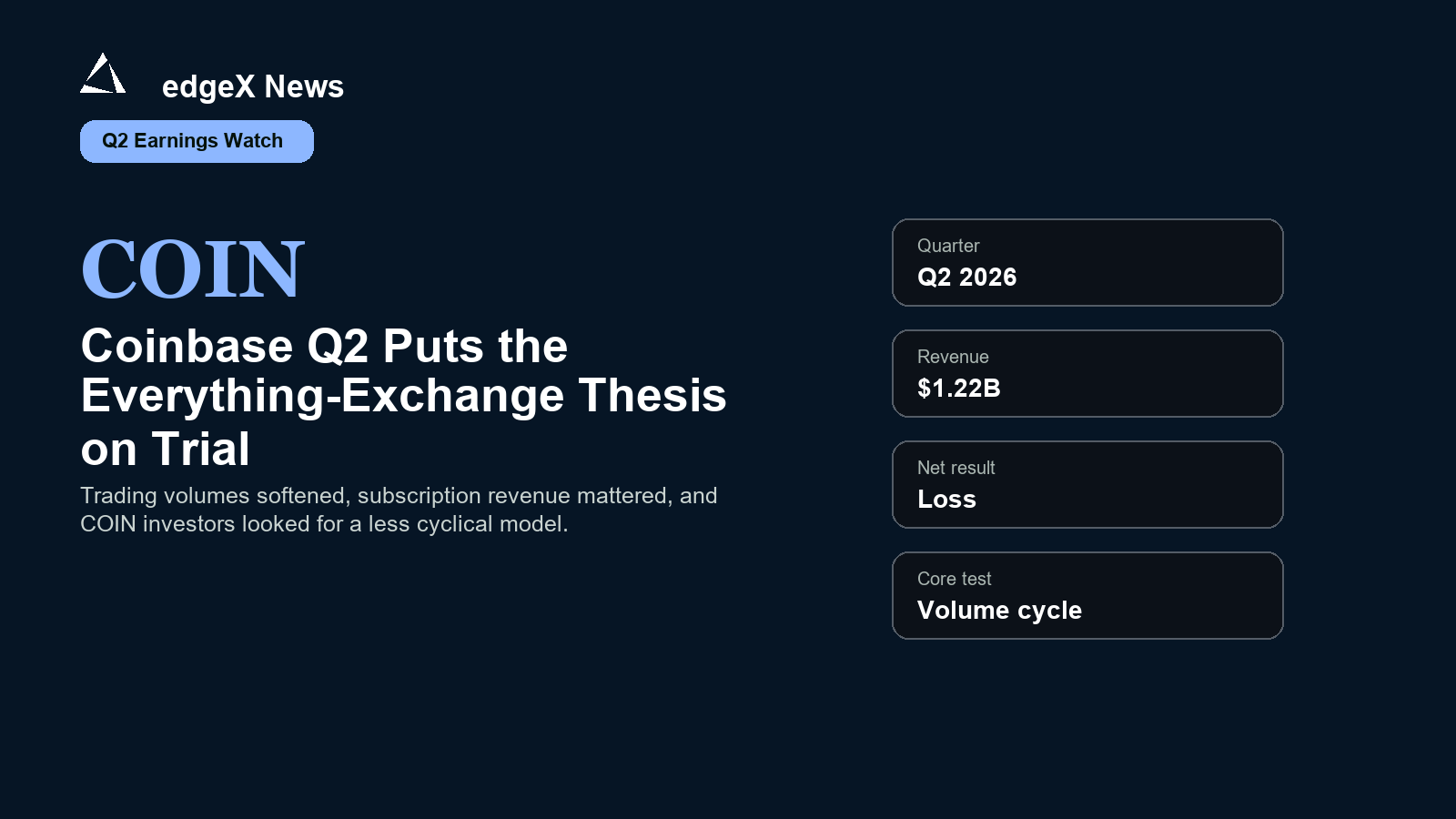
- •Coinbase reported Q2 2026 revenue of approximately $1.22 billion alongside a net loss of roughly $359.5 million, missing market expectations.
- •Transaction revenue declined year over year as weaker spot crypto trading activity weighed on the company's core earnings engine.
- •Subscription and services revenue reached about $555 million, providing more stability but proving insufficient to fully offset trading volume softness.
- •Coinbase shares weakened after the earnings release as investors sought clearer evidence that the company's diversification into custody, stablecoins, derivatives, and new asset classes is reducing cyclicality.
- •Key forward indicators include transaction revenue stabilization, subscription and services durability, institutional product adoption, and U.S. regulatory progress on digital asset oversight frameworks.
Why This Earnings Report Matters Now
Coinbase entered Q2 with a bigger ambition than simply running a crypto exchange. The company has been telling investors it wants to become a broader trading venue - one place for crypto, derivatives, equities, prediction markets, custody, payments, and stablecoin infrastructure. That ambition is powerful, but Q2 reminded the market that Coinbase is still deeply exposed to the crypto activity cycle.
The Numbers That Changed the Debate
The official Coinbase investor-relations calendar confirmed Q2 2026 earnings materials were scheduled for July 30 after market close. Fresh financial reporting showed a difficult quarter: revenue around $1.22 billion, a net loss, lower transaction revenue, and pressure from weaker spot activity. For investors, the numbers matter less as isolated line items than as evidence of how far Coinbase has moved beyond pure trading volume.
| Metric / Issue | Q2 2026 Context | Investor Read |
|---|---|---|
| Revenue | About $1.22 billion | Below expectations and down from stronger crypto periods |
| Net result | Net loss of roughly $359.5 million | Shows earnings remain sensitive to crypto-market conditions |
| Transaction revenue | Reported decline year over year | Spot activity still matters heavily |
| Subscription and services | About $555 million in current reporting | More stable, but not enough to fully offset volume softness |
| Strategic direction | "Everything exchange" expansion | Long-term upside depends on execution outside spot crypto |
| Market reaction | Shares weakened after results in major reporting | Investors wanted cleaner proof of resilience |
The table shows why Coinbase is difficult to value. A weak crypto quarter can quickly pressure transaction revenue, but the company is no longer only a spot-exchange story. Stablecoin economics, custody, staking, subscription services, derivatives, and new market categories can all expand the model. The problem is timing. Investors want the diversified revenue base to arrive before the next crypto downturn tests the business again.
The Investor Narrative After Earnings
Coinbase's investment case sits between two identities. One is a high-beta crypto equity tied to retail volume, token prices, and risk appetite. The other is a regulated financial infrastructure company trying to become a multi-asset trading and settlement platform. Q2 leaned investors back toward the first identity because trading weakness showed up clearly in the numbers.
That is the core tension for COIN. The company benefits when crypto markets are active, but the equity market wants to value it as something more durable than a volume-sensitive exchange. Coinbase has credibility, brand recognition, custody infrastructure, regulatory relationships, and stablecoin economics. What Q2 showed is that those strengths still need to carry a larger share of the income statement before the stock can escape the old cycle label.
What the market is really testing
The market is testing whether Coinbase can grow through a softer crypto tape. A crypto bull market can make the model look powerful because volume, spreads, assets on platform, and investor excitement all move together. A weaker tape strips that away and forces investors to ask whether subscriptions, stablecoin revenue, institutional services, and new products can carry more of the load.
This is not only a revenue question. It is a credibility question. If Coinbase can keep expanding recurring or semi-recurring revenue while controlling expenses, weaker trading periods become manageable. If the company needs retail speculation to return before margins improve, the stock remains a leveraged bet on crypto risk appetite.
What could change the next quarter
The next quarter should be read through four signals: transaction revenue stabilization, subscription and services durability, institutional product adoption, and regulatory progress in the U.S. Coinbase can still benefit from clearer crypto-market rules, but policy progress alone will not replace activity. The business needs both legal clarity and trading demand.
Investors should also pay attention to how management describes new asset classes. Equities, prediction markets, derivatives, and stablecoin-linked services can expand Coinbase's addressable market, but they also bring execution risk. A broader platform can diversify revenue, yet it can also dilute focus if adoption is slow or regulatory approvals take longer than expected.
Stock Reaction: Momentum Is Useful, But Not the Whole Story
The stock reaction was cautious because investors did not get the clean resilience they wanted. That does not mean the long-term thesis is broken. It means the market is asking Coinbase to prove that its expansion is more than a strategic slogan. The everything-exchange story needs to show up in revenue mix, margin quality, and customer behavior.
For traders, that creates a volatile setup. COIN can recover quickly if crypto volumes rebound or if investors regain confidence in the expansion story. It can also remain under pressure if weaker transaction revenue makes the diversified business look too small to offset the core cycle.
The Bull Case, the Bear Case, and the Middle Path
The bull case is that Coinbase is building the regulated front door to a much larger on-chain financial system. In that version of the story, weak trading quarters are uncomfortable but temporary. The more important development is whether Coinbase can keep expanding services around custody, stablecoins, derivatives, institutional access, and new market categories that bring users back even when spot speculation cools.
The bear case is that Coinbase remains too dependent on the parts of crypto activity that are hardest to forecast. Retail trading can disappear quickly. Token-market enthusiasm can rotate away from listed assets. Fee compression can arrive as competition increases. If transaction revenue keeps carrying too much of the model, investors may discount the broader platform story until they see a more stable earnings base.
The middle path is a more nuanced COIN. It may not become a smooth, low-volatility financial infrastructure stock soon, but it also does not need to remain only a bitcoin-beta vehicle. The next stage of the equity story depends on whether Coinbase can preserve upside to crypto cycles while making down cycles less damaging. Q2 showed the need for that transition; the coming quarters have to show the evidence.
Valuation Lens After the Report
Coinbase is difficult to value because investors are not sure which earnings stream deserves the most weight. Transaction revenue can be extremely profitable in strong markets, but it is volatile. Subscription and services revenue can be more durable, but it may not yet be large enough to anchor the entire valuation. That mix creates a moving target for COIN's multiple.
A higher valuation depends on the market believing Coinbase is becoming less cyclical without losing upside to crypto activity. If the company can show that stablecoin revenue, institutional custody, derivatives, and new trading products remain resilient during slower quarters, investors may assign a stronger platform multiple. If not, the stock will likely continue trading more like a high-beta crypto equity, with valuation tied to retail volume expectations and token-market sentiment.
What Investors Should Watch Next
Watch spot and derivatives volumes, USDC-linked economics, subscription and services revenue, adjusted expense discipline, institutional custody growth, and whether new product categories gain enough traction to matter. For COIN, volatility is not only a risk. It is also part of the revenue engine. The challenge is building a company that can perform when volatility is absent or moves in the wrong direction.
The most constructive path would be a quarter where transaction revenue stabilizes while subscription and services revenue continues to prove sticky. That would allow investors to treat Coinbase less like a pure trading-volume proxy and more like a financial infrastructure platform with upside to crypto market cycles.
Risk Map for the Next Trading Window
The first risk is market activity. Coinbase can have strong products and still face pressure if crypto volumes soften. The second risk is fee compression. As crypto market structure matures, users may become more price-sensitive, and competitors may pressure trading economics. The third risk is regulatory timing. Clearer U.S. rules can help Coinbase, but policy progress may not arrive in a straight line.
There is also execution risk in becoming an everything exchange. A broader product set can deepen the customer relationship, but it also increases operational complexity. Investors should ask whether each new product improves the platform's economics or simply adds another story line. The best version of Coinbase is broader and more durable. The weaker version is broader but still driven by the same crypto-volume cycle.
One more risk sits between product and sentiment: trust. Coinbase benefits from being seen as one of the more credible listed crypto platforms, but that status also raises the bar. Any outage during volatility, custody concern, compliance setback, or disappointing product rollout can weigh on the stock because investors expect Coinbase to be the institutional-quality operator in the space.
Trade Coinbase Stocks Perpetual Futures on edgeX
TradFi is going on-chain. edgeX now lets traders access Coinbase stock perpetual futures on a fully decentralized exchange - no account verification, no centralized custodian, and no compromise on performance.
The DEX Advantage for Stock Traders
Most traders who want exposure to stocks are still pushed toward TradFi platforms: brokerage accounts, KYC requirements, and limited trading hours. edgeX breaks that mold. Built on the EDGE chain and settled on Ethereum via Arbitrum, edgeX combines on-chain infrastructure with institutional-grade execution speed of up to 200,000 orders per second and sub-10ms matching latency.
Self-custody is built into every trade. Assets remain under the user's control, backed by private keys the user holds. USDC on the platform is designed around 1:1 dollar redemption, with Circle Ventures among the platform's backers.
Trade COIN Perpetuals with an Edge
Coinbase stock perpetual futures on edgeX offer up to 10x leverage, with a maximum position size of 1,000 COIN, giving traders meaningful exposure without locking up excessive capital. Liquidity is deep: $10 million within a 1 basis point spread, with sub-0.1 basis point slippage on trades over $0.1 million.
Through the current TradFi Trading Season promotion, traders can earn 110% fee rebates plus a share of a 200,000 USDC prize pool.
Why edgeX Stands Out
The case for decentralized exchange trading is straightforward: no KYC friction, full self-custody, deep liquidity, high leverage, and trading fee rewards returned to the community. For anyone seeking exposure to blue-chip stocks like COIN without the constraints of traditional finance, edgeX offers a different route to express a market view.
Frequently Asked Questions
Is this a calendar Q2 2026 earnings article?
Yes. Coinbase's Q2 2026 earnings materials were scheduled for release after market close on July 30, 2026, and current financial reporting covers the quarter ended June 30, 2026.
What is the most important number in the report?
Transaction revenue and subscription and services revenue should be read together. Transaction revenue shows exposure to crypto activity, while subscription and services revenue shows whether the company is building a more durable base.
Should readers treat the latest share price in this article as live market data?
No. This article does not state a live stock price. Readers should verify the current share price through Nasdaq, NYSE, a broker, or a real-time market-data page before making any trading decision.
How does edgeX fit into this earnings story?
edgeX gives traders a 24/7 perpetual futures venue for expressing a view on selected stock-linked markets without using a traditional brokerage account. The trading product is different from owning common shares, so readers should understand leverage, funding, liquidation, and custody mechanics before trading.

