Coinbase Opens IPO Access to US Retail Customers as COIN Gains 5.4% on Oura Debut
Key Takeaways
- •Coinbase stock gained approximately 5.4% on Monday, Sept. 21, after the company opened IPO access to eligible U.S. retail customers, allowing share requests before public trading starts.
- •The service's first deal is smart-ring maker Oura, which is offering 50 million shares at $40 to $44 for a Nasdaq listing under ticker OURA, potentially raising up to $2.2 billion at a roughly $15.62 billion fully diluted valuation.
- •Customers who sell allocated IPO shares within 30 days may lose access to future offerings for 60 days, reflecting Coinbase's allocation model that favors long-term holders.
- •IPO access runs through Coinbase Capital Markets, a FINRA-registered broker-dealer, with Apex Clearing handling execution, clearing, and custody while Coinbase participates as a selling-group member rather than an underwriter.
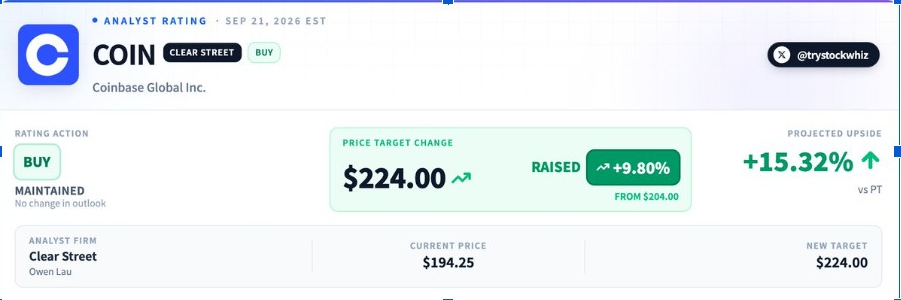
- •Clear Street maintained its Buy rating on Coinbase and raised its price target to $224 from $204, with the $200-$204 range viewed as a key near-term technical zone.
Coinbase stock rose on Monday, Sept. 21, after the cryptocurrency exchange launched initial public offering access for eligible U.S. retail customers, allowing them to request shares in upcoming deals before public market trading begins. IPO allocations have historically flowed mainly to institutional investors, leaving most individual buyers to purchase shares only once they begin trading on the open market.
Shares of Coinbase (COIN) gained about 5.4% during Monday's session as the company continued to expand its broader Everything Exchange strategy, which has been pushing the platform beyond digital-asset trading. The move places Coinbase within a broader fintech push, in which consumer brokerages have worked in recent years to open deal access once reserved largely for institutions.
The new service debuts with smart-ring maker Oura, which plans to sell 50 million shares priced at $40 to $44 ahead of a Nasdaq listing under the ticker OURA. Coinbase customers can submit IPO requests directly through the company's mobile application before public trading starts. The Oura transaction is the first allocation the retail service will run end to end.
How the Retail IPO Service Works
Eligible customers can access active IPO offerings directly in the Coinbase mobile app. After selecting an offering and funding their account, they can submit a conditional request for shares. While the IPO order book remains open, customers can adjust or cancel their requests; if the final offer price exceeds their selected limit, they may need to submit a new request. The structure mirrors the bookbuilding process used in traditional offerings, where banks gauge investor demand before setting a final price.
Once the order book closes, Coinbase will allocate the available shares based on demand and supply. Customers may receive their full request, a partial allocation, or no shares at all.
Oura Leads the Rollout
Oura is the first company available through the new service. The smart-ring maker and its shareholders are offering 50 million shares at $40 to $44 each. At the top of that range, the IPO could raise as much as $2.2 billion and give Oura a fully diluted valuation of roughly $15.62 billion. The final pricing will determine how much capital the company actually raises and the valuation it lists at.
Oura plans to list its shares on Nasdaq under the ticker OURA, with Goldman Sachs, Morgan Stanley, and JPMorgan leading the offering. The company reported $1.21 billion in revenue during the nine months ended June 30, a 74% increase from the same period one year earlier.
Holding Periods Shape the Allocation System
Coinbase has also introduced rules designed to discourage customers from quickly selling newly allocated IPO shares. Its allocation model favors investors who appear more likely to hold their positions for longer. Customers who sell allocated shares within 30 days may lose access to future IPO offerings for 60 days, and repeated early selling could reduce their chances of receiving shares in later offerings. Discouraging so-called flipping has long been a feature of IPO allocations, where distributors typically favor buyers who hold their stakes.
"Our allocation algorithm prioritizes investors who believe in what they're purchasing for the long haul," Coinbase said.
IPO access will be provided through Coinbase Capital Markets, the company's FINRA-registered broker-dealer. Apex Clearing will handle the execution, clearing, and custody of allocated shares. Coinbase will act as a selling-group member rather than an IPO underwriter, collecting customer requests before passing them to Apex for processing, a role that lets it distribute shares without carrying the pricing and underwriting responsibilities of the lead banks.
The product adds another securities service to Coinbase's expansion beyond digital assets. The company has already introduced stocks, options, index products, and private-company derivatives. Its earlier pre-IPO perpetual contracts gave some investors price exposure to companies such as SpaceX, although those products did not represent direct ownership of private-company shares. The new IPO service differs in that successful customers receive actual securities at the offering price. Coinbase plans to add more IPOs as its broker-dealer receives allocations from future offerings, making the pace of incoming deals an early indicator of how far the retail IPO push extends.
COIN Stock in Focus as Traders Watch $200 and $224
Clear Street has maintained its Buy rating on Coinbase while raising its price target to $224 from $204. The revised target provides another reference level for COIN after the stock's move above $200.
From a technical perspective, the $200-$204 range remains an important near-term zone. Holding above that area would keep COIN above a widely watched psychological level, and a sustained move above the recent range could place $224 back into focus. Analyst targets, however, remain estimates and do not guarantee future market performance.
On the downside, the $190 to $194 area stands as the nearest support zone. A break below that range could weaken the recent price structure and bring lower levels into view.
This article is for informational purposes only and does not constitute financial or investment advice. Equity and cryptocurrency investments involve risk, and analyst price targets do not guarantee future performance.

