Coinbase Derivatives Files With CFTC to Offer US Single-Stock and ETF Perpetual Futures
Key Takeaways
- •Coinbase Derivatives has filed with the CFTC to offer perpetual futures based on single and ETFs, extending its derivatives business beyond crypto-native products.
- •The filing was submitted through the CFTC's designated contract market self-certification process, which permits exchanges to list new products by certifying compliance rather than undergoing a full commission review.
- •No equivalent perpetual futures product for single stocks or ETFs currently trades on a CFTC-regulated U.S. exchange, so a cleared filing would create a first for the U.S. derivatives market.
- •Contract specifications, eligible tickers, margin requirements, leverage tiers, launch timing, and retail versus institutional availability have not been disclosed, and the CFTC may still review or stay the submission.
- •Perpetual futures carry no fixed expiry date and expose holders to funding rates, leverage, and liquidation mechanics that differ substantially from directly owning the underlying securities.
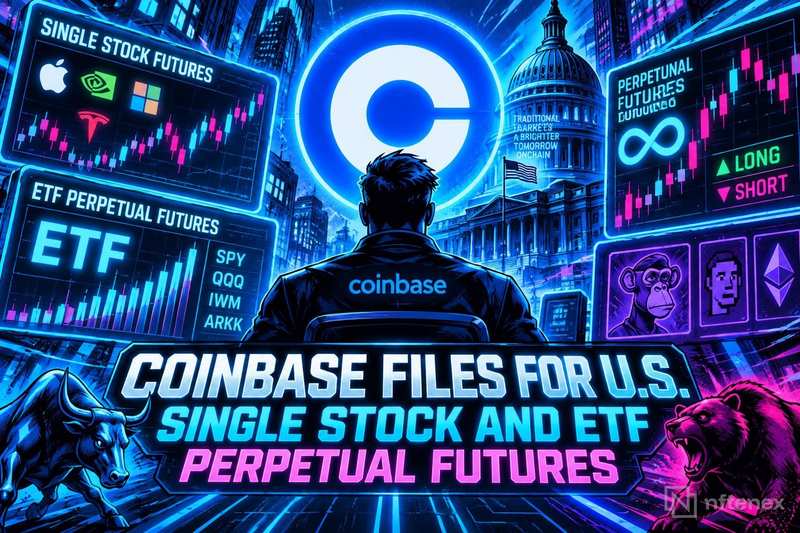
Coinbase Derivatives has filed with the U.S. Commodity Futures Trading Commission (CFTC) to introduce perpetual futures tied to individual stocks and exchange-traded funds (ETFs), a move that would expand the range of regulated derivatives products available to U.S. traders. The filing is a regulatory development rather than a product launch, and approval and availability remain unconfirmed.
Key Points
- Coinbase Derivatives has submitted a filing with the CFTC seeking to offer single-stock and ETF perpetual futures in the United States.
- The proposed products would span both individual equity names and exchange-traded funds, broadening the scope beyond crypto-native derivatives.
- Regulatory approval, contract specifications, eligible products, and launch timing have not been confirmed.
Coinbase Derivatives Files With the CFTC for New Perpetual Futures
Coinbase Derivatives, the regulated futures arm of Coinbase, submitted the filing through the CFTC's designated contract market self-certification process, which allows exchanges to list new products by certifying compliance with core principles rather than waiting for a full commission review. The filing covers perpetual futures tied to single stocks and ETFs, two asset classes that would mark new territory for U.S.-listed perpetual contracts. Perpetual-style contracts have long been among the most heavily traded instruments on cryptocurrency venues, yet no equivalent product for single stocks or ETFs currently trades on a CFTC-regulated U.S. exchange — the void this filing would fill if it clears the regulatory process.
The announcement should be read narrowly: a self-certification filing signals intent and a regulatory pathway, not a cleared product. Specific contract details, eligible tickers, margin requirements, and any launch date remain unannounced. Coinbase's broader derivatives ambitions have also been visible in its recent financial results, which showed the exchange scaling revenue across multiple business lines.
What Single-Stock and ETF Perpetual Futures Are
Perpetual futures are derivative contracts that reference an underlying asset — in this case individual stocks or ETFs — without a fixed expiry date. Unlike buying shares directly, a trader holding a perpetual futures position does not own the underlying security and is exposed to funding rates, leverage, and liquidation mechanics that differ substantially from spot ownership. Funding rates — periodic payments exchanged between long and short positions that keep the contract's price aligned with the underlying asset — are the mechanism that stands in for a fixed expiry in this contract design.
The products Coinbase Derivatives is seeking to introduce would track U.S.-listed equities and fund structures rather than cryptocurrency prices. That distinction matters for the regulatory framework: equity-linked derivatives fall under CFTC jurisdiction when structured as futures, separate from securities regulation overseen by the SEC. For context on how futures pricing can diverge from the assets they reference, the dynamics in Bitcoin futures markets illustrate how funding and basis can shift relative to spot prices.
Product specifications, including which stocks or ETFs would be eligible, margin rules, and position limits, would be defined in the final offering documents and remain subject to the regulatory process. Derivative instruments of this type are not suitable for all participants, and outcomes can differ materially from simply holding the referenced asset.
What Remains Unknown
The filing does not confirm a launch date, an eligible product list, or final contract terms. Under the self-certification process, the CFTC has the ability to stay or review a filing before a product goes live, so the regulatory path is not yet complete. Coinbase Derivatives has not publicly disclosed which single stocks or ETFs would be covered, what leverage tiers would be permitted, whether the products would be available to retail participants or restricted to institutional accounts.
The scope of the filing, spanning both individual equities and fund structures, is broad. Recent product developments in the leveraged ETF space, such as the launch of 2x leveraged ETFs tracking digital asset companies, show how demand for leveraged and derivative exposure to equity-linked products has grown. Whether Coinbase Derivatives' perpetual futures would complement or compete with such products will depend on final contract design and the regulatory outcome.
Further disclosures from Coinbase Derivatives, or CFTC action on the filing, will clarify the timeline. The markers to watch are a published listing notice or contract terms, confirmation of which single stocks and ETFs are covered, and any CFTC decision to review or stay the submission — each of which would move the product from filing toward availability. Until those details are public, the announcement represents an early-stage regulatory development with meaningful implications for U.S. derivatives market structure, but no confirmed product availability.
Disclaimer: This article is for informational purposes only and does not constitute financial or investment advice. Derivatives and digital asset markets carry significant risk. Always do your own research before making decisions.
Source: NFTENEX

