Coinbase CEO Says Crypto Regulation Can Advance With or Without Clarity Act
Key Takeaways
- •The Senate is scheduled to hold a procedural cloture vote on the CLARITY Act on September 15, requiring 60 votes to advance the bill to debate.
- •Armstrong said regulatory clarity could come either through the CLARITY Act or through SEC and CFTC rules issued under existing authority, though legislation would provide the more durable framework.
- •The CLARITY Act would establish a statutory framework for digital-asset market structure, setting rules for exchanges, brokers, and digital commodities while splitting oversight between the SEC and CFTC.
- •Ethics provisions concerning elected officials' digital-asset holdings remain unresolved, with Democrats seeking stronger restrictions such as divestiture and the White House offering its own proposal, while Senator Ruben Gallego has linked stronger ethics rules to securing the 60 votes needed for cloture.
- •Coinbase reported second-quarter revenue of $1.2 billion, down from $1.5 billion a year earlier, and a $359.5 million net loss, prompting expansion into stocks, commodities, foreign exchange, stablecoins, custody, and international markets including the UAE and Singapore.
Coinbase CEO Brian Armstrong said U.S. cryptocurrency regulation could gain clarity whether or not the CLARITY Act advances through its next Senate test on September 15. He pointed to two possible paths: congressional legislation and regulatory action by the Securities and Exchange Commission (SEC) and the Commodity Futures Trading Commission (CFTC).
The Senate is scheduled to hold a procedural cloture vote on September 15, rather than a final vote on passage. Armstrong said either legislative action or rules issued under the agencies’ existing authority could reduce uncertainty for crypto businesses operating in the United States. However, he acknowledged that agency rules cannot fully replace legislation because the SEC and CFTC remain limited by the powers Congress has already granted them.
The CLARITY Act would establish a broader statutory framework for digital-asset market structure and divide oversight between the SEC and CFTC.
Armstrong Sees Two Paths to Crypto Clarity
Armstrong said the crypto industry could receive clearer rules even if senators prevent the CLARITY Act from moving forward. He cited planned regulatory work by the SEC and CFTC, which could define parts of the market through their existing authority.
A successful Senate vote would preserve the legislative route and give the industry a federal statutory framework. If the vote fails, attention could shift toward agency rules within days. Armstrong said the sector would receive “regulatory clarity one way or another” around the September 15 vote.
The CLARITY Act would establish rules for exchanges, brokers, digital commodities and other market participants while dividing responsibility for digital-asset oversight between the two agencies. Supporters say the legislation could end years of disputes over which regulator controls different parts of the crypto market.
Senate Vote Tests Support for the Legislation
The Senate’s cloture vote will determine whether lawmakers can advance the bill to debate and further Senate action. The measure requires 60 votes to clear that procedural hurdle. Approval would not send the legislation directly to the president.
Crypto groups and banks have lobbied senators in their home states, presenting competing positions on market structure, stablecoins, safeguards and financial competition.
The House passed the CLARITY Act in July 2025. The Senate Banking Committee later advanced it by a 15-9 vote in May 2026, bringing the market-structure bill closer to a full Senate debate.
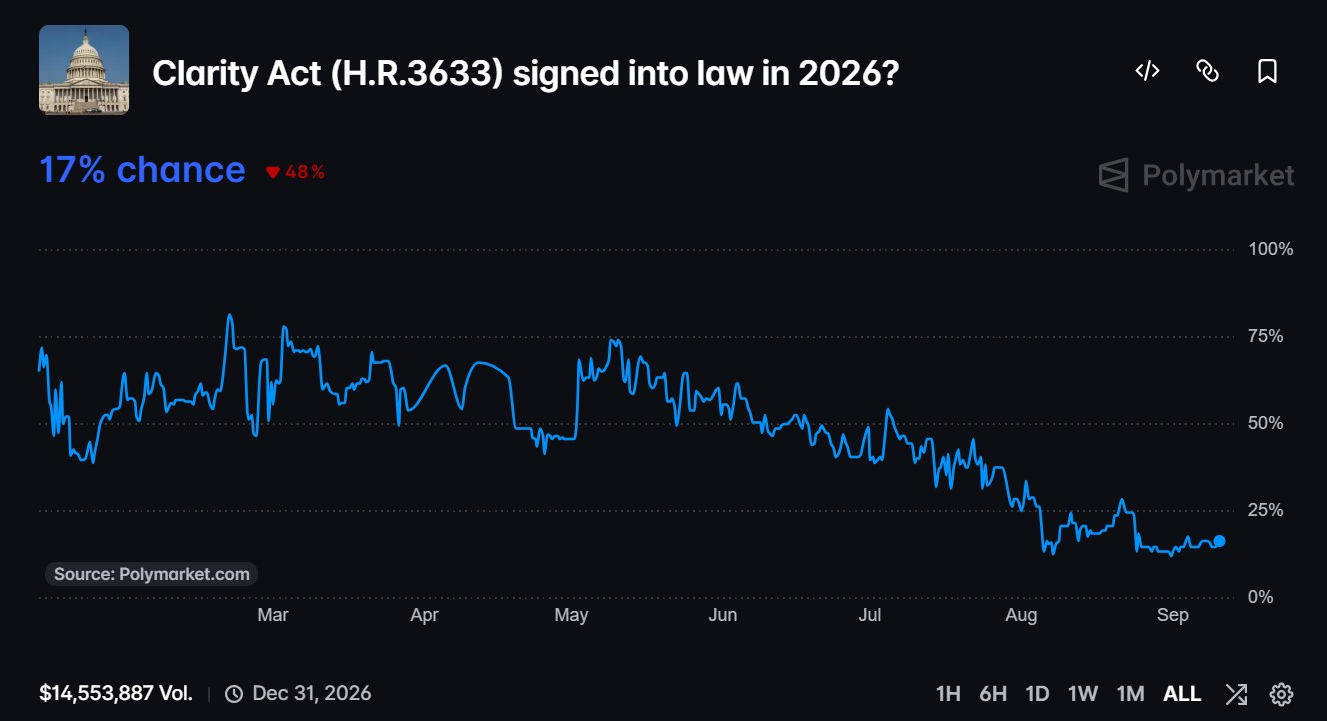
According to Polymarket data, the CLARITY Act has a 17% chance of being signed into law in 2026, down 48%. The market has recorded about $14.55 million in trading volume.
Armstrong said lawmakers had reached broad compromises through hundreds of pages of negotiations. He also said several banks, crypto companies and law enforcement groups support the legislation. Opposition remains among some Democrats and Republicans, however, particularly over safeguards and banking concerns.
Ethics Provisions Remain Under Negotiation
Ethics rules for elected officials continue to influence negotiations ahead of the Senate vote. Armstrong said lawmakers still need to resolve provisions concerning digital-asset holdings and conflicts of interest. Democrats have sought stronger restrictions, including possible divestiture requirements.
The White House has offered an ethics proposal, while Democratic lawmakers are seeking additional measures. Armstrong described the two sides as close to an agreement. Senator Ruben Gallego has also linked stronger ethics provisions to efforts to secure the 60 votes needed for cloture.
The negotiations also include concerns from parts of the banking industry. JPMorgan CEO Jamie Dimon has criticized stablecoin provisions that could increase competition for bank deposits. Armstrong rejected that criticism and pointed to support from Goldman Sachs, BNY Mellon and Fidelity.
Coinbase Diversifies Beyond Spot Crypto Trading
Armstrong also discussed Coinbase’s efforts to diversify its revenue as spot-trading activity weakens. He said trading accounts for about half of the company’s revenue. Coinbase now operates across stocks, commodities, foreign exchange, stablecoins and institutional custody.
Coinbase reported second-quarter revenue of $1.2 billion, down from $1.5 billion a year earlier. The company posted a $359.5 million net loss after recording a $1.43 billion profit in the comparable period. It also missed Wall Street estimates for revenue and earnings for a third consecutive quarter.
Armstrong said Coinbase continues to expand outside the United States, including in the United Arab Emirates and Singapore. He described Singapore as the company’s Asian hub. At the same time, the CLARITY Act vote remains central to Coinbase’s U.S. policy focus.
The immediate question is whether senators can secure the 60 votes required for cloture. A failed vote would increase attention on potential SEC and CFTC action, while a successful vote would keep the legislative process active. Either outcome could affect Coinbase’s regulatory environment, although congressional legislation would provide the more durable statutory framework.
Source: The Market Periodical
