Coinbase Enables USDC Payments from AI Agents for Business Customers
Key Takeaways
- •Coinbase Business customers can now accept USDC payments initiated by autonomous AI agents through the x402 payment standard, which was originally introduced in May 2025 to enable stablecoin transfers over HTTP.
- •The exchange launched AI-enabled trading tools that allow users to monitor orders, access live market data, and execute actions based on predefined conditions rather than open-ended autonomous decision-making.
- •Coinbase released a software development kit designed to help developers build agent-powered applications that integrate payments, market connectivity, and trade execution within a single framework.
- •Agent-generated traffic on Coinbase's Base documentation pages exceeded human traffic for the first time last month, signaling a shift in how systems interact with blockchain resources.
- •The initiative reflects a broader sector trend in which exchanges and payment companies are positioning stablecoins and blockchain infrastructure as payment rails for the emerging autonomous agent economy.
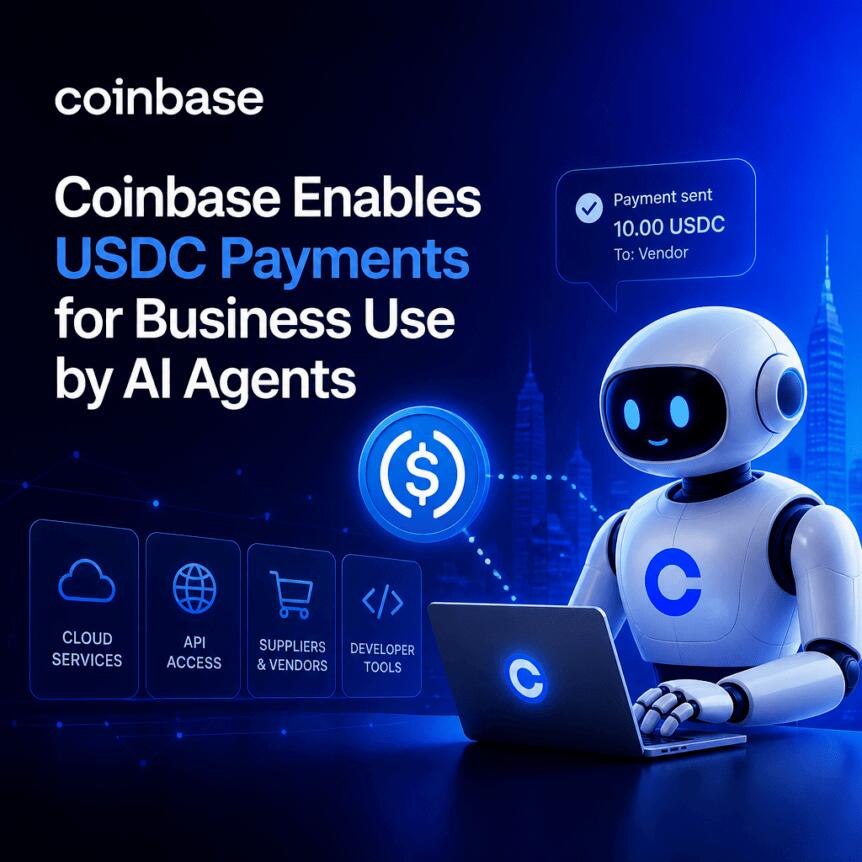
Coinbase is introducing a suite of tools designed for what it calls the "agentic economy," enabling businesses to receive stablecoin payments from autonomous AI agents. In a Thursday announcement posted on X, the exchange stated that Coinbase Business customers will be able to accept USDC payments initiated by AI agents through the x402 payment standard.
The rollout extends beyond payments. Coinbase also outlined AI-enabled trading functionality for market monitoring and condition-based execution, along with a software development kit (SDK) aimed at helping developers build agent-driven applications on Coinbase's infrastructure. Taken together, the announcement frames AI agents not only as software that can gather information, but as systems that may need payment access, market data, and execution tools inside defined workflows.
USDC Payments for AI Agents via x402
The centerpiece of the announcement is a new payment capability. According to Coinbase's X post, Coinbase Business customers will be able to accept USDC payments originating from AI agents via x402—an interface designed to enable stablecoin transfers over HTTP.
Coinbase first introduced x402 in May 2025 as a method to make stablecoin payments more compatible with how agents and applications communicate across the internet, including through APIs. The Thursday announcement connects that standard to a new business-facing feature: merchants and enterprises can now receive stablecoin payments initiated by AI agents, eliminating the traditional requirement for human-in-the-loop workflows.
For businesses, the practical implication is that payment execution becomes more amenable to automation. Rather than routing transactions through manual processes, agent software can integrate directly with payment endpoints in a manner consistent with modern web-based communication patterns. That matters for agent-based applications because payments are often a bottleneck in otherwise automated tasks: an agent may be able to identify a service, call an API, or complete a workflow, but still require a payment method that can operate within software-defined limits.
AI Trading Tools and Condition-Based Execution
In addition to payments, Coinbase detailed new AI trading tools. The company described these tools as designed to help users oversee trading activity and respond to market movements using predefined rules.
Coinbase stated that customers will be able to monitor orders, access live market data, and execute actions based on conditions established in advance. The announcement positions these features as an operational layer for agent-style workflows, where monitoring and decision logic can be incorporated into automated routines rather than relying exclusively on manual oversight.
While the post did not specify which trading venues, asset types, or order types are included, it emphasized the broader "agentic" theme: enabling systems that can observe, interpret, and act according to user-defined rules. The emphasis on predefined conditions is also important context for users evaluating the tools, because it distinguishes rule-based execution from open-ended autonomous decision-making and leaves implementation details to Coinbase's product rollout.
Developer Kit for Agent-Powered Finance
Coinbase also announced the release of a software development kit to support the creation of agent-powered applications. The SDK is presented as part of the same strategy that encompasses x402-based payment support and AI trading tooling, indicating Coinbase's intent to provide developers with foundational building blocks for connecting autonomous agents to financial operations.
This approach addresses a key dependency in many AI-agent use cases—reliable integrations for both receiving funds and executing actions in response to changing conditions. By consolidating payments, market connectivity, and an SDK within a single framework, Coinbase aims to reduce the custom integration work that developers typically encounter when linking agent software with cryptocurrency rails and trading interfaces.
Coinbase's Rationale for Autonomous Agent Infrastructure
Coinbase framed the rollout within the context of what it described as accelerating AI agent adoption. The company reported that agent-generated traffic surpassed human traffic on its Base documentation pages for the first time last month, signaling a shift in how developers and systems interact with blockchain-related documentation.
Coinbase also argued that the internet's financial infrastructure was built around a single assumption: "a human clicking the button." According to the company, that design choice has left businesses, developers, and users without tools designed for AI agents capable of initiating payments and executing tasks autonomously.
The direction of Coinbase's rollout aligns with a broader sector trend, as stablecoins and blockchain-based payments are increasingly positioned as infrastructure for AI agents. Multiple exchanges and payment-focused companies are pursuing similar use cases, according to earlier Cointelegraph coverage of the "autonomous agent economy," as well as reporting on payment providers exploring AI-agent purchasing and payment flows.
Coinbase's announcement represents not merely an additional payment feature, but an effort to align cryptocurrency payment and trading interfaces with the way autonomous systems are increasingly expected to operate—with fewer manual steps and greater reliance on direct, API-driven execution. For that vision to move beyond developer experimentation, businesses will likely focus on practical controls such as which agents are authorized to pay, which endpoints they can use, and how predefined limits are enforced.
Open Questions for Users and Builders
For users and developers, several key questions remain: how broadly x402 support will roll out across Coinbase Business integrations, what the AI trading tools will cover in practice, and how developers will leverage the SDK to connect agent workflows to payments and trade execution. As agent adoption continues to grow, the central test will be whether these interfaces can reliably support real-world automation at scale without requiring human intervention.

