COIN Stock Falls as Coinbase's Tokenized Stocks Gain Aave V4 Lending Utility
Key Takeaways
- •COIN shares fell 2.06% to close at $195.11 on, Sept. 25, after sliding from around $199 during the morning session.
- •Aave V4 now accepts seven Coinbase tokenized stocks, tracking Apple, Amazon, Alphabet, Meta, Microsoft, Nvidia, and Tesla, as collateral for USDC loans on Base.
- •Coinbase's tokenized U.S. equities, launched on Base in August for eligible users outside the United States, have generated more than $1 billion in trading volume on decentralized exchanges.
- •The new Aave market restricts stock tokens to collateral use at launch, applies per-token collateral factors with caps, and uses Chainlink price feeds on a 24/5 schedule tied to U.S. equity market hours.
- •CEO Brian Armstrong said autonomous AI agents may use crypto wallets and stablecoins to pay for data, subscriptions, and computing power, positioning stablecoin payments within Coinbase's broader product strategy.
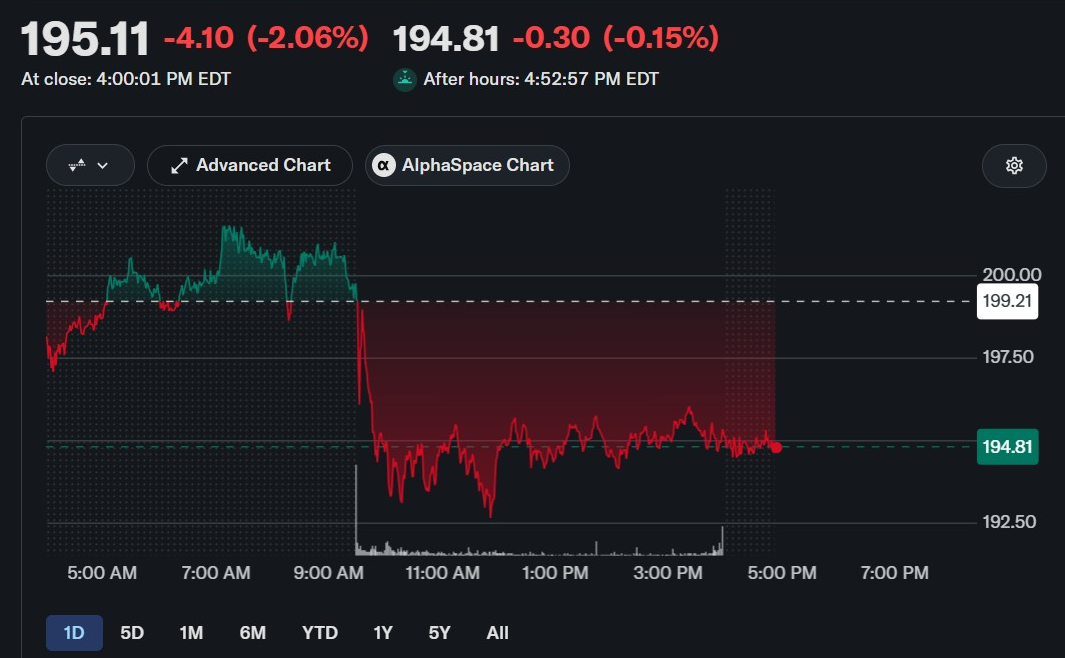
COIN stock closed at $195.11 on Friday, Sept. 25, down 2.06%, as Coinbase expanded its tokenized-equity business on Base. On the same day, the lending protocol Aave V4 added seven Coinbase-issued stock tokens as collateral for USDC loans, extending the assets beyond spot trading.
COIN Stock Drops Over 2% During Friday Trade
COIN stock started the session near its previous close before selling accelerated after the U.S. market opened. Shares slid from around the $199 area and moved below $195 during the morning session before buyers later stabilized the price near the $195 mark.
The decline came on the same day Coinbase's on-chain equity business added new functions, though the price action does not by itself establish a direct link to the tokenized-stock news. Coinbase stock often reacts to several factors, including crypto prices, trading activity, broader equity moves, and company developments.
Coinbase Tokenized Stocks Enter Aave V4 Lending
Aave V4 now lets eligible users post seven Coinbase tokenized stocks as collateral on Base and borrow USDC, a U.S. dollar-linked stablecoin, against them. The initial group of tokens tracks Apple, Amazon, Alphabet, Meta, Microsoft, Nvidia, and Tesla — a roster of large-capitalization U.S.-listed technology names.
Aave places the assets in a dedicated Equities Hub, while USDC provides borrowing liquidity. The stock tokens cannot serve as borrowed assets at launch, keeping the new market's initial scope to collateral use.
The market's design sets separate collateral factors for each tokenized equity, and its initial parameters also cap the amount of collateral and USDC borrowing within the new market. Aave says the structure separates tokenized-equity risk from its other markets on Base. Chainlink price feeds support the collateral calculations and follow a 24/5 schedule tied to U.S. equity market pricing, so collateral valuations follow traditional market sessions rather than updating around the clock.
Tokenized Stock Volume Passes $1 Billion on Base
Coinbase launched its tokenized U.S. equities on Base, the exchange operator's layer-2 network, in August for eligible users outside the United States. Since that launch, the products have generated more than $1 billion in trading volume on decentralized exchanges, according to the Base team.
The milestone gives Coinbase a growing on-chain market alongside its core centralized exchange business, and the Aave integration adds another function beyond buying, selling, and holding the tokens. A holder can keep exposure to a supported stock token while using it to secure a USDC loan. Collateralized borrowing of this kind is a standard function across decentralized-finance lending markets.
That setup also introduces standard borrowing risks. Falling collateral values can weaken a loan position and may trigger liquidation under Aave's risk rules. Oracle pricing and market-hour differences also matter when tokenized stocks trade on blockchain networks.
Coinbase CEO Armstrong Links Stablecoins With AI Agent Payments
Separately, Coinbase CEO Brian Armstrong tied crypto payments to the growth of autonomous AI agents. He said agents may use crypto wallets and stablecoins to pay for data, subscriptions, computing power, and other digital services. Blockchain networks can process those transfers around the clock, while stablecoins give software access to dollar-linked payment units.
Coinbase has also worked on tools that connect AI agents with financial activity, and Armstrong expects software agents to play a larger role in automated transactions as users let them manage specific tasks. The comments place stablecoin payments, tokenized assets, and automated finance within Coinbase's wider product strategy.
This article is for informational purposes only and does not constitute financial or investment advice. Tokenized securities and decentralized-finance products carry market and operational risks.
Source: The Market Periodical

