Anthropic's Claude Agents Find CRISPR-Like Enzyme System, but Its Function Remains Unknown
Key Takeaways
- •Claude agents found the ART system during a 21.5-hour autonomous campaign spanning 949 sessions and about 215.6 million tokens, ending with 19 reports for human review.
- •Each ART locus pairs a reverse transcriptase with an array of 3 to 21 short DNA repeats and a nearby gene of unknown purpose, with no Cas genes present.
- •RNA data from a Staphylococcus phage show the array is transcribed into short RNAs representing up to 8% of the phage's RNA 15 minutes after infection, though the enzyme's activity and any guiding role are unproven.
- •All ten reruns of the identical search missed the repeat array, so the discovery reached human reviewers through a path none of the reruns reproduced.
- •Feng Zhang described the RNA-repeat arrays linked to reverse transcriptases as intriguing and deserving of further investigation, while CEO Dario Amodei suggested the system could represent a new, still untested gene-editing mechanism.
Anthropic said on Wednesday that its Claude agents flagged an uncharacterized enzyme system in viral DNA after roughly 21 hours of autonomous searching. The system carries a CRISPR-like pattern, but the company says it does not yet know what the system does. It is one of the first results to emerge from the molecular biology group Anthropic set up in spring 2026.
The team has named the find array-associated reverse transcriptases, or ART, according to Anthropic's announcement.
Ten reruns of the same search all missed the repeat array
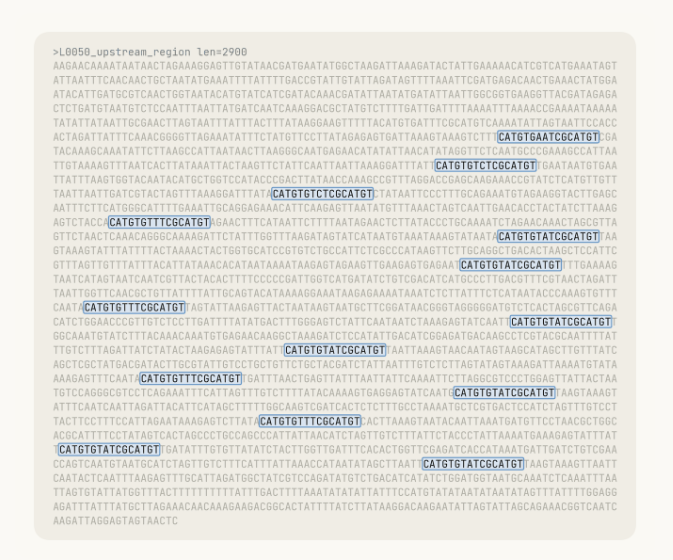
Bacteria combat viruses by deploying reverse transcriptases, enzymes that convert RNA into DNA. Beside the enzyme sat what caught Claude's eye: an evenly spaced run of repeat DNA next to a second gene of unknown purpose.
That three-part layout echoes CRISPR, which stores a library of RNA guides in an array — a bacterial defense that researchers have since adapted into widely used genome-editing tools. Each ART array contains 3 to 21 copies of a short repeat, and no Cas genes are situated near any ART locus, the preprint states.
Public RNA data from a Staphylococcus phage show that the array is transcribed into distinct short RNAs, which account for up to 8% of the phage's RNA 15 minutes post-infection. Whether those RNAs play a guiding role like CRISPR's is unresolved, and the preprint notes that the team has not demonstrated the enzyme is active or that it acts on those RNAs.
Anthropic gave the agents a brief: hunt through 1.9 billion protein clusters for new reverse transcriptase systems. Each task was planned and run by one worker agent and reviewed by a supervisor agent. As findings accumulated, supervisors opened new tasks.
The campaign ran for 21.5 hours with no human input, the preprint says, across 949 agent sessions and 215.6 million tokens. Anthropic's post rounds those figures to about 950 agents and 210 million tokens. The agents amassed roughly 200,000 enzyme clusters and scored 3,564 candidate partner families, and the campaign closed with 19 reports for human review.
ART surfaced almost by accident. An agent reading raw DNA beside a peculiar enzyme wrote that it could see a repeat pattern “by eye,” then counted the repeats and checked them against the literature before writing up the finding.
Anthropic repeated the same campaign ten more times. Every rerun missed the array, and no rerun read the DNA upstream of the enzyme. When given the DNA directly, the best models described the array in a minimum of 90% of attempts, but with the addition of tools and files, the rate sank to as low as 32%. The discovery therefore reached human reviewers by a route none of the reruns replicated.
Feng Zhang backs more study as Kevin Blake doubts any therapy
Feng Zhang, a CRISPR pioneer at MIT and the Broad Institute, reviewed the preprint. He called the identification of RNA-repeat arrays tied to reverse transcriptases “genuinely intriguing,” saying it “merits further investigation.”
On X, CEO Dario Amodei went a step further. The “molecular machine” could “represent a new gene editing mechanism,” he suggested, in keeping with his bet that AI could compress decades of biological progress into years. That possibility remains untested while ART's function is unknownn
ART came out of a Bay Area lab that Anthropic only recently made public. The company says the facility operates at biosafety levels 1 and 2, does not handle pathogens that infect humans, and leaves all bench work to human scientists. As Cryptopolitan reported when the wet lab was confirmed, it is testing whether Claude can help direct experiments.
In April, Anthropic purchased startup Coefficient Bio for about $400 million. That same month, OpenAI shipped its own life sciences model, GPT-Rosalind.
Anthropic says experiments to pin down what ART does are already underway, and it is inviting other scientists to submit research proposals. The questions in front of those efforts are the ones the preprint leaves open: whether the enzyme is active, and whether it acts on the array's short RNAs.
Source: Cryptopolitan

