CLARITY Act Short of Senate Votes as Stablecoin Yield Rules Divide Backers
Key Takeaways
- •The CLARITY Act has 49 Senate supporters but needs 11 more votes to reach the 60-vote cloture threshold, and four existing backers want revisions before a final vote.
- •A prior cloture vote on the bill failed 50 to 49, meaning it could not move to a final debate.
- •The core dispute concerns how the law should regulate stablecoins that pay yield to holders, with concerns they could be classified as securities subject to stricter SEC registration and disclosure requirements.
- •The latest draft of the bill added crypto ethics provisions, but disagreements over the yield language remain unresolved.
- •Banks and 17 state attorneys general have challenged the legislation, adding pressure on undecided senators to demand changes before committing their votes.
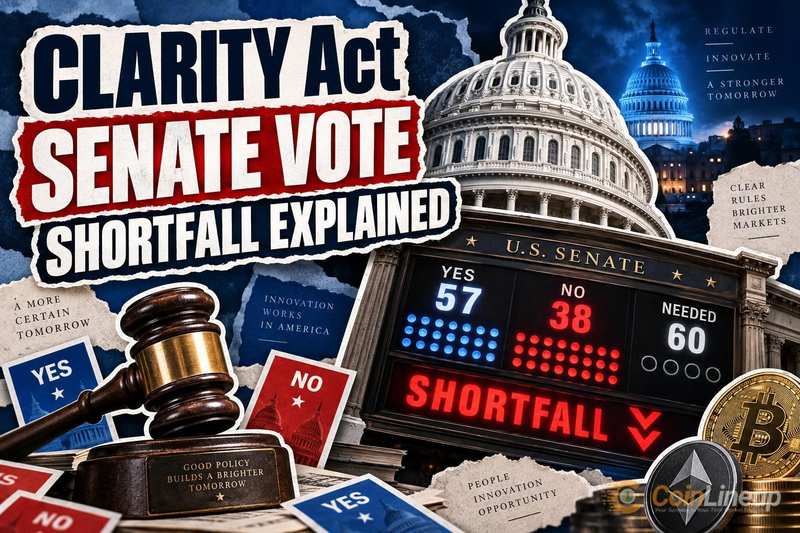
The CLARITY Act, a major U.S. cryptocurrency regulation bill, does not yet have the Senate votes it needs to pass, and some lawmakers who already support the bill want it rewritten before they commit to a final vote. The standoff centers on a single question: how the law would treat stablecoins that pay yield to the people who hold them. Until that question is settled, the rules for yield-bearing stablecoins remain undefined for both issuers and the people who hold them.
Why the bill is short on Senate votes
The CLARITY Act is legislation moving through the U.S. Congress that would set rules for how digital assets, including cryptocurrencies and stablecoins, are regulated. A stablecoin is a crypto token designed to hold a steady value, usually pegged to the U.S. dollar.
According to CryptoSlate's reporting, the bill needs 11 more Senate votes to advance. It currently has 49 confirmed supporters, but 4 of those 49 senators want changes to the bill before they will back it in a final vote — the same yield dispute at the center of the standoff.
The gap matters. In the U.S. Senate, most major legislation needs 60 votes to clear a procedural hurdle called a cloture vote. A prior cloture vote on the CLARITY Act failed 50 to 49, meaning the bill could not even move to a final debate. Securing 11 more votes while keeping current supporters on board is a formidable challenge.
Beyond the vote count, the bill's fate is unfolding as crypto firms have put $206 million into midterm super PACs, and bitcoin is eyeing $82,000 after Fed and CLARITY shocks.
What tougher stablecoin yield rules could change
Yield, in this context, means a return paid to someone for holding a stablecoin, similar to the interest paid on a savings account. Some crypto platforms offer yield on stablecoins as a way to attract deposits, and the lawmakers pushing for changes want stricter rules around the practice.
The concern is that stablecoins paying yield could blur the line between a stable payment tool and an investment product — the same line that separates money parked for spending from money placed in an interest-bearing account. If regulators treat yield-bearing stablecoins as securities (investment contracts regulated by the SEC), the rules that apply become much stricter, taking on the kind of registration and disclosure obligations associated with investment products.
The latest draft of the CLARITY Act added crypto ethics rules ahead of the Senate vote, but disagreements over the yield provisions remain unresolved. The bill's text is publicly available on Congress.gov, where it is listed as House Bill 3633 in the 119th Congress.
What the Senate standoff means for crypto users
Until the Senate resolves its disagreement, businesses and platforms offering stablecoin yield products face legal uncertainty. They do not know which regulator will oversee them, what disclosures they must make, or whether their products could be reclassified as securities — and for individual holders of yield-bearing stablecoins, that same uncertainty hangs over the products they use today.
Opposition has also built beyond the Senate. Banks and 17 state attorneys general have challenged the bill, adding pressure on undecided senators to demand changes before committing their votes.
For anyone holding a stablecoin that earns yield on a crypto platform, the practical takeaway is straightforward: the rules governing that product are not settled law yet. Watch for Senate negotiations over the yield provisions, any revised bill language, and whether the bill's sponsors can secure the 11 additional votes needed to advance.
Disclaimer: This article is for informational purposes only and does not constitute financial or investment advice. Cryptocurrency and digital asset markets carry significant risk. Always do your own research before making decisions.

