CLARITY Act Reportedly Faces September 15 Senate Cloture Vote
Key Takeaways
- •The reported September 15 Senate vote concerns procedural advancement of H.R. 3633 rather than final passage into law.
- •No official filing or Congressional Record entry has confirmed the reported vote date, threshold, vote count or commitments.
- •The House version would direct the SEC and CFTC to define specified digital-asset and blockchain terms through joint rules.
- •Its proposed self-custody protection covers personal holdings and certain direct transactions but excludes custodial or fiduciary activity for others.
- •Coin Center endorsed the legislation in a May 13, 2026 letter, while noting that Senate and House versions contain different provisions.
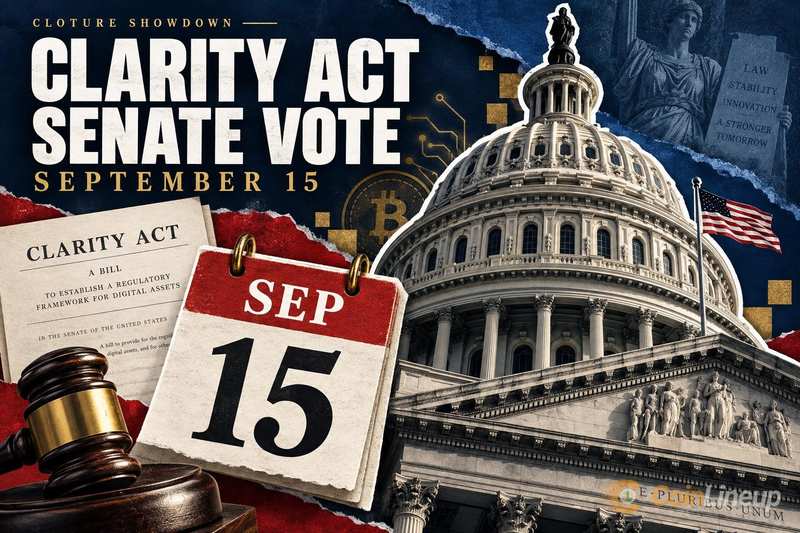
The CLARITY Act, a major U.S. cryptocurrency bill, reportedly faces a Senate cloture vote on September 15. The procedural vote could determine whether the legislation advances, but it would not represent final passage into law.
A September 13, 2026 report by crypto.news said the vote would concern a motion to proceed to H.R. 3633. The scheduling claim was attributed to a single outlet and could not be independently verified against official Senate or congressional records. No official cloture filing or Congressional Record entry confirming the date was obtained.
What the reported vote would mean
Cloture is a Senate procedure used to end debate and move legislation to the next stage. Approving cloture on a motion to proceed would allow the Senate to begin considering H.R. 3633; it would not enact the bill.
The same unconfirmed coverage described a general 60-vote threshold, a figure echoed by other outlets in reporting about the bill’s reported need for 60 Senate votes. The official status of the vote date, threshold details, tallies and any support commitments remains unconfirmed.
The official House-engrossed text of H.R. 3633 from the 119th Congress calls the legislation the Digital Asset Market Clarity Act of 2025, also known as the CLARITY Act of 2025. The bill would establish federal market rules for digital assets. Its text is proposed legislation, not current law. The House version is available through GovInfo.
Section 105(a) of the House version directs the Securities and Exchange Commission and the Commodity Futures Trading Commission to jointly issue rules defining specified digital-asset and blockchain terms. Because the bill has not been enacted, those provisions do not currently impose legal requirements.
The House text also addresses personal self-custody, meaning holding cryptocurrency in one’s own hardware or software wallet. Section 105(c)(1) preserves an individual’s lawful personal custody of digital assets and specified direct peer-to-peer transactions, subject to stated counterparty and sanctions conditions.
That provision has limits. Section 105(c)(2) restricts the self-custody subsection to personal use and excludes anyone acting in a custodial or fiduciary capacity for others. In practical terms, the proposed protection covers holding one’s own coins, not holding coins on behalf of another person.
Coin Center support and next steps
The crypto policy organization Coin Center supported the bill earlier in 2026. On May 13, 2026, it published a letter from executive director Peter Van Valkenburgh supporting the Digital Asset Market Clarity Act. The letter is available on Coin Center’s website.
“On behalf of Coin Center, I write to express our support for the Digital Asset Market Clarity Act,” Van Valkenburgh wrote.
The letter welcomed Section 604 of the then-current Senate draft and the Blockchain Regulatory Certainty Act’s protections for non-custodial developers and infrastructure providers. The House-engrossed 2025 bill and the May 2026 Senate draft are different versions of the legislation, so their section numbers are not interchangeable.
If the reported vote takes place, the key developments would be the official result and any subsequent Senate action. A successful cloture vote would move the bill toward further debate, while a failed vote would stall that step. Related coverage has described September 15 as a test for U.S. crypto policy, with the White House reportedly pushing ahead. Those reports include coverage of the reported Senate vote, the reported policy test, and the reported White House push.
The reported schedule should therefore be treated as a claim awaiting confirmation rather than a settled fact. Related reports have also covered criticism over a delay ahead of the September vote and the wait for a CLARITY Act vote following a CFTC crypto-rules meeting.

