SEC Chair Expects Senate to Clear Clarity Act as September 15 Cloture Vote Nears
Key Takeaways
- •The U.S. Senate will hold a cloture vote on September 15 on the Digital Asset Market Clarity Act, a procedural vote rather than final passage.
- •The Clarity Act would establish the first comprehensive U.S. market-structure framework for digital assets and clarify SEC and CFTC jurisdiction over crypto trading and token classification.
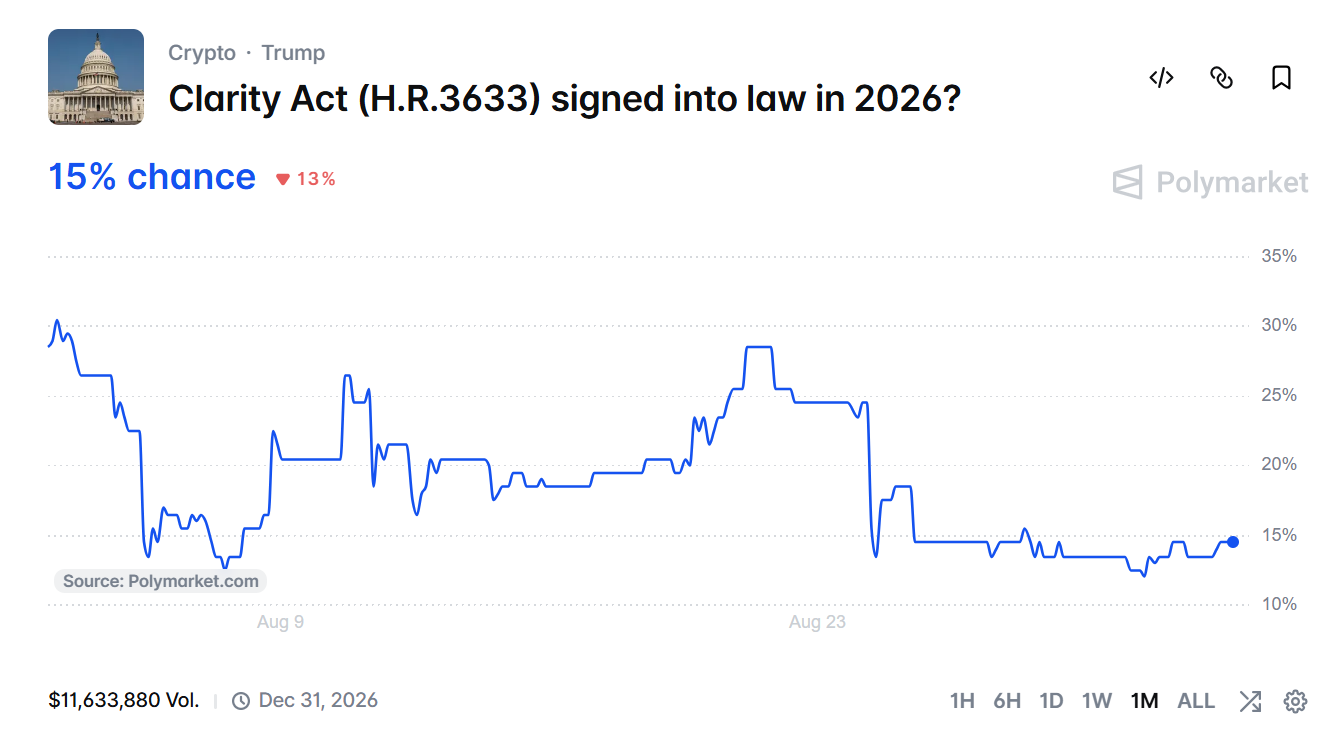
- •Polymarket traders price the probability of the Clarity Act becoming law before the end of 2026 at roughly 14%–15%, the lowest level since the market's creation.
- •The bill requires 60 votes to advance, and there are no signs bipartisan support has been achieved, with ethics provisions remaining a key unresolved sticking point.
- •If cloture fails, attention is expected to shift toward agency-level rulemaking, including an SEC proposal allowing transfer agents to use blockchain technology for official records.
Crypto regulation faces a critical test in the U.S. Senate on September 15, when lawmakers are set to hold a procedural vote on the Digital Asset Market Clarity Act — legislation that would establish the first comprehensive U.S. market-structure framework for digital assets, clarifying how the SEC and CFTC divide jurisdiction over crypto trading and token classification.
SEC Chair Paul Atkins told FOX Business that he anticipates and hopes the bill will eventually clear the Senate and reach President Donald Trump's desk. However, the scheduled September 15 vote is a cloture vote on the motion to proceed, not a final vote on passage.
Market expectations remain substantially less optimistic than Atkins' public stance. Polymarket traders currently price the probability of the CLARITY Act becoming law before the end of 2026 at roughly 14%–15% (Polymarket market).
Optimism Around Clarity Act Passage Thins
Atkins' optimism stands in contrast to the sentiment among industry insiders. With the bill failing to secure a cloture vote before the August recess, some now believe it has missed its window.
Polymarket odds for the Clarity Act's passage in 2026 now sit at 15%, the lowest level since the market's creation. Stakeholders have warned that the outcome of the midterm election could end any chance of the legislation passing — a political timeline that matters because the current Republican-held Senate majority sits below the 60-vote threshold needed to advance most major legislation.
Still, the September 15 cloture vote remains a much-anticipated event, as its outcome will determine the direction of the legislative push. The Clarity Act requires 60 votes to advance, making bipartisan support necessary.
So far, there are no signs that bipartisan support has been achieved. There is no update yet on whether the major sticking point — ethics provisions — has been resolved to the satisfaction of all stakeholders. However, reports confirm that discussions are ongoing on how to reach a compromise on the key issues before the day of the cloture vote.
https://x.com/bitcoinnews/status/2095147438025650476?s=46
US Regulators Continue Rulemaking While Clarity Act Hangs in Balance
Meanwhile, U.S. regulators have turned their attention to rulemaking, apparently as a contingency plan in case the Clarity Act fails. Beyond the Regulation of Crypto Assets, the SEC recently introduced a new proposal to modernize rules for registered transfer agents.
According to crypto journalist Eleanor Terret, the proposed rule would allow transfer agents to use blockchain technology for official records and also includes reporting requirements for tokenized securities (https://x.com/EleanorTerrett/status/2094839273086497105?s=20).
Crypto groups have also increased their calls for regulators to issue guidance on innovative products. The Crypto Council on Innovation (CCI) recently called on the SEC to issue rules regulating non-conventional exchange-traded funds (ETFs).
Additionally, a bipartisan group of former regulators called on the Commodity Futures Trading Commission (CFTC) to properly regulate the derivatives market so as to bring those markets onshore.
The September 15 vote is the next concrete checkpoint to watch: if cloture fails again, attention is likely to shift further toward these agency-level rulemaking efforts as the primary near-term path for U.S. crypto policy.
This article is for informational purposes only and does not constitute legal, financial, or investment advice.

