Midterm Results Narrow CLARITY Act’s Path to 60 Votes
Key Takeaways
- •The CLARITY Act failed a September 15 Senate cloture vote, 49-50, with no Democrat voting in favor, falling short of the 60 votes required to open debate.
- •Democrats won a Senate majority in the November 3 midterms with a net gain of six seats, narrowing the bill's prospects if it must be reintroduced in the next Congress beginning January 3.
- •Senator Mark Warner conditioned his support on ethics requirements covering the president and other senior officials, while Senator Elizabeth Warren argued the September ethics provisions could not be enforced against the president and would leave his family's crypto businesses unaffected.
- •Republican Senator Thom Tillis entered a motion to reconsider, keeping a lame-duck revote possible this session, though it would be held by the same chamber and still require 11 additional yes votes.
- •Sherrod Brown defeated Ohio Republican Jon Husted despite Fairshake's planned $30 million opposition and could chair the Agriculture Committee, which oversees the CFTC that would regulate digital commodity markets under the bill.
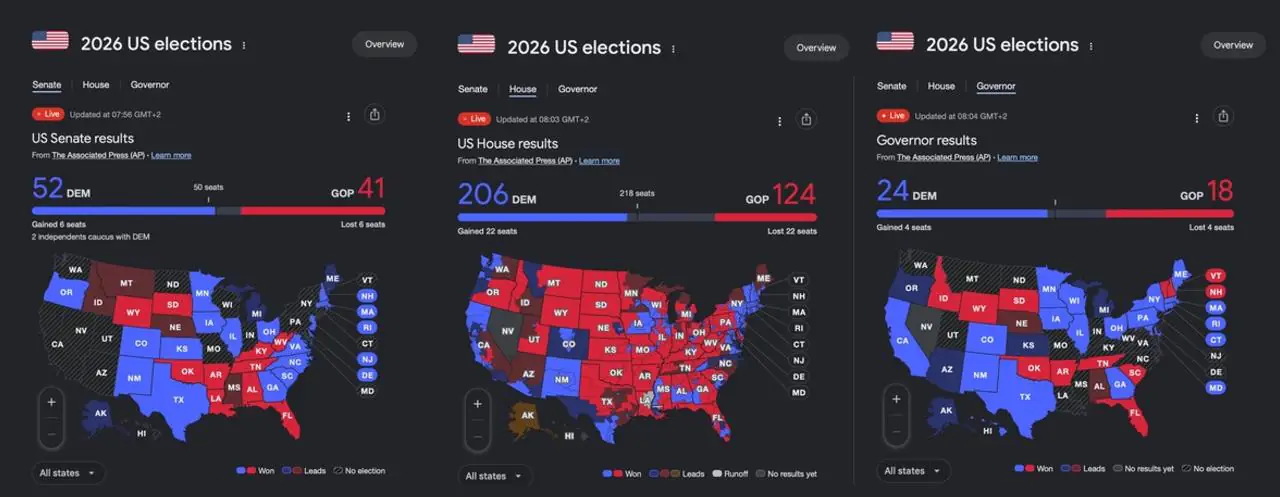
The Digital Asset Market CLARITY Act faces a narrower path to Senate passage after Democrats gained seats in the November 3 midterm elections, while Democratic senators tied their support to ethics requirements involving the president and other senior officials.
The bill failed to advance in a September 15 procedural vote, 49-50, with no Democrat voting to proceed. Although another vote remains possible during the current session, unpassed legislation must be reintroduced when the next Congress begins on January 3 unless lawmakers establish another date by law.
At the time of writing on November 4, the Associated Press had called the Senate for Democrats. AP results displayed on Google at 05:56 UTC showed Democrats with 52 Senate seats and Republicans with 41, a Democratic net gain of six seats. The results panel noted that two independents caucus with Democrats.
The House had not been called. AP’s tally at 06:03 UTC showed 206 seats for Democrats and 124 for Republicans, leaving Democrats 12 seats short of the 218 needed for a majority. Several news organizations nevertheless projected a Democratic majority, Bloomberg reported. These were media calls rather than official results. Final tallies will come after states finish counting and certify the vote.
The bill’s clock runs out on January 3
The CLARITY Act is not finished in the current Congress. Republican Senator Thom Tillis voted against cloture in September and then entered a motion to reconsider, preserving the possibility of another vote later in the session, The Block reported. Tillis said after the September vote that it did not represent the end of the bill.
That option lasts only until the current session ends. According to Senate guidance on a new Congress, legislation that has not passed must be reintroduced when the next Congress convenes. The new Congress is scheduled to begin on January 3 unless lawmakers set another date by law.
The administration has already stopped relying on a lame-duck passage. One week after the vote, White House crypto adviser Patrick Witt said regulators would not delay their own crypto rulemaking in the hope that the bill would pass during the lame-duck session, CoinDesk reported in its report on crypto market-structure legislation.
The 60-vote math remains unchanged
The September 15 motion required three-fifths of the Senate, or 60 votes, to open debate. The official Senate roll call recorded 49 votes to proceed and 50 votes against. No Democrat voted in favor.
The vote was divided as follows:
- Voted to proceed: 49 — All Republicans.
- Voted against: 50 — 44 Democrats, two independents, and Republicans Susan Collins, Josh Hawley, Jerry Moran and Thom Tillis.
- Did not vote: 1 — Chris Coons, Democrat of Delaware.
The election results do not change that count for a possible lame-duck revote. Senators who lost on November 3 retain their seats until the new Congress begins. A second cloture vote during the current year would therefore be held by the same chamber that produced the 49-50 result and would still require 11 additional senators to vote yes.
The election changed the situation that would follow if the bill is reintroduced. Among the senators who supported the September motion, Ohio Republican Jon Husted lost to Democrat Sherrod Brown, the Associated Press reported. Kansas Republican Roger Marshall and the Iowa seat left open by retiring Senator Joni Ernst also went to Democrats, according to AP projections reported by Forbes and Axios. Beginning in January, those votes for the current text will no longer be available from the same senators.
Democrats identify ethics as a condition
Senator Mark Warner of Virginia said in a statement on the CLARITY Act after the vote that he supports digital-asset rules that protect consumers and give responsible companies certainty. He voted against the motion because, he said, Congress could not pass the bill “while allowing the President of the United States to personally profit from it.” Warner said meaningful ethics requirements covering the president and other senior officials were his minimum condition for support.
Warner’s statement also described a narrower objection. He said negotiators had come close to resolving some of the most difficult issues involving law enforcement and national security, but that the unresolved conflict of interest prevented him from supporting the motion.
Senator Elizabeth Warren, the Banking Committee’s top Democrat, raised broader objections in her floor remarks before the procedural vote. Warren argued that revised ethics provisions released by Republicans shortly before the vote, which she said had been negotiated with the White House, could not be enforced against the president and would leave his family’s crypto businesses unaffected.
Warren said the September ethics language would fail in several ways. Enforcement against the president would rest solely with the attorney general, while state attorneys general would not be able to bring cases against the president. She also said a legal opinion from the Office of Government Ethics could shield the president from enforcement.
According to Warren, World Liberty Financial and the Trump memecoin could continue operating, and new ventures could be launched. She also argued that a blind trust would satisfy the rules even if the president still knew what assets it contained.
Her objections extended beyond ethics. Warren opposed provisions that she said would allow non-crypto companies to move traditional securities onto blockchains outside investor protections, expand the crypto activities banks could finance with deposits, and limit states’ ability to enforce their own consumer-protection laws.
Republicans characterized the negotiations differently. After the vote, Tillis said the bill had made substantial bipartisan progress, much of it because of the White House.
Democrats’ positions on the bill are not uniform. In July 2025, 78 House Democrats voted for CLARITY as it passed the House, 294-134, according to the House Clerk’s vote record. In the Senate, Warner’s stated condition focused on ethics rather than the bill’s central division of oversight between the Securities and Exchange Commission and the Commodity Futures Trading Commission. Warren’s objections covered a broader range of provisions.
Brown returns as committee assignments become important
Brown, a former three-term senator who chaired the Banking Committee before losing his seat in 2024, won Ohio’s special election despite renewed opposition from the crypto industry’s largest super PAC. Fairshake planned to spend $30 million against him, The Hill reported, after crypto interests spent about $40 million trying to defeat him two years earlier.
That spending has not consistently translated into Senate votes. Ruben Gallego and Elissa Slotkin, two Democrats whom Fairshake supported in 2024, both voted against cloture, The Block noted in its coverage of the vote.
Brown’s committee assignment could prove more significant than his individual vote. The Block has raised the possibility that he could chair the Agriculture Committee, which oversees the CFTC, the agency that would regulate digital commodity markets under CLARITY. No assignment has been made. Under Senate procedures, each party prepares its committee assignments, after which the full chamber approves them. Coindoo has also examined the implications of the Senate committee seats.
Four checkpoints before January 3
The next indications of whether the industry will receive legislation on the current terms or have to begin again next year will come from four areas:
- A possible rerun vote: Majority Leader John Thune would need to bring Tillis’s motion back to the floor before the session ends.
- New ethics language: Revised provisions covering officials’ crypto holdings would need to appear, and Warner, who has said he wants to reach a yes vote, would need to endorse them.
- Committee leadership: The Senate’s choices for Democratic chairs of the Banking and Agriculture committees would shape oversight of the SEC and CFTC.
- Oversight requests: A majority gains committee investigative powers. Warren has already urged Scott Bessent and Todd Blanche to investigate national-security risks she linked to World Liberty Financial in a letter and statement.
If neither a rerun vote nor new ethics language emerges by January 3, the next version of CLARITY will start from scratch before committees chaired by Democrats.

