Senate Filibuster Math Puts CLARITY Act at Risk Before August Recess
Key Takeaways
- •The House passed the CLARITY Act on July 17, 2025, and the Senate Banking Committee advanced its version on May 14, 2026, but floor passage remains uncertain.
- •Senate Democrats have not agreed on key provisions involving ethics rules, illicit finance, and stablecoin yield restrictions.
- •The bill would assign the CFTC oversight of digital commodity spot exchanges, brokers, and dealers while keeping SEC authority over tokenized securities.
- •Bernstein warned that failure to pass the bill before recess could pressure Bitcoin and riskier altcoins in the short term.
- •If the Senate does not vote in August, comprehensive crypto rules could be delayed into 2027.
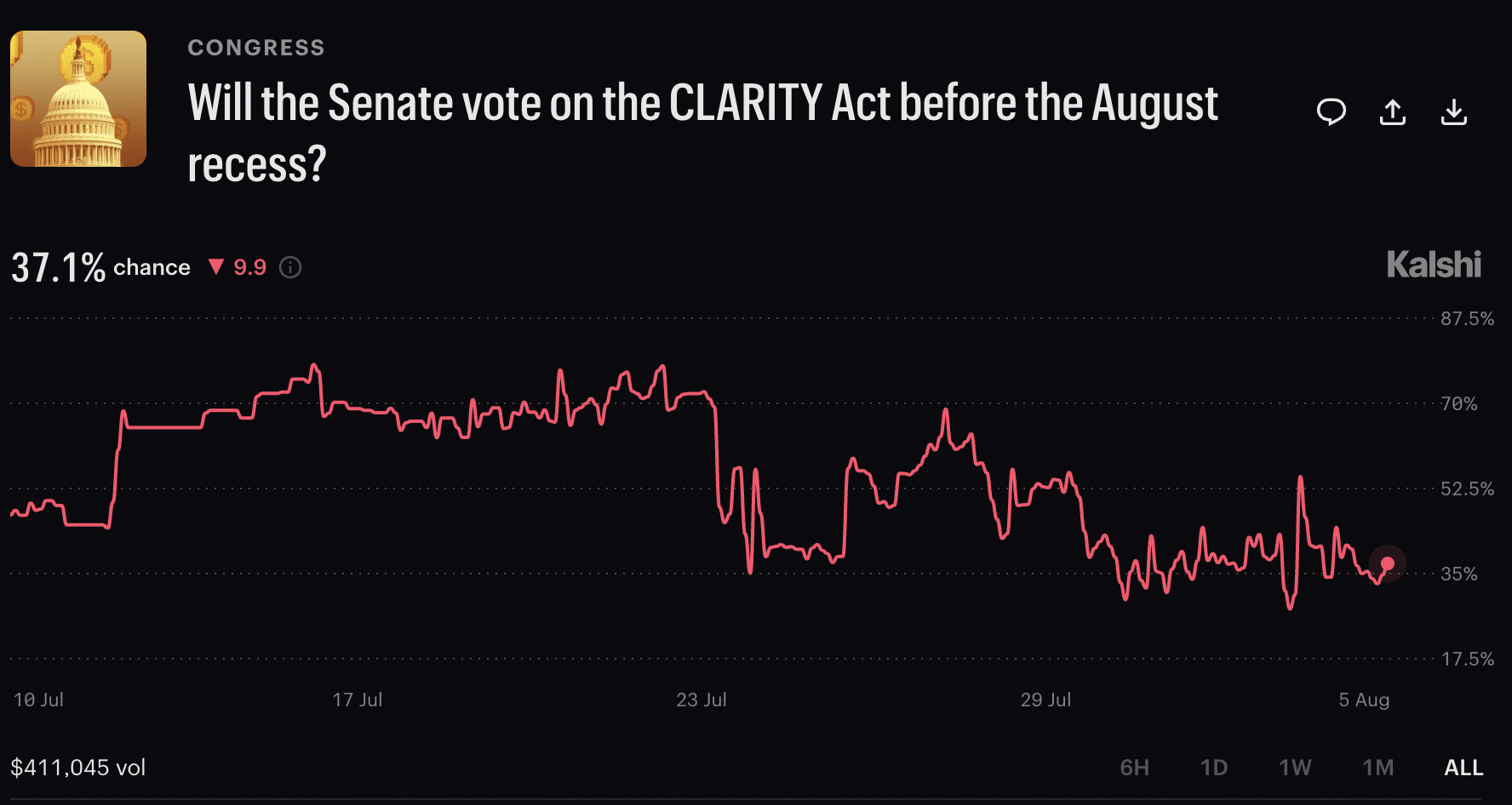
The most consequential crypto regulation bill in years is running out of time. The CLARITY Act, formally the Digital Asset Market Clarity Act, is facing a near-certain Senate defeat before lawmakers leave Washington for the August recess, and Bitcoin is already reflecting the uncertainty, trading near $63,500, about 50% below its October 2025 all-time high of $126,200.
The core obstacle is straightforward: Senate Republicans need 60 votes to overcome a filibuster, and Democrats have not reached agreement on several unresolved provisions.
Senate Democrats have raised concerns about ethics rules, illicit finance provisions, and stablecoin yield restrictions, leaving the path to a successful cloture vote — the procedural motion needed to end debate and advance the bill — unclear without further negotiation.
Where the Legislation Stands
The House passed H.R. 3633 on July 17, 2025, by a 294-134 vote, with 78 Democrats backing the bipartisan crypto bill. The Senate Banking Committee advanced its version on May 14, 2026, by a 15-9 vote, with Democrats Ruben Gallego and Angela Alsobrooks crossing the aisle. Both lawmakers said committee approval did not guarantee support on the floor.
Senate Majority Leader John Thune has said the CLARITY Act is on his pre-recess agenda, but a procedural vote remains uncertain, and the next realistic chance for floor action may not come until mid-September.
That delay reflects government funding negotiations and the approach of the midterm elections. Senator Cynthia Lummis said a floor vote is expected, and noted that Democratic compromises, including ethics provisions for federal officials, have already shaped the bill’s text. For crypto companies and traders watching Washington, the timing matters because the bill is meant to settle long-running jurisdiction questions that have left parts of the industry operating under overlapping or unclear federal oversight.
(Source: Kalshi)
What the CLARITY Act Is Designed to Do
The CLARITY Act is intended to create a clearer regulatory framework by giving the CFTC full oversight of digital commodity spot exchanges, brokers, and dealers, while preserving SEC authority over tokenized securities. That division is central to the bill’s market-structure overhaul.
As of July 20, 2026, the total crypto market value had reached $2.28 trillion, with Bitcoin accounting for $1.29 trillion. Bitcoin has benefited from its established commodity treatment and a developed derivatives market.
The bill would mainly formalize Bitcoin’s regulatory status, but it would also affect the $680 billion in non-Bitcoin, non-stablecoin assets that remain in regulatory limbo, along with U.S. spot exchanges, DeFi protocols, and capital-raising firms that use token sales. That is why the debate has drawn attention beyond Bitcoin itself: the legislation would help determine how a large share of the U.S. digital asset market is supervised, registered, and policed.
The political standoff centers on ethics provisions. Republicans risk dividing their own coalition if ethics rules limit White House-aligned crypto activity, while Democrats argue that without ethics language, there will be no 60th vote.
Market Implications of a Delay
JUST IN: $86 billion Mizuho Bank says Clarity Act will NOT pass in August
"It will happen at some point, but not in 2026." pic.twitter.com/oRPiBqIhkv — Bitcoin Archive (@BitcoinArchive) August 4, 2026
JUST IN: $86 billion Mizuho Bank says Clarity Act will NOT pass in August
"It will happen at some point, but not in 2026." pic.twitter.com/oRPiBqIhkv
— Bitcoin Archive (@BitcoinArchive) August 4, 2026
Wall Street firm Bernstein said a failure to act before the recess could trigger a short-term selloff in Bitcoin and higher-risk altcoins. Even so, Bernstein said it remains optimistic that the crypto market could recover in late Q3 and early Q4 ahead of the midterms.
Polymarket currently puts the probability of the CLARITY Act passing in 2026 at 31%, down 9 points over the past month. Coinbase CEO Brian Armstrong and Grayscale are pushing for an immediate Senate vote, with support from firms including BlackRock, Fidelity, and Goldman Sachs, which view the bill as important for U.S. crypto market structure.
If the Senate does not vote, Bernstein said the SEC and CFTC could try to accelerate rulemaking under Project Crypto to build a digital asset framework, although that path would be slower and less effective than legislation.
Failure to pass the bill would not make crypto assets illegal, but it would extend the current fragmented regulatory environment. If no vote occurs in August, comprehensive rules for the $2.28 trillion industry could be pushed into 2027, when Congress may look very different.

