Banks and 17 State Attorneys General Challenge CLARITY Act Ahead of Vote
Key Takeaways
- •The CLARITY Act is a market structure bill aimed at clarifying whether the SEC or CFTC oversees different crypto assets, and lawmakers have not yet voted on it.
- •Banks are challenging the legislation before the vote, with stablecoin rewards provisions serving as a focal point of banking industry objections.
- •An earlier round of banker pushback over stablecoin rewards resulted in the bill accumulating more than 100 amendments.
- •Seventeen state attorneys general are challenging the act, adding a state-level dimension tied to questions of federal preemption of state law.
- •The exact vote date, chamber, and procedural stage remain unconfirmed until an official calendar verifies the schedule.
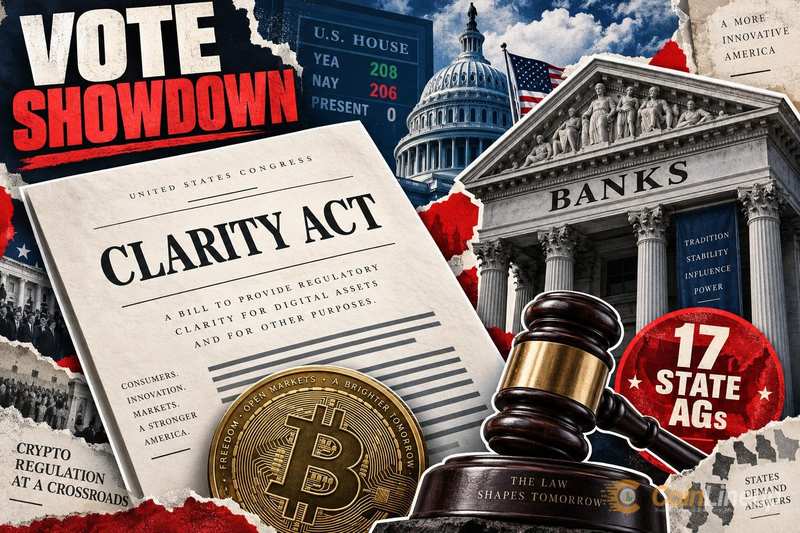
The CLARITY Act, the crypto market structure bill headed toward a vote, is now facing challenges from two directions: banks and a group of 17 state attorneys general. The pushback signals fresh friction over how the United States plans to regulate digital assets. The vote has not yet taken place, and both challenges have arrived in the run-up to it.
Banks Raise Objections Before the Vote
Banks are pushing back on the CLARITY Act, a proposed law that would set rules for how crypto assets are regulated in the United States. The challenge comes before lawmakers hold a vote on the measure, landing at a pivotal moment for the legislation. For related coverage, see CLARITY Act Faces 100+ Amendments as Bankers Oppose Stablecoin Rewards.
For readers new to the term, stablecoin rewards are benefits or yields tied to holding stablecoins, tokens designed to track the value of a reference asset such as the dollar. That provision has been one of the banking industry's focal points in this debate so far.
The available reporting confirms that banks are among the groups raising concerns. It does not, on its own, name every institution involved or spell out each objection in detail. For related coverage, see Illinois crypto tax lawsuit faces second challenge.
This is not the first time the banking industry has clashed with the bill. Earlier coverage noted that the measure drew more than 100 amendments as bankers pushed back on stablecoin rewards, showing the industry has engaged heavily with the text. For related coverage, see Top Crypto News for Wed, Apr 15: CLARITY Act Deadline, Senate Gridlock.
Banking groups have also tied the bill to broader stablecoin worries. Prior reporting described how a delay fueled a Wall Street stablecoin warning while the White House pushed back. Market structure rules cut close to banks because they help determine how digital asset products sit alongside traditional financial services, and the industry's repeated interventions show it is treating the drafting stage as the moment to make its case.
The State Attorneys General's Challenge
Alongside the banks, a group of 17 state attorneys general is challenging the CLARITY Act. Attorneys general are the top legal officers for their states, and they often weigh in when federal rules could affect state powers. Their involvement adds a state-level dimension to a federal debate.
That dimension matters because federal legislation can preempt, meaning it can override, state law, and how a national crypto framework handles the boundary between federal and state authority is precisely the kind of question state legal officers tend to examine.
The number of officials, 17, comes from the reporting on this development. Their individual names, states, and the exact wording of their concerns are best confirmed through official statements, such as those posted by state attorney general offices like the New York Attorney General's press release page.
It is not yet clear whether the attorneys general and the banks share the same objections. Two groups challenging the same bill does not mean they are coordinating or raising identical points, and the alignment may become as official statements are released.
What to Watch as the Vote Approaches
The CLARITY Act is a market structure bill that aims to clarify which regulator oversees different crypto assets. That question has long been a source of confusion for the industry. In the American framework, the confusion has largely centered on the boundary between the Securities and Exchange Commission and the Commodity Futures Trading Commission, the two federal agencies most often at the center of crypto jurisdiction questions.
The challenges arrive ahead of a vote, but the exact date, the chamber, and the procedural stage are not confirmed in this reporting. Readers should treat any specific timing as unverified until an official calendar confirms it.
Timing has already been a flashpoint. Coverage of the bill has tracked how a delay drew criticism ahead of a September vote, a theme readers can follow as the schedule firms up. Official positions can be verified as they are published through a search for the latest statements.
With the bill having already accumulated more than 100 amendments during an earlier round of banker pushback, one concrete marker to follow is whether the new objections surface as further changes to the text or remain in statements outside the drafting process.
For a regular crypto holder, the practical takeaway is simple. The rules for crypto in the United States are still being written, and this bill is one of the main efforts to define them. Watching who supports or opposes it, and why, helps you understand where the law may land.
Disclaimer: This article is for informational purposes only and does not constitute financial or investment advice. Cryptocurrency and digital asset markets carry significant risk. Always do your own research before making decisions.

