Clarity Act Negotiations Stall as BitMEX Plans September Shutdown
Key Takeaways
- •The Clarity Act remains unresolved because lawmakers disagree over whether enforcement should sit with the federal Attorney General or state attorneys general.
- •Democrats have criticized presidential exception provisions, including reported rules that would expire when President Trump is scheduled to leave office in 2029.
- •Senate Majority Leader John Thune has said the bill may not currently have enough votes, though a floor vote could still be used to gauge support before the August recess.
- •BitMEX plans to shut down in September after 11 years, as declining volumes and industry consolidation pressure mid-tier crypto trading venues.
- •S&P Dow Jones Indices and Pantera Capital launched an institutional digital asset index with 18 constituents that excludes Bitcoin and XRP.
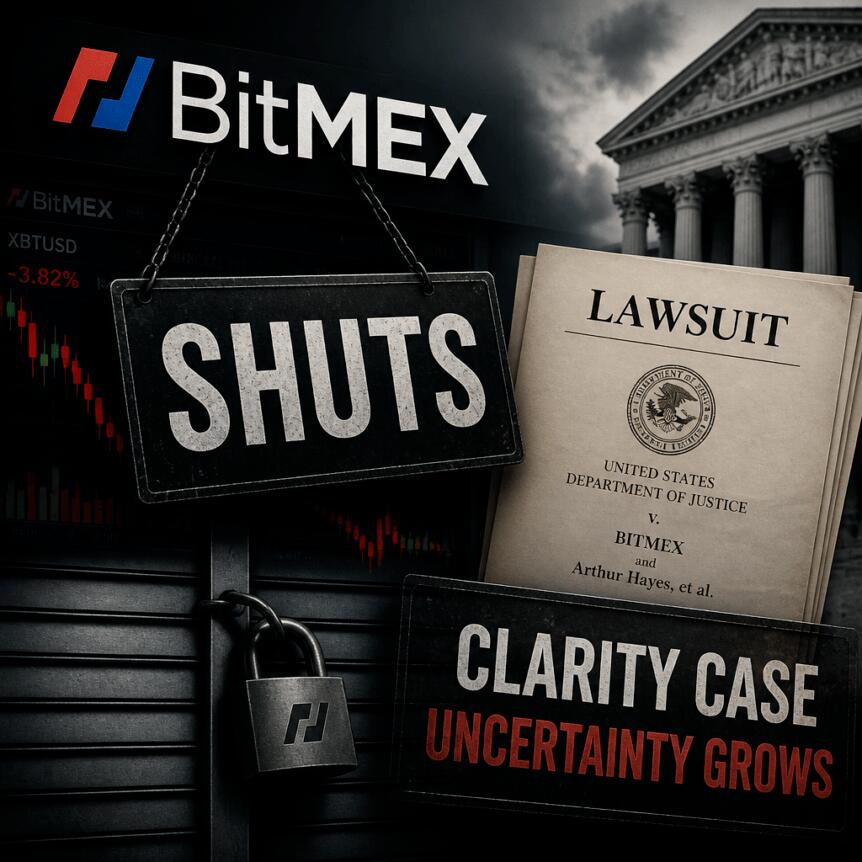
U.S. lawmakers remain in negotiations over the Clarity Act as the August recess deadline approaches, with disagreements over ethics enforcement and presidential exceptions leaving the digital asset proposal unresolved. The bill would restrict U.S. officials from issuing or sponsoring crypto assets, but Senate Majority Leader John Thune has expressed doubt that it currently has enough votes to pass. He has also said a floor vote could still be used to “get Clarity started” and measure support.
The legislation has become part of a wider political fight over enforcement powers. Democrats want the ethics rules enforced by state attorneys general, while the White House and Republicans have favored a framework centered on the federal Attorney General, an official appointed by President Trump. Democrats have also criticized provisions they say would give the President special leeway. Those disputes have kept the bill in limbo even as parts of the financial industry and law enforcement community show support for the latest version.
Clarity Act talks focus on ethics and enforcement
A central feature of the Clarity Act negotiations is an ethics framework that would bar U.S. officials from issuing or sponsoring digital assets. The proposal also includes exceptions that Democrats have described as a “get out of jail free” arrangement for the President.
One issue raised in reporting is that certain rules would expire on the day President Trump is scheduled to leave office in 2029. Critics have argued that this would weaken the durability of the restrictions and narrow their practical effect.
The enforcement structure is another major divide. Under the approach backed by the White House and Republicans, the ethics provisions would be administered by the Attorney General appointed by Trump. Democrats have instead pushed for state attorneys general to have enforcement authority. That would broaden enforcement across multiple jurisdictions, but Republicans and the White House appear unlikely to support an approach that empowers independent state-level prosecutors.
The fight over who enforces the rules is not only procedural. It determines whether alleged violations would be handled through a single federal channel or could be pursued by multiple state-level officials, a distinction that affects both political accountability and the practical reach of any ethics regime.
According to Cointelegraph, Thune does not believe the bill has enough votes to pass at this stage. Even so, he indicated that he may bring it to the Senate floor to “get Clarity started” and identify where the remaining votes stand before the August recess deadline.
Institutions and law enforcement show support as partisan trust remains limited
Despite the political divisions, outside support for the bill has grown. The White House called the proposal the “most comprehensive and wide-ranging ethics provision in history.” Democratic Senator Ruben Gallego took the opposite view, describing it in blunt terms as neither serious nor acceptable. Negotiations are reportedly continuing as lawmakers try to find language that both sides can accept.
Financial institutions have also commented on the proposal. Goldman Sachs CEO David Solomon said the measure is “not perfect,” but still supported it. Cointelegraph also reported that Fidelity and Charles Schwab have backed the initiative. Those endorsements suggest supporters view the bill as a workable baseline for limiting perceived conflicts of interest, particularly for firms seeking clearer rules of conduct around digital assets.
Law enforcement groups have also entered the debate. The National Fraternal Order of Police said the latest version of the BRCA, described as protecting developers of decentralized protocols, would not interfere with investigations into money laundering and fraud. That point is important to supporters who want ethics restrictions to address conflicts of interest without unintentionally limiting legitimate enforcement activity.
Still, distrust between the parties remains a major obstacle. Negotiators may be able to adjust implementation details, but the central disagreements over presidential exceptions and who can enforce the rules directly affect each side’s political incentives.
Polymarket odds reflect uncertainty
Prediction market data also points to uncertainty around the legislation. According to Polymarket, the odds of the Clarity Act passing this year are currently 38%. Even if a floor vote is scheduled, the bill could face significant resistance if lawmakers cannot agree on a version that enough senators are willing to defend publicly.
Two issues remain especially important in the near term: whether the enforcement framework moves toward a model involving multiple enforcers, and whether the presidential exception provisions are preserved or narrowed. Those points are likely to determine whether a political compromise can become a voteable package before the August recess.
BitMEX plans to close after 11 years
Outside the Clarity Act debate, BitMEX, one of the early crypto derivatives trading platforms, announced that it will shut down operations in September after 11 years. BitMEX launched in 2014 and became known for introducing 100x leverage perpetual swaps, a futures-like crypto derivative that does not have a fixed expiry date.
The exchange has faced falling volumes in recent years as competition increased. Major centralized exchanges such as Binance and fast-growing decentralized venues such as Hyperliquid have taken market share. CryptoQuant CEO Ki Young Ju said BitMEX’s share of the Bitcoin futures market has fallen to 0.08%, with roughly $84 million in daily trading volume.
Ju described the shutdown as an industry “torch” moment, saying an exchange that helped define the market is now stepping aside for the next wave it helped inspire. Cointelegraph also reported that BitMEX’s utility token, BMEX, dropped sharply after the shutdown announcement.
On the same day, a class action lawsuit emerged alleging that BitMEX fraudulently engineered liquidations to seize trader collateral. BitMEX denied the allegations and said it had previously defended itself successfully against similar claims.
Analysts linked the shutdown to broader structural changes in crypto trading. Cointelegraph reported that restructuring adviser Roshan Dharia said BitMEX’s demise reflects accelerated consolidation. A quoted passage said the top five platforms control an estimated 80% of global spot volume, putting pressure on mid-tier operators as structural headwinds, rather than short-term market cycles, reduce margins and limit paths to scale.
The consolidation theme continued as Cointelegraph also reported that BitMart later announced it would close in the coming months. The report suggested that pressure is spreading across crypto venues rather than remaining limited to a single platform.
S&P and Pantera launch digital asset index
Index providers are also expanding further into digital assets. S&P Dow Jones Indices and Pantera Capital launched the S&P Pantera Digital Asset Index, an institutional benchmark designed to track major crypto assets while excluding Bitcoin and XRP.
According to Cointelegraph, the index is intended for institutional use and filters blockchains according to minimum thresholds for protocol revenue, market capitalization, and liquidity. It launched with 18 constituents. Ether (ETH), BNB (BNB), Solana (SOL), TRON (TRX), and Hyperliquid (HYPE) are the five largest holdings. Bitcoin (BTC) and XRP are the largest non-constituents.
The launch is part of a wider push to create institutional-grade digital asset benchmarks. Benchmarks can give asset managers a common reference point for measuring exposure, comparing performance, and designing financial products, which is why eligibility rules around liquidity, market size, and revenues are central to institutional adoption. Cointelegraph cited related products including the Nasdaq Crypto Index US ETF, a Franklin Crypto Index ETF, and a Coinbase Store of Value Index. The developments show that traditional finance-style benchmarking is moving from concept toward more concrete market infrastructure.
Robinhood explores prediction market expansion
In U.S. consumer markets, Robinhood is reportedly discussing an expansion of its prediction markets business through the integration of yes-or-no event contracts supplied by Crypto.com. Cointelegraph noted that Robinhood began offering prediction markets in March 2025, initially facilitated by Kalshi to meet compliance requirements from the U.S. Commodity Futures Trading Commission (CFTC).
At the same time, regulatory scrutiny of event contract certification is increasing. Cointelegraph reported that the CFTC issued another warning that platforms must be more specific and should not rely on broad template-style certifications covering multiple possible event variations. That regulatory position could affect how quickly providers scale new contract templates or expand the range of covered scenarios.
Cointelegraph also referenced legal commentary tying potential clarity on market structure oversight to the Clarity Act, framing the ethics legislation as potentially supportive of the CFTC’s ability to monitor growth in prediction markets.
Across governance, exchanges, benchmarks, and consumer-facing products, regulation, institutional infrastructure, and market structure pressures continue to shape developments in the crypto sector. For the Clarity Act, the immediate questions are whether lawmakers can reach a durable enforcement compromise and whether senators are prepared to turn that compromise into votes before the August recess deadline.

