Bitcoin Faces Regulatory Uncertainty as CLARITY Act May Slip Past August Recess
Key Takeaways
- •Senate Majority Leader Thune indicated the CLARITY Act may not advance before the August recess, leaving approximately ten business days for the bill to clear procedural hurdles.
- •Major financial institutions including JPMorgan, Bank of America, and Citi are constructing crypto infrastructure such as a shared tokenized deposit network despite ongoing legislative uncertainty.
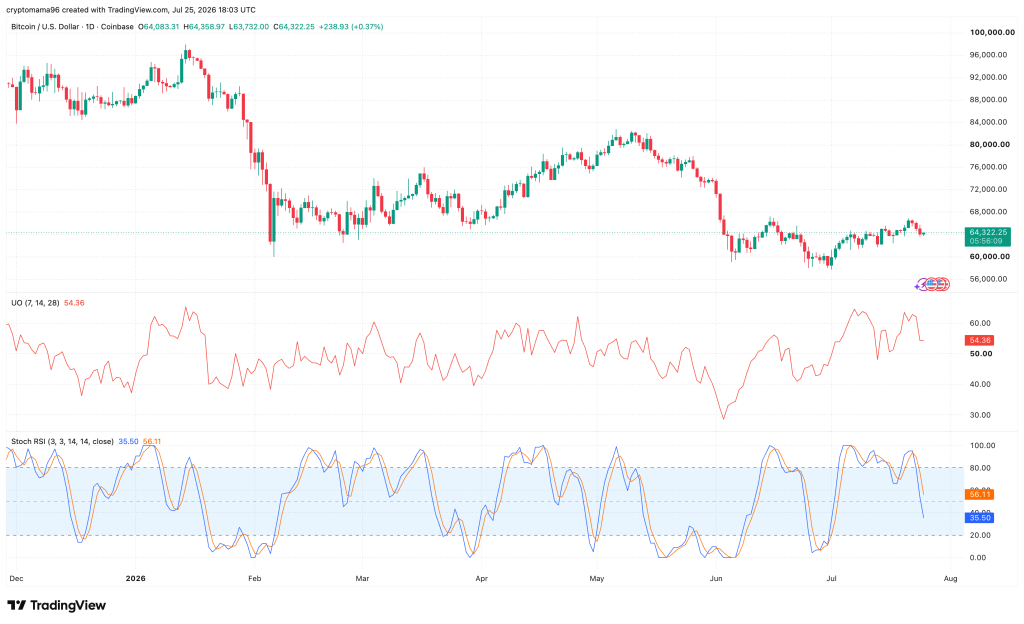
- •Bitcoin is consolidating in a range between $60,000 and $66,000, with technical indicators suggesting heightened vulnerability to negative regulatory developments near support levels.
- •Analysts expect that if the CLARITY Act does not pass in 2026, the market reaction would likely be negative but not catastrophic, as institutional adoption and fundamental demand drivers remain intact.
- •The crypto industry has invested $189 million in the 2026 midterm elections, making it the largest corporate political spender in the current election cycle.
The cryptocurrency market has been closely monitoring the CLARITY Act, widely regarded as one of the most significant pieces of digital asset legislation in U.S. history. The bill arrives after years in which U.S. crypto oversight has relied primarily on SEC enforcement actions against major exchanges—including Coinbase, Binance, and Kraken—rather than a coherent statutory framework, leaving market participants to navigate ambiguous applications of decades-old securities law. However, comments from Senate Majority Leader Thune suggesting the bill may not reach the Senate floor before the August recess have raised concerns among traders about potential market repercussions, including the possibility of another Bitcoin price decline.
Notably, while Washington deliberates, major Wall Street institutions are proceeding as if the regulatory framework is already in effect. JPMorgan, Bank of America, and Citi have announced a shared tokenized deposit network. These institutions possess top-tier legal and political intelligence and are unlikely to commit billions of dollars to infrastructure projects they expect to fail under regulatory uncertainty. Their build-first posture also reflects competitive pressure from jurisdictions that have already enacted comprehensive crypto rules, such as the European Union's MiCA framework, which began full implementation in 2024.
Why the CLARITY Act Delay Has Bitcoin Traders Concerned
The CLARITY Act was anticipated to deliver a long-awaited regulatory structure for digital assets in the United States. The bill aims to establish clear rules for cryptocurrency exchanges, define which assets are subject to securities laws, and create a pathway for traditional financial institutions to offer crypto-related services with legal certainty.
Optimism increased when the White House reached an agreement on the ethics provision on July 20. The final working draft emerged on Wednesday, and Senator Lummis committed to working toward a deal. However, Senator Thune subsequently told reporters that the bill would likely not advance before the August recess.
The Senate floor schedule is critical because Congress faces a narrow legislative window. With only approximately ten business days remaining before recess, the bill must clear several procedural hurdles. If it fails to do so, consideration would slip to September or later, when lawmakers returning from recess typically confront appropriations deadlines and budget negotiations that consume substantial floor time and legislative attention.
For Bitcoin traders, the delay introduces renewed uncertainty. The market had begun pricing in a relatively smooth legislative passage, and any setback could trigger a negative price reaction.
Institutional Activity Continues Despite Legislative Uncertainty
Crypto analyst Dan Gambardello has been tracking the CLARITY Act's progress and highlighted a perspective that many observers have overlooked: while politicians debate and delays mount, the world's largest financial institutions are building infrastructure as though the law were already enacted.
CLARITY ACT MIGHT NOT PASS?! Okay. Then why did JPMorgan, Bank of America, and Citi just announce a shared tokenized deposit network? Why did Visa and Mastercard launch a stablecoin backed by 140+ companies? Why did Morgan Stanley stand up a national trust bank and complete… pic.twitter.com/vw3B2hofIh — Dan Gambardello (@dangambardello) July 24, 2026
CLARITY ACT MIGHT NOT PASS?! Okay. Then why did JPMorgan, Bank of America, and Citi just announce a shared tokenized deposit network? Why did Visa and Mastercard launch a stablecoin backed by 140+ companies? Why did Morgan Stanley stand up a national trust bank and complete… pic.twitter.com/vw3B2hofIh
Gambardello pointed to several additional examples of institutional commitment. Charles Schwab, managing $12 trillion in client assets, has openly stated its intention to compete for Coinbase's market share and is considering crypto-related acquisitions. Vanguard, which blocked Bitcoin ETFs in 2024, recently posted its first Head of Digital Assets position. Samsung announced native stablecoin support for Samsung Wallet. The Fraternal Order of Police, representing 382,000 members, endorsed the bill.
The crypto industry has invested $189 million in the 2026 midterm elections, making it the largest corporate political spender in the current cycle. Fair Shake, the industry's super PAC, holds approximately $127 million in cash reserves. Ripple alone contributed $48 million.
Gambardello's central argument is that institutions with the most sophisticated legal teams and lobbyists do not construct settlement networks, trust banks, and multi-year roadmaps if they anticipate regulatory failure. Their capital commitments reflect a conclusion that cryptocurrency is a permanent fixture in the financial landscape, regardless of the CLARITY Act's legislative timeline.
Bitcoin Technical Analysis: Consolidation Near Key Support
From a technical standpoint, Bitcoin is currently trading in a consolidation range between $60,000 and $66,000. This sideways movement follows a decline from the $82,000–$83,000 region and indicates that the market is awaiting a decisive catalyst.
Key technical levels include immediate resistance at $65,500–$66,000 and major resistance at $67,500–$68,500. On the downside, support is located at $62,500–$63,000, with major support at $59,000–$60,000.
The Ultimate Oscillator reads 54.36, indicating neutral momentum. Neither overbought nor oversold conditions are present, which typically suggests the market is positioned for a move in either direction. However, the Stochastic RSI has produced a bearish crossover and is declining from elevated levels.
Chart structure reveals that buyers have repeatedly failed to push above the $66,000 area during July, with sellers consistently defending resistance. Unless Bitcoin closes decisively above the $66,000–$68,000 range, the market remains in consolidation rather than a confirmed uptrend.
This technical configuration is significant because Bitcoin is trading near support levels rather than at new highs, making it more susceptible to negative developments. A regulatory disappointment could intensify selling pressure, particularly if short-term traders opt to realize gains.
Potential Market Impact of a CLARITY Act Delay
If the CLARITY Act does not pass in 2026, the immediate market reaction would likely involve heightened volatility and profit-taking by short-term traders. Diminished institutional optimism could push Bitcoin toward the $60,000 support level. A break below $59,000–$60,000 on heavy volume could expose the mid-$50,000 range as the next significant demand zone. Altcoins would likely experience steeper declines due to their higher sensitivity to regulatory uncertainty.
However, several factors suggest any downside may be contained. The CLARITY Act primarily affects regulatory certainty rather than Bitcoin's underlying fundamentals. Key demand drivers remain in place, including institutional adoption, spot ETF demand, corporate treasury accumulation, fixed supply, and broader macroeconomic liquidity conditions.
Bitcoin's 2026 price action resembles a policy-sensitive consolidation rather than a defined trend. Price remains in the low-to-mid $60,000 range, and ETF flows continue to influence sentiment on a daily basis. If the CLARITY Act does not pass this year, the expected reaction would be negative but likely not catastrophic: weaker institutional confidence, prolonged regulatory ambiguity, and a higher probability that traders demand a larger risk premium on BTC.
The market has treated the CLARITY Act as a key signal for U.S. crypto market structure. A failure to pass would leave regulatory clarity unresolved and extend uncertainty for exchanges, funds, and entities holding crypto on their balance sheets. Should the bill slip to the fall, attention would shift to whether Senate leadership can reconcile it with House-passed market structure legislation and navigate committee markups alongside an already crowded end-of-year agenda. In the near term, the most probable outcome is a sentiment-driven setback rather than an automatic structural collapse. Institutional adoption continues to provide underlying support for Bitcoin regardless of the legislative outcome.

