Circle Puts USDC on the Front of Chelsea's Shirt for the 2026/27 Season
Key Takeaways
- •Circle confirmed on Aug. 28 that USDC will serve as Chelsea's principal front-of-shirt sponsor for the men's, women's, and academy teams throughout the 2026/27 season.
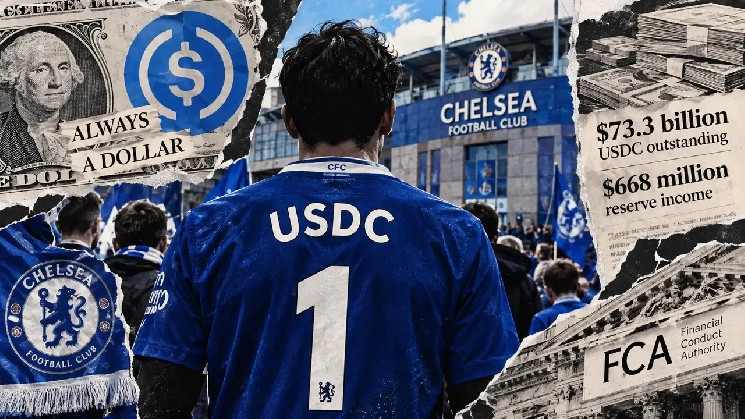
- •With $73.3 billion of USDC in circulation at the end of June, reserve income of $668 million drove about 95% of Circle's second-quarter revenue, and USDC holders receive no interest on the assets backing the token.
- •USDC ranks as the second-largest dollar stablecoin by circulation behind Tether's USDT, and Circle has traded on the New York Stock Exchange under the ticker CRCL since its June 2025 listing.
- •Chelsea extended its partnership with crypto exchange BingX as training-kit sponsor for 2026/27, the same season Premier League clubs will voluntarily remove gambling companies from the front of matchday shirts, and the deal follows the US GENIUS Act stablecoin framework enacted in July 2025.
- •The UK's Financial Conduct Authority identified 18 arrangements between 13 football clubs and unauthorized financial providers in a July review, though it found no evidence of illegality in most cases and the review predated the Circle-Chelsea announcement.
Chelsea has a new principal shirt sponsor, and its flagship product is about as uneventful as finance gets: a stablecoin designed to hold steady at one dollar.
USDC is built to track the US dollar—today, tomorrow, and next Tuesday alike. When everything works as intended, its price barely moves, which leaves little room for a victory parade. Yet Circle, the company behind USDC, has decided the token belongs on the front of one of the most famous shirts in world football.
Circle announced the agreement on Aug. 28. Circle and USDC branding will appear as Chelsea's principal front-of-shirt sponsor across the men's, women's, and academy teams for the 2026/27 season. The deal places a digital dollar in front of an audience that spends its weekends caring intensely about things considerably more dramatic than reserve assets.
That raises an obvious question: why does a stablecoin need football fans? The answer lies at the heart of Circle's business.
The World's Least Exciting Crypto Product Still Needs a Brand
Stablecoins carry a built-in marketing problem. It is not the challenge facing Bitcoin, whose promise of absolute scarcity propelled it to the top of both crypto and traditional markets. Nor is it the challenge facing an exchange, which can sell the thrill and dynamism of trading. USDC, by contrast, promises to remain worth roughly what it is now—and that is precisely the point.
USDC is designed to track the US dollar. Circle backs the token with cash and cash-equivalent assets, with the majority of the reserve held in a government money market fund that can hold short-term US Treasury securities and Treasury-backed lending. In practice, tokens like USDC are used to hold and move dollar value on blockchains—for trading, payments, and cross-border transfers.
Crucially, those reserves can earn interest, but USDC holders do not receive any of it. Circle's USDC terms state explicitly that the token pays no interest and gives holders no claim on returns generated from the reserves. That gap is a cornerstone of Circle's business model.
The scale is substantial. At the end of June, $73.3 billion of USDC was outstanding. Circle reported $668 million in reserve income for the second quarter, compared with $701 million in total revenue and reserve income. Using those rounded figures, reserve income accounted for roughly 95% of the total reported in Circle's second-quarter results.
Those figures also sit inside a competitive landscape. USDC is the second-largest dollar stablecoin by circulation, behind Tether's USDT, in a market where every major issuer makes the same core promise: a token worth one dollar. Circle, which has traded on the New York Stock Exchange under the ticker CRCL since its June 2025 listing, reports figures like these publicly each quarter.
The football shirt suddenly makes more sense. Circle benefits when more USDC exists and remains in circulation. The precise economics depend on interest rates and what the reserves earn, but broadly speaking, a larger USDC reserve base means a larger pool of interest-earning assets. Circle therefore has a clear incentive to make USDC the digital dollar people recognize—and football is exceptionally good at producing recognition.
You Don't Need to Understand USDC to Recognize It
Consider someone who knows nothing about stablecoins. They watch Chelsea every weekend and see USDC on the shirt—during matches, in highlights, in photographs, and on players' social media accounts, the same four letters repeated over and over for an entire season.
Six months later, a financial app asks whether they want USDC or another dollar stablecoin. Only one of those names looks familiar.
That is advertising in its purest form. The fan does not need to rush out after Chelsea-Arsenal and open a crypto wallet. Circle does not need everyone watching the match to become a customer that afternoon; it just needs the name to stop looking strange.
This matters particularly for a stablecoin, because the product itself is not easy to advertise emotionally. Nobody in the Shed End is singing about short-duration Treasury. Football is an emotional sport with deeply invested fans, and Circle gets to attach itself to something people already care about rather than trying to convince them to care about digital dollars.
Chelsea Is Becoming a Crypto Marketing Experiment
Circle is not Chelsea's only crypto partner. The club also renewed its partnership with BingX for the 2026/27 season. BingX, a crypto exchange, is Chelsea's training-kit partner, meaning the club can now introduce supporters to two very different crypto businesses through clothing alone: one helps people trade financial assets, and the other issues a token designed to sit at one dollar.
BingX receives training-kit branding and campaigns built around performance, preparation, and "Trained on Greatness," while Circle takes the match shirt. Different businesses, same badge—doing something neither financial company can easily achieve on its own: making the brand feel familiar.
This is hardly unique to crypto. Football shirts have been doing this for airlines, banks, betting companies, electronics brands, and various companies vaguely remembered from the Champions League for decades. What remains to be seen is what happens when increasingly complicated financial products occupy that space.
The timing is also notable. Premier League clubs agreed to remove gambling companies from the front of matchday shirts beginning with the 2026/27 season under a voluntary agreement. That does not mean betting advertising disappears from football, and it does not mean the rule caused Chelsea to sign Circle. But it does mean the most valuable piece of advertising real estate on a Premier League shirt is changing at exactly the moment financial and crypto companies are competing for global attention.
The stablecoin backdrop has shifted in the same period: in July 2025, the United States enacted the GENIUS Act, its first federal regulatory framework for payment stablecoins. And the most visible phase of Circle's bet is still ahead—USDC's name will not appear on a matchday shirt until the 2026/27 season begins.
Circle now holds one of those spots for USDC, and unlike a betting company, it is not trying to persuade the average Chelsea supporter to place a wager before kickoff. Its main and only goal for now is to get people to remember the name.
Knowing the Name Isn't the Same as Knowing the Product
This is where football sponsorship gets slightly strange. Shirts are excellent at announcing that a company exists, but terrible at explaining what it actually does.
The UK's Financial Conduct Authority (FCA) has already been examining financial-company sponsorships in football. In a July freedom-of-information response, the FCA said it had written to 21 clubs, including all 20 then in the Premier League, and identified 18 arrangements involving 13 clubs and financial providers without FCA authorization.
Important caveats apply. The figures covered financial companies beyond crypto, included former sponsorships, and predated the Circle-Chelsea announcement. The FCA also noted that lack of authorization did not automatically mean anything illegal had occurred, and that for most of the arrangements it reviewed, it found no evidence of illegality or breaches of UK regulatory requirements.
The findings are therefore not evidence of a problem with Circle's deal, but they do illustrate a broader issue with financial advertising in football: the badge reveals almost nothing about the protections attached to the product. Someone who discovers USDC through Chelsea still needs to know where they are buying it, who holds it for them, how they can redeem or sell it, what fees apply, and what protections exist where they live.
Circle itself draws a similar distinction in the sponsorship announcement, which states that the release is not an invitation to buy, hold, or trade crypto or use a financial service. It is an invitation to remember four letters—and that may be plenty.
Circle Doesn't Need You to Chant About USDC
Circle's task here is not to make Chelsea supporters passionate about USDC. The goal is to make USDC boring precisely because everybody has seen it.
The ideal outcome for Circle may be that someone encounters USDC in an app two years from now and reacts the same way they react to Visa, Mastercard, or PayPal: "Oh yeah, I know that." They may not know how the reserves work. They may not know who can redeem directly with Circle. They certainly will not be thinking about the yield on short-term Treasuries—they will simply recognize the name.
That is what Chelsea can sell Circle that a blockchain cannot: cultural familiarity.
USDC already knows how to stay near a dollar. Now Circle has to make people remember which digital dollar is theirs.
This article originally appeared on CryptoSlate.

