Circle Stock Forecast as Revenue and USDC Growth Slow
Key Takeaways
- •Circle reported second-quarter revenue growth of 7% to $701 million and net income of $48 million.
- •USDC circulation declined to about $72 billion from nearly $80 billion earlier in the year.
- •US bond yields have eased, with the two-year yield falling to 4.22% and the one-year yield to 4.02%.
- •Circle plans to launch its Arc Layer 1 network in September and says it has secured more than 100 partners.
- •CRCL has traded between $58 and $73 since June, and the chart suggests a bearish flag pattern.
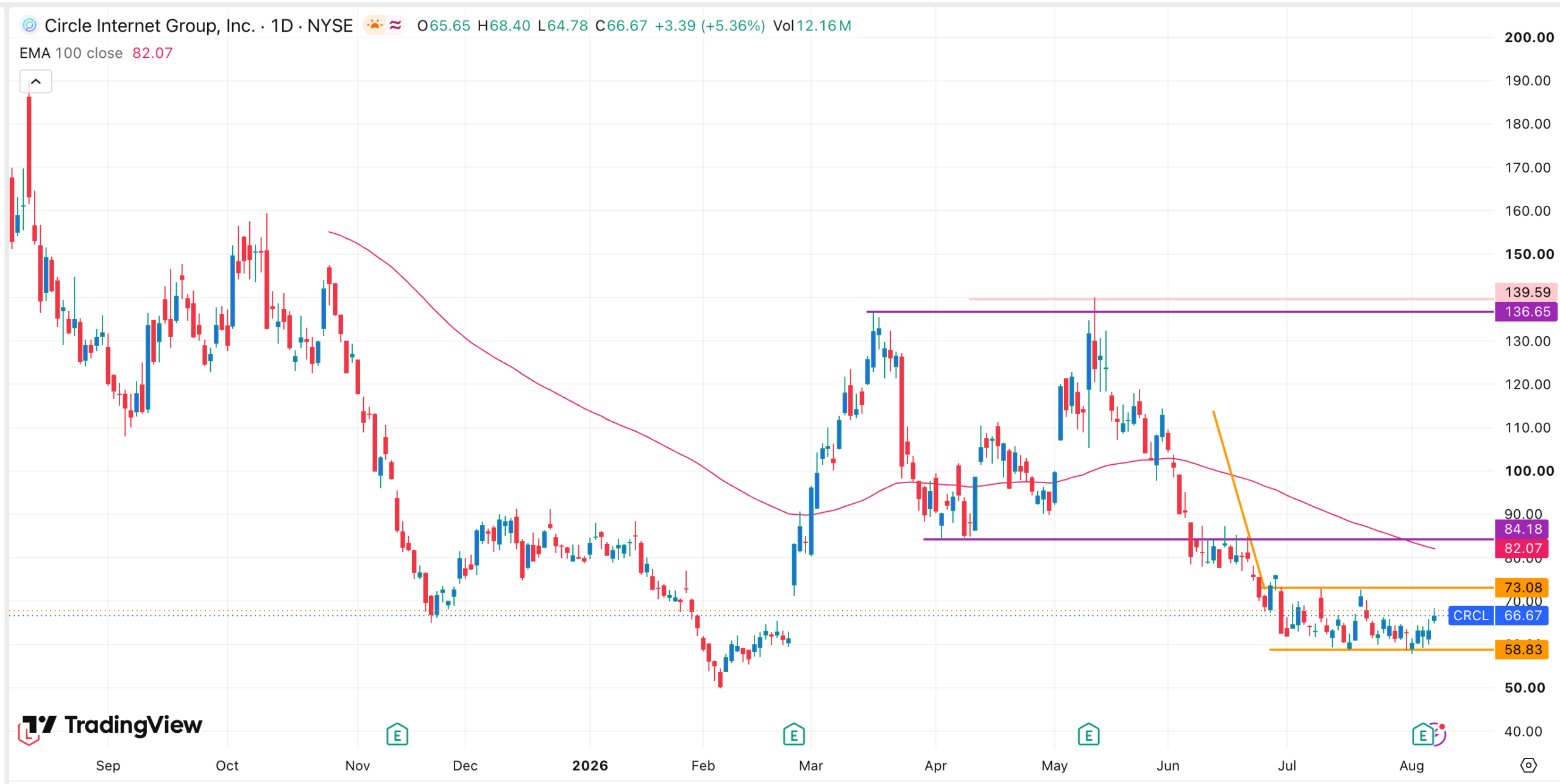
Circle stock has moved sideways over the past two months. The shares rose modestly after last week's earnings release, but they remain trapped in a narrow trading range. At $66.67, the stock is still far below its all-time high of $300. This report examines what may come next as signs emerge that Circle's revenue growth is decelerating.
Circle Faces Pressure as Revenue Growth Slows
Circle Internet Group released its results last week, showing that revenue growth is slowing. The slowdown is notable because Circle is the second-largest company in the stablecoin industry after Tether, whose USDT supply exceeds $170 billion — more than double USDC's circulating supply. The competitive gap underscores the stakes for Circle as it works to maintain momentum in a sector still widely viewed as having long-term growth potential, particularly after the passage of U.S. stablecoin legislation in 2025 established a federal regulatory framework for issuers.
The company said revenue increased by just 7% in the second quarter to $701 million. Excluding the distribution costs it pays to companies such as Coinbase, Circle generated $289 million. Net income for the quarter was $48 million.
There are indications that the slowdown could continue in the coming months. Circle's business model makes its growth relatively easy to track. The company issues stablecoins that users can hold and invests the backing assets in short-term government bonds, earning the spread between those yields and what it pays to distribution partners. That model tends to benefit when interest rates and stablecoin balances are both strong.
Circle said USDC in circulation stood at $73 billion at the end of the quarter. CoinMarketCap data shows that the figure has since fallen to $72 billion, down from nearly $80 billion earlier this year. Although Circle also offers other assets such as EURC, USDC remains its most important product.
US Bond Yields Have Eased
US bond yields have also pulled back this month. The two-year yield has fallen to 4.22% from its year-to-date high of 4.37%, while the one-year yield has declined to 4.02% from 4.14%. Technical indicators suggest a bearish divergence pattern, which can point to a reversal.
Yields moved lower after the US released July nonfarm payrolls data. The report showed that the economy lost 23,000 jobs, missing analyst expectations by a wide margin. The unemployment rate fell to 4.2%, which can indicate that more people have stopped actively looking for work.
There is also a possibility that the upcoming US consumer inflation report will show a decline in prices in July. If that happens, it could reduce the odds of the Federal Reserve raising interest rates later this year.
Circle stock also reacted to the planned launch of Arc, its Layer 1 network, which is scheduled for September. Management said the project has already secured more than 100 partners, including Mastercard, Galaxy Digital, SBI Group, and Visa. Circle said the testnet has processed more than 502 million transactions and accumulated 2.8 million wallets.
The company is positioning Arc as a leading chain for stablecoin payments, with the goal of competing with networks such as Ethereum and Tron. The push into infrastructure reflects a broader industry trend in which stablecoin issuers and payment firms are building dedicated chains to capture transaction fees and on-chain settlement volume. Even so, history suggests it is difficult to establish traction in the Layer 1 and Layer 2 markets. Networks such as Kraken's Ink and Uniswap's Unichain have not gained significant market share.
Circle Internet Stock Price Technical Analysis
On the daily chart, CRCL has remained range-bound over the past few months. Since June, the stock has traded between $58 and $73, and the consolidation appears to be forming a bearish flag pattern.
The shares have not broken below the 50-day and 100-day moving averages, indicating that buyers have not yet lost control completely. Even so, the technical setup suggests a bearish breakout may occur in the near term. If that happens, the next key level to watch is $50.
That technical backdrop helps explain why analysts have been cutting their CRCL forecasts.

