Circle Stock Outlook: Revenue Growth Slows as USDC Circulation Falls to $70 Billion
Key Takeaways
- •Circle's third-quarter revenue grew 17% year over year to $865 million, and profit rose 5% to $226 million despite expenses reaching $245 million.
- •USDC in circulation has declined to $70.6 billion from its year-to-date high of $80 billion, falling below the third-quarter average of $73 billion.
- •The three-month Treasury yield has dropped to 4.12% from its year-to-date high of 4.281%, reducing the interest income Circle earns on reserves backing USDC.
- •Circle plans to generate revenue from its Arc blockchain through staking rewards, token sales, and ecosystem incentives while holding 2.5 billion ARC tokens, equal to 25% of total supply.
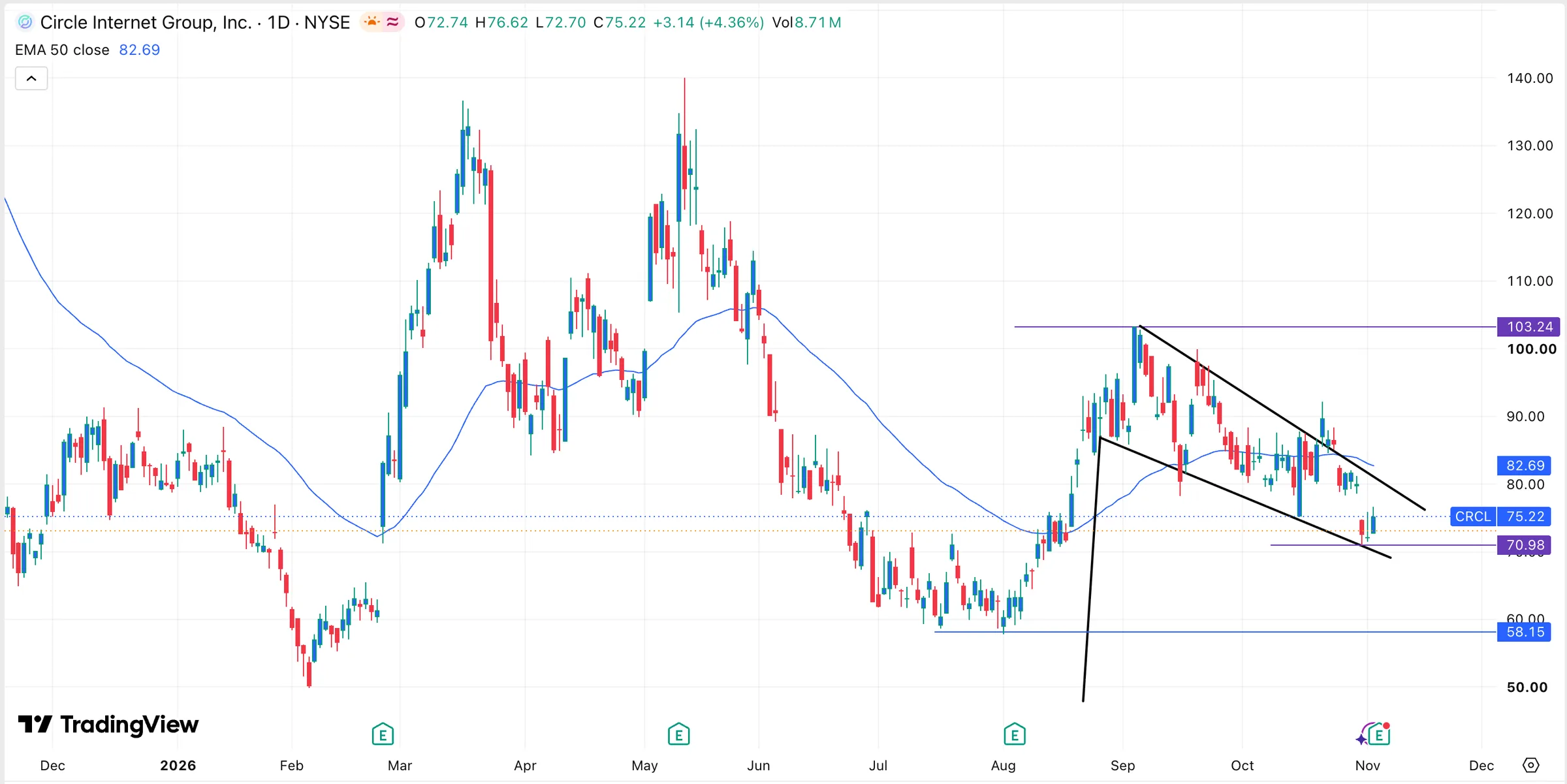
- •CRCL shares have fallen from $103.25 on September 3 to roughly $73, trading below the 50-day EMA in a descending channel that forms part of a bullish flag pattern with a potential breakout target of $82.70.
Circle Posts Modest Growth Amid Crypto Winter
Shares of Circle Internet Group (CRCL), the issuer of the USDC stablecoin, wavered but traded fairly unchanged after the company published third-quarter financial results showing that revenue growth continued to moderate amid the crypto winter — the industry's shorthand for a prolonged stretch of falling crypto-asset prices and subdued on-chain activity.
Revenue rose 17% year over year to $865 million, helped by an 8% increase in USDC in circulation. Profit climbed 5% to $226 million, while nine-month revenue rose to $2.26 billion. The improvement in profitability came even as expenses rose to $245 million.
Growth Tied to USDC Momentum and Arc
Circle expects its revenue growth to continue, driven by growing USDC momentum and by Arc, the blockchain network it launched a few months ago. The company expects to make money from Arc through staking rewards, token sales, and ecosystem incentives. It also plans to generate income by holding 2.5 billion ARC tokens, which is 25% of the total supply.
Circle believes its annual revenue in the "other segment" will be between $310 million and $330 million, with an RLDC margin — revenue less distribution costs, the payments made to the partners that help distribute the stablecoin — of between 41.7% and 43.7%.
USDC in Circulation Drops to $70.6 Billion
Despite the optimistic outlook, Circle faces major challenges ahead. One is that USDC growth has stagnated in recent months. The company's earnings depend on both the size of USDC's circulation and the yields it earns on the reserves backing the token.
Data compiled by CoinMarketCap shows that USDC in circulation has dropped to $70.6 billion from the year-to-date high of $80 billion. That level is also much lower than the third-quarter average of $73 billion.
The amount of USDC in circulation is important because of Circle's business model, which involves issuing the stablecoin and then making money by investing in government bonds. As a result, its revenue is usually affected whenever USDC in circulation drops. In most cases, circulation depends on prevailing market conditions, rising during crypto market rallies and falling during crypto winters. There are signs that the recovery seen a few months ago has stalled, with Bitcoin falling into a correction — conventionally, a decline of 10% or more from a recent peak.
Another potential challenge is that US bond yields have started falling. The benchmark three-month Treasury yield has dropped to 4.12% from its year-to-date high of 4.281%. Lower yields reduce the interest income Circle earns on the reserves backing USDC, and the combination of lower bond yields and falling USDC in circulation means its revenue growth will be under pressure.
Most importantly, the Arc blockchain faces challenges as competition in the industry intensifies. Data from DeFi Llama shows that the total value locked (TVL) on the network — a key measure of on-chain activity — has dropped modestly in the past few weeks.
Taken together, softer stablecoin supply, lower bond yields, and rising competition in the blockchain sector form the main obstacles facing the company. For readers tracking the setup, the most direct signposts from here are routine data points: USDC circulation readings, the path of short-term Treasury yields, and Arc's TVL on DeFi Llama.
BitMine Under Pressure
Elsewhere among crypto-linked stocks, BitMine's stock remained under pressure as Ethereum ETF withdrawals — a flow metric often tracked as a gauge of institutional demand for ETH — continued and ETH traded near $2,300. BMNR closed at $22.05 on Oct. 28, down substantially from its reported September peak. The decline increased attention on BitMine's cryptocurrency treasury and staking revenue, while technical indicators raised the possibility of another retreat toward $20.
CRCL Technical Analysis
The daily chart shows that CRCL has retreated in recent months, falling from a high of $103.25 on September 3 to the current price of about $73. The stock has formed a descending channel — a pattern of progressively lower highs and lower lows bounded by parallel trendlines — and moved below the 50-day Exponential Moving Average (EMA), a widely followed trend indicator. Trading below that average is a sign that bearish momentum continues.
On the positive side, the channel is part of a bullish flag pattern, which normally leads to a strong breakout. If that happens, the next important level to watch will be at $82.70. This view will be confirmed if the price moves above the upper side of the descending channel.
This article originally appeared on The Market Periodical.

