Circle Receives Limited-Purpose Trust Charter From NYDFS
Key Takeaways
- •Circle was granted a limited-purpose trust charter by the New York Department of Financial Services, formalizing its oversight under the state's financial supervision framework.
- •The NYDFS charter complements Circle's federal regulatory achievements, including final approval from the OCC to establish a national trust bank.
- •Circle issues USDC, one of the largest dollar-pegged stablecoins by market capitalization, competing primarily against Tether's USDT in a growing institutional market.
- •The trust charter enhances Circle's compliance perception among institutional partners and aligns with its reported plans to become a publicly listed company.
- •The approval arrives as U.S. federal lawmakers continue debating comprehensive stablecoin legislation, creating uncertainty about how new national rules will interact with existing state-level charters.
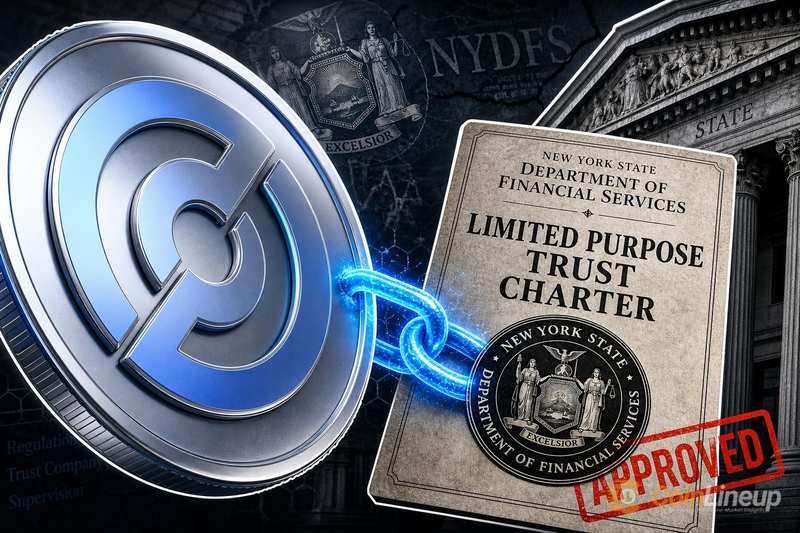
Circle has been granted a limited-purpose trust charter by the New York Department of Financial Services (NYDFS), adding a state-level regulatory approval that strengthens the stablecoin issuer's compliance standing within the United States.
A limited-purpose trust charter is an authorization issued by a state banking regulator that permits a company to operate as a trust entity for a defined scope of activities, rather than as a full commercial bank. For a cryptocurrency firm such as Circle, the charter formalizes the company's oversight under the state's financial supervision framework.
The NYDFS supervises virtual currency businesses through a dedicated licensing regime, as detailed on its virtual currency businesses program page. This regime is among the most established state-level frameworks for digital asset firms operating in the U.S.
Circle is the issuer of USDC, one of the largest dollar-pegged stablecoins by market capitalization. USDC competes in a market long dominated by Tether's USDT, and Circle's regulatory positioning has been a key differentiator as institutional adoption of stablecoins grows across payments, settlement, and treasury management use cases.
Significance of a NYDFS Trust Charter
The charter originates from a state financial regulator rather than a private industry body, which is the primary reason the approval carries weight. NYDFS approvals are closely monitored in the cryptocurrency sector because the department applies bank-level scrutiny to capital requirements, custody standards, and consumer protection.
A trust charter can enhance how counterparties and institutional partners perceive a company's compliance posture, since it signals a regulated operating structure subject to ongoing examination. That perception, however, is distinct from actual market adoption, which depends on demand and liquidity rather than licensing alone. Regulatory standing is one factor among several that institutional users consider when evaluating stablecoin issuers.
Context Within Circle's Broader Licensing Strategy
Circle has separately pursued federal banking recognition, having applied for a national trust charter with the Office of the Comptroller of the Currency (OCC). A state trust charter runs alongside that federal track as part of the company's wider licensing strategy.
The company subsequently announced it had received final OCC approval to establish a national trust bank, reflecting a multi-layered approach to regulatory recognition across both state and federal levels. The NYDFS charter fits this pattern of accumulating approvals rather than depending on a single authorization.
For Circle, the development supports its institutional positioning by demonstrating supervision under a recognized state regulator. This multi-layered regulatory strategy also aligns with Circle's reported plans to become a publicly listed company, where demonstrable regulatory compliance across jurisdictions is a factor investors and underwriters evaluate. Circle has also been broadening its infrastructure footprint, including a move to acquire nearly 1,000 IBM blockchain patents.
Within the wider U.S. landscape, where enterprise adoption of dollar-pegged tokens is an increasing focus, the charter may signal continued momentum toward regulated stablecoin operations. The approval also arrives as federal lawmakers continue debating comprehensive stablecoin legislation, which could establish a national framework for issuers. How such legislation would interact with existing state-level charters like Circle's NYDFS authorization remains an open question for the industry. Any broader impact will depend on how the approval translates into adoption over time.
Disclaimer: This article is for informational purposes only and does not constitute financial or investment advice. Cryptocurrency and digital asset markets carry significant risk. Always conduct your own research before making decisions.

