Circle Launches Arc Public Mainnet as CRCL Stock Drops 11% Before Debut
Key Takeaways
- •Circle opened Arc's public mainnet on Sept. 16, with more than 190 institutional and ecosystem builders participating at launch.
- •The blockchain uses USD Coin as its native gas asset and supports Ethereum Virtual Machine applications with deterministic sub-second finality.
- •Circle's stock fell 11.41% to $86.30 on Sept. 15, a decline that occurred before the network's public debut.
- •Arc initially relies on a selected cohort of institutional validators, including BlackRock, DTCC, Galaxy, Mastercard, Standard Chartered, and Visa, rather than a permissionless system.
- •USDC circulation reached $73.3 billion at the end of the second quarter, while onchain transaction volume hit $14.8 trillion, up 151% year over year.
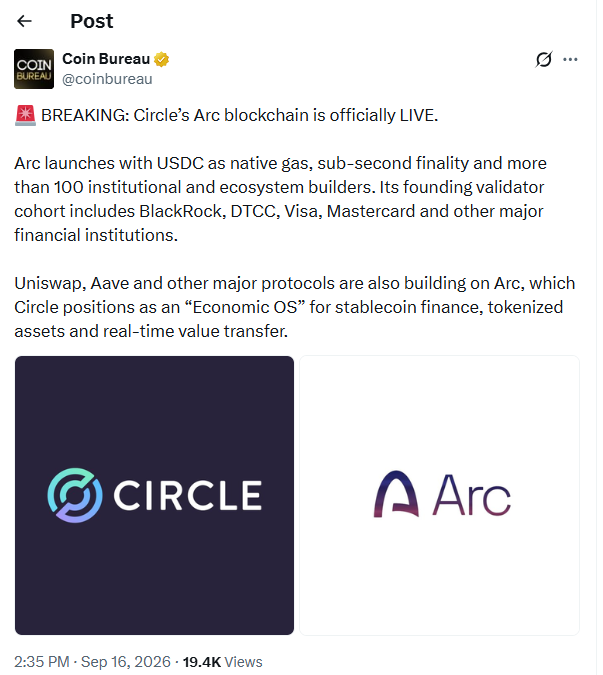
Circle launched the public mainnet of its Arc blockchain on Sept. 16, opening the network to developers and financial institutions. The chain uses USD Coin (USDC) as its native gas asset and targets payments, tokenized assets, foreign exchange, and settlement. The launch makes Circle both a stablecoin issuer and a blockchain operator, tying the network directly to the asset that pays its transaction fees. The debut followed an 11.4% drop in Circle (CRCL) stock during's session, placing the product launch against a weaker market backdrop for the company's shares.
Yahoo Finance data showed Circle shares closed Sept. 15 at $86.30, down from a previous close of $97.42. Because the decline occurred before Arc opened publicly, the launch did not cause Tuesday's selloff.
Arc Mainnet Opens After Private Network Phase
According to a post from Arc's official X account, the mainnet launched with more than 190 institutional and ecosystem builders. The network supports Ethereum Virtual Machine applications and uses USD Coin as its native gas asset. Arc also advertises deterministic sub-second finality for transaction settlement. Deterministic finality describes transactions that become final and irreversible at confirmation, rather than gaining finality probabilistically over time.
Arc's August launch schedule said the network had operated privately with more than 100 ecosystem and institutional builders. The official Arc website said the public mainnet would support financial markets and real-time money movement, and it listed stablecoin payments, foreign exchange, tokenized assets, and automated economic activity among planned uses.
Circle previously named BlackRock, DTCC, Galaxy, Mastercard, Standard Chartered, and Visa among Arc's founding validators. Its Aug. 5 announcement also listed Global Payments, ICE, MoneyGram, SBI Group, and Sumitomo Corporation. Circle said participating institutions would help operate and secure the network.
That structure differs from the permissionless validator systems used by several public blockchains. Arc initially relies on a selected institutional validator cohort while Circle develops broader network governance, giving the company closer operational coordination during the chain's early mainnet phase.
CRCL Stock Entered Launch After 11% Decline
Yahoo Finance data showed Circle stock fell $11.12 on Sept. 15, closing 11.41% lower at $86.30. CRCL traded between $84.80 and $93.28 during the session, and the previous close stood at $97.42.
Trading activity also rose during the decline. FinanceCharts recorded roughly 22.4 million shares traded on Sept. 15, compared with 17 million the previous session, showing increased activity around CRCL stock before the Arc launch.
The price move followed recent analyst revisions. Google Finance data showed Goldman Sachs analyst James Yaro maintained a $92 price target in September. Clear Street analyst Owen Lau maintained a $107 target, while KBW started coverage with a $105 target. Those estimates reflected different views on Circle's valuation rather than Arc's first-day network activity. The launch therefore created a fresh operating metric for investors to track beyond analyst targets.
Circle Builds Arc Around USDC Economics
Circle's second-quarter results showed USD Coin circulation reached $73.3 billion at quarter-end, up 19% from the same period last year. USDC onchain transaction volume reached $14.8 trillion during the quarter, a 151% increase year over year. Those figures explain Arc's direct connection to Circle's existing stablecoin business.
The blockchain uses USDC for transaction fees instead of introducing a separate volatile gas asset, and Circle designed fees in dollar terms through USDC, making transaction costs easier to measure. Arc also supports Ethereum-compatible smart contracts, reducing migration work for applications built around Ethereum tooling.
Circle designed Arc to connect with its payments, cross-chain, wallet, and stablecoin infrastructure. The network connects with Circle's Cross-Chain Transfer Protocol and Gateway infrastructure. Those integrations place Arc inside Circle's existing product stack rather than as a separate business line, a structure that could allow the company to connect blockchain activity directly with its stablecoin services.
The company reported $701 million in second-quarter revenue and reserve income, the latter earned on the reserves backing USDC in circulation. Net income from continuing operations reached $48 million, while adjusted EBITDA totaled $143 million.
Arc could broaden how Circle distributes USDC across payments and tokenized financial applications. However, network participation does not automatically translate into transaction volume or company revenue. Adoption data after launch will show how much institutional interest converts into active usage.
Arc Usage Data Is the Next Test
The next measurable test will come from Arc's post-launch activity. Transaction counts, stablecoin balances, application deployments, and validator performance will provide clearer evidence of usage.
Circle also expects DTCC-related tokenization work on Arc to begin during the second half of 2027, while BlackRock is expected to deploy its BUIDL tokenized fund on the network. Those integrations offer longer-term milestones beyond Arc's launch-day builder count.
Source: The Market Periodical

