Circle Removes USDC and EURC Redemption Overage Fees Effective Oct. 19
Key Takeaways
- •Circle will eliminate redemption overage fees for both USDC and EURC starting October 19, removing the extra charge previously applied when redemptions exceeded a set threshold.
- •The fee removal covers only the issuer-set overage portion, as banking transfer fees, network gas fees, and third-party platform charges remain unaffected.
- •The change delivers the greatest cost reduction to frequent, high-volume redeemers, particularly businesses that convert incoming stablecoin payments back into fiat.
- •Circle's H1 financials showed $819 million in distribution and transaction costs, underscoring how redemption economics affect both the issuer and its users.
- •The fee elimination does not apply retroactively and aligns with Circle's infrastructure expansion, including the Arc mainnet launch with USDC gas fees.
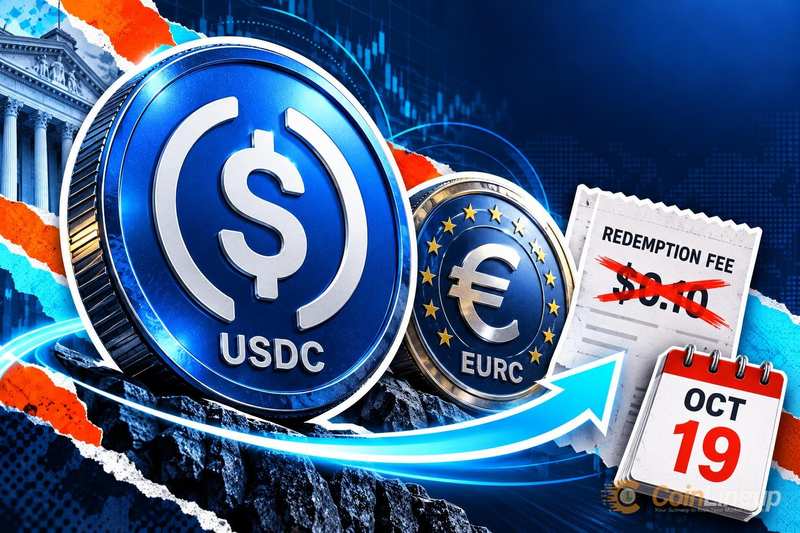
Circle, the issuer of the USDC and EURC stablecoins, is eliminating redemption overage fees for both tokens starting October 19. Eligible users who cash out USDC or EURC through Circle's platform will no longer be charged the additional fee that previously applied when redemptions exceeded a set threshold.
The move was reported by CryptoSlate, which noted that Circle is dropping the extra cash-out fees effective October 19. Overage fees are charges applied when a user's redemption activity exceeds a defined limit during a billing period, similar to the fees some bank accounts impose when a transaction limit is surpassed. Because redemption is the mechanism that connects a fiat-backed stablecoin to its reference currency, the terms attached to it — including fees — are a core part of how these tokens function for users.
What the fee removal covers
The fees being removed are redemption overage fees tied to USDC (USD Coin, a dollar-backed stablecoin) and EURC (a euro-backed stablecoin), both issued and managed by Circle.
The change is narrower than it may first appear. Circle is removing only the overage portion of redemption fees, not all costs associated with redeeming stablecoins. Banking transfer fees, network gas fees, and charges set by third-party platforms remain separate and are unaffected. Issuer-set redemption fees are the one component Circle controls directly, which is why this change lowers costs for users while bank and third-party charges remain in place. Users should review their applicable redemption terms to understand which charges, if any, will still apply after October 19.
The adjustment aligns with Circle's recent infrastructure expansion. The company launched the Arc mainnet with USDC gas fees as part of a broader push to embed USDC more deeply into on-chain activity, and reducing redemption friction fits that same direction.
What it means for USDC and EURC holders
For holders who redeem through Circle on or after October 19, the overage fee that previously applied to high-volume redemptions will no longer be charged — a direct cost reduction for users who regularly redeem large amounts. Because overage charges scaled with redemption volume, the removal is most consequential for frequent, high-value conversions — the kind of recurring activity involved when businesses convert incoming stablecoin payments back into fiat.
The change applies equally to both tokens. USDC, which is dollar-denominated, is among the most widely used stablecoins globally. EURC is its euro-denominated counterpart, designed for users transacting in European currency.
Fee structures around redemptions are also material to Circle's own business. The company's H1 financials showed $819 million in distribution and transaction costs, underscoring how redemption economics affect both the issuer and its users.
Businesses and developers building payment tools on Circle's infrastructure may benefit as well. SAP Pay recently addedDC payment support via Circle, an example of how enterprise integrations rely on predictable, low-cost redemption processes. In related coverage, Visa launched 24/7 USDC funding for cross-border payments.
Before you redeem
Users planning a redemption after October 19 should confirm three things. First, the redemption date must fall on or after October 19, as the fee removal does not apply retroactively. Second, the asset being redeemed must be USDC or EURC specifically; other assets are not covered by this change. Third, users should review the current redemption terms in their Circle account or through the platform they use to access Circle's services, since fees set by banks or third parties remain in effect.
Those who access USDC liquidity through lending platforms should also note that borrowing costs are separate from redemption fees. OKX recently launched flexible USDC loans in Europe, which operate under a different fee structure than direct Circle redemptions.
For readers new to stablecoins, redemption means converting a stablecoin back into traditional currency, such as dollars or euros, through an issuer like Circle. The overage fee was an extra charge applied to such conversions above a set volume. As of October 19, that extra charge no longer applies to USDC and EURC redemptions through Circle.
Disclaimer: This article is for informational purposes only and does not constitute financial or investment advice. Cryptocurrency and digital asset markets carry significant risk. Readers should conduct their own research before making decisions.

