Renewed Circle-Coinbase Agreement Opens Two Paths to Challenge USDC Payouts
Key Takeaways
- •Circle and Coinbase renewed a commercial agreement, filed as an exhibit with the SEC after Circle's June 2025 New York Stock Exchange listing, that restructures how the companies govern USDC.
- •Circle holds two routes to press for payout changes: a contractual path based on the agreement's defined revenue-allocation terms and a commercial path through renegotiation, neither of which allows immediate unilateral action.
- •USDC is the second-largest stablecoin by market capitalization, and its reserves are held largely in cash and short-dated U.S. Treasury instruments, so interest-rate levels anchor the size of the payout pool the two companies divide.
- •Any payout change is expected to be slow because contract terms bind both parties for defined periods and a renegotiation would require Coinbase's consent, with Coinbase's stablecoin-linked economics visible in its second-quarter 2026 results.
- •The GENIUS Act, signed into law in July 2025 as the first U.S. federal framework for payment stablecoins, along with any future disclosed amendments or renegotiation signals, are key factors that could influence how the payout terms are applied.
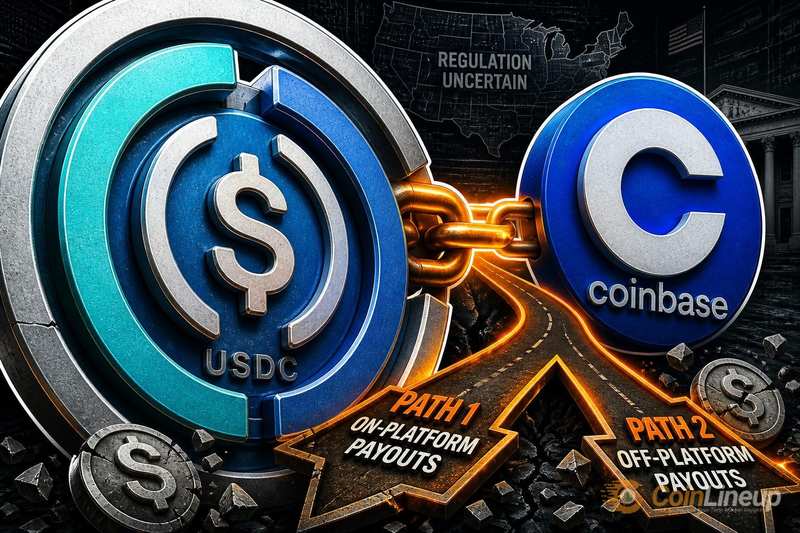
A renewed commercial agreement between Circle and Coinbase, filed with the U.S. Securities and Exchange Commission, restructures how the two companies govern USD Coin (USDC). The arrangement gives Circle more than one avenue to press for changes to how USDC-related payouts are shared, but any practical shift remains bound by contract terms and negotiation rather than immediate execution.
What the renewed deal changes for USDC economics
The updated agreement between the two companies is documented as an exhibit in Circle's SEC filing, which serves as the primary record for the terms discussed here. The filing exists in that form because Circle listed its shares on the New York Stock Exchange in June 2025, bringing material commercial contracts into the disclosure regime that applies to public companies.
Circle is the issuer of USDC, while Coinbase has long acted as a core distribution partner sharing in the economics generated by the token's reserves. The partnership dates to 2018, when Coinbase co-founded the Centre Consortium with Circle to govern USDC. That consortium was dissolved in 2023, Circle became the token's sole issuer, and Coinbase took an equity stake in Circle while continuing to share in reserve-linked revenue on USDC held on its platform — the arrangement the renewed agreement now updates. For USDC, the significance of the renewal is that the relationship is contractual rather than purely a matter of branding or distribution. That distinction matters because payout leverage flows from the specific rights written into the agreement, not from marketing alignment.
For businesses weighing settlement options, the underlying question of which stablecoin to use for payments is shaped in part by how issuers and their distribution partners divide the economics. USDC is the second-largest stablecoin by market capitalization, behind Tether's USDT, so the terms governing its reserve income rank among the most consequential payout arrangements in the digital asset sector.
The two ways Circle can challenge USDC payouts
The framing of two separate routes rests on the distinction between a contractual, governance-based path on one side and a commercial, negotiation-based path on the other. Both are grounded in the agreement filed with the SEC rather than in outside commentary.
The first route is contractual: the terms of the renewed agreement define how revenue tied to USDC reserves is allocated between the parties, and changes to those defined terms would run through the agreement itself.
The second route is commercial leverage, exercised through renegotiation or future amendments. This path depends on the willingness of both parties rather than conferring a unilateral right. Each route could alter USDC payout flows, but each also carries dependencies that limit how quickly it can be used.
Because so much of stablecoin economics is tied to reserve income, the broader debate over stablecoin yield and Treasury rates is directly relevant to what is actually being divided in these payouts. Circle's regularly published attestation reports have shown USDC reserves held largely in cash and short-dated U.S. Treasury instruments, which is why interest-rate levels anchor the size of the pool the two companies divide.
Why Circle is unlikely to change USDC payouts quickly
There are at least two concrete reasons any change would be slow. First, contractual terms bind both sides for defined periods, so leverage on paper does not convert into a payout change until those terms allow it.
Second, a commercial renegotiation requires agreement from Coinbase, whose stablecoin-linked economics were a visible part of its second-quarter 2026 results. That gives the exchange reason to resist changes that would reduce its share.
The gap between theoretical leverage and immediate financial impact is the core of the story: having a route to challenge payouts is not the same as producing a different quarterly cash split.
Both companies remain sensitive to the policy backdrop, having moved on revised stablecoin legislation, and the shape of federal stablecoin rules could influence how the payout terms are ultimately applied. The GENIUS Act, signed into law in July 2025, established the first federal regulatory framework for payment stablecoins in the United States, and the timeline around its final implementing rules is a related thread for anyone tracking the issue.
What to watch next is whether either company discloses an amendment to the agreement, or signals a renegotiation, in a future filing or earnings update. Until then, the two challenge paths remain potential rather than active, and the current payout structure stays in place.
Disclaimer: This article is for informational purposes only and does not constitute financial or investment advice. Cryptocurrency and digital asset markets carry significant risk. Always do your own research before making decisions.

