What Is the Arc Blockchain? How Circle Is Building a Native USDC Settlement Rail
Key Takeaways
- •Arc is Circle's stablecoin-native Layer-1 blockchain designed for USDC-based settlement, with network fees denominated in USDC and sub-second deterministic finality, and its public mainnet is scheduled for September 16, 2026.
- •edgeX plans to launch on the Arc mainnet on day one, offering on-chain FX perpetuals starting with JPY plus more than 150 perpetual markets across US equities, commodities, and crypto, all using native USDC as margin and settlement currency.
- •Circle went public on the NYSE under ticker CRCL in June 2025, and the U.S. GENIUS Act signed in July 2025 established a federal regulatory framework for payment stablecoin issuers, prompting institutions to treat stablecoin infrastructure as a build-or-buy decision.
- •No ARC token or ARC airdrop has been confirmed in official sources, and investors should treat related claims as speculation.
- •Arc's success will depend on sustained post-launch activity such as settlement volume, validator performance, integration depth, and FX liquidity rather than launch-day announcements.
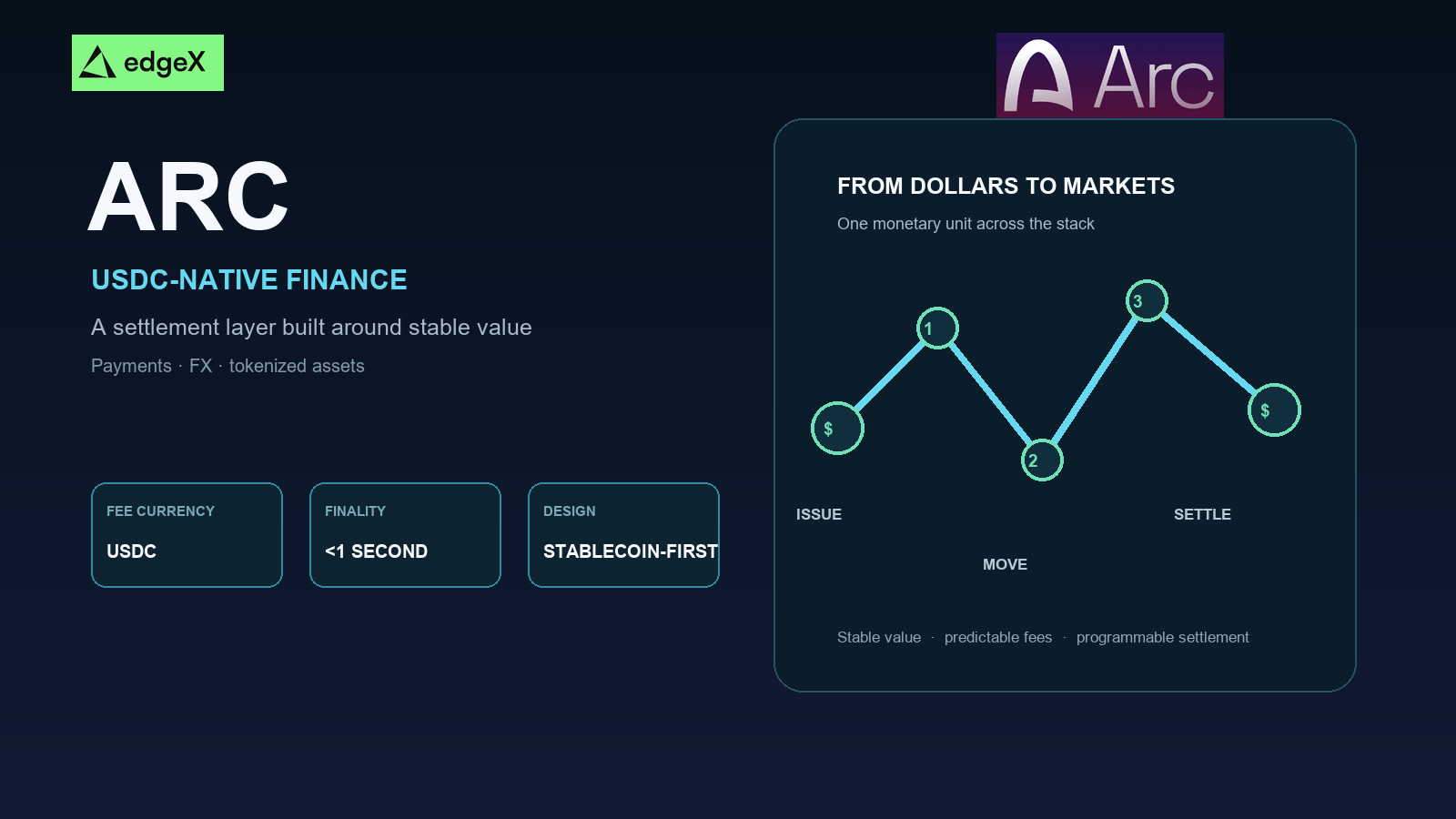
Arc is Circle's attempt to place stablecoin finance on infrastructure designed around USDC from the very beginning. USDC already spans multiple major blockchains, but liquidity, fees, cross-chain bridges, wallet support, and compliance remain fragmented. Arc's proposition is this: digital dollar settlement should not be grafted onto infrastructure built for other purposes.
Information is as of September 3, 2026. The Arc public mainnet is scheduled to go live on September 16, 2026; readers should verify launch status and product availability through official Arc, Circle, and edgeX channels.
Quick answer
The Arc blockchain is Circle's stablecoin-native Layer 1 for USDC-based settlement, payments, tokenized assets, and on-chain markets. According to official Arc materials, its design emphasizes fees denominated in USDC and deterministic finality in under one second. The core idea is to provide a purpose-built environment for stablecoin finance rather than relying solely on third-party networks.
The big bet behind Circle's new blockchain
Arc matters because stablecoins are becoming financial infrastructure, not just exchange balances. They now underpin payments, treasury operations, remittances, collateral, tokenized markets, and trade settlement. At this stage, fees, finality, liquidity, compliance, and integration quality all become part of the product.
Why Circle wants its own settlement environment
USDC's strength has always been distribution. It reaches users across multiple ecosystems rather than forcing activity onto a single chain. That breadth benefits exchanges, wallets, developers, and traders, but it also creates operational fragmentation. A business might hold USDC on one network, owe counterparty funds on another, and need a separate gas token to move money.
Circle has partially addressed this with the Cross-Chain Transfer Protocol, which supports native transfers of USDC between compatible chains. Arc extends that logic by making USDC the operating asset of its own network.
Arc should therefore not be viewed primarily as a Layer-1 token story. The question is whether a USDC-native settlement layer makes stablecoin activity easier to build, reconcile, and integrate.
What stablecoin-native design changes
Most general-purpose chains were not built around dollar settlement. Their native assets typically pay for gas, staking, governance, validator incentives, and speculation. That model can support a broad crypto ecosystem, but it creates friction for businesses that think in dollars and want costs that map cleanly to the financial system.
Arc's official materials state that fees are denominated in USDC. If actual network conditions support this design, users can hold, transfer, settle, and pay network costs in the same dollar-denominated instrument. A payments company would no longer need to explain why a USDC transfer requires a volatile gas asset. Treasury departments would not need to manage unrelated network tokens just to move cash-like balances.
This does not mean Arc is superior to Ethereum, Solana, Base, or other networks that support USDC. It simply defines Arc's positioning: infrastructure built around stablecoin-intensive workflows.
What Circle has confirmed
New blockchain launches often attract speculation before infrastructure arrives: a name becomes a token symbol, a testnet becomes an airdrop, a roadmap becomes a trading schedule. Arc's confirmed facts remain meaningful without relying on those assumptions.
Circle and Arc have confirmed the core positioning: Arc is a stablecoin-native Layer-1 blockchain closely tied to Circle infrastructure and built around USDC-denominated fees. According to the official Arc mainnet announcement, the Arc public mainnet is scheduled to go live on September 16, 2026. Circle has also announced a public testnet and a founding validator lineup ahead of launch.
| Claim | Status | What investors can rely on | What still needs confirmation |
|---|---|---|---|
| Arc is a stablecoin-native Layer-1 blockchain | Confirmed by official Arc materials | Arc is positioned for stablecoins, tokenized assets, economic contracts, and on-chain markets | Post-mainnet production performance and adoption |
| Arc fees are denominated in USDC | Confirmed by official Arc materials | USDC is central to the network fee experience | Specific fee mechanics under actual mainnet operation |
| Arc public mainnet timing | Officially scheduled | Arc mainnet is planned for September 16, 2026 | Whether timing, features, and availability change before launch |
| Arc integrates with Circle infrastructure | Confirmed as positioning | Integrations mentioned in Arc materials include USDC, CCTP, Gateway, on/off-ramps, and developer services | Availability, scope, supported jurisdictions, and actual integration depth |
| An ARC token exists | Not confirmed in the provided set of official sources | Investors should not assume a tradable ARC token exists | Any official token model, ticker, supply, or issuance plan |
| An ARC airdrop | Not confirmed in the provided set of official sources | Airdrop claims should be treated as speculation | Official eligibility criteria, snapshots, claim portals, or event announcements |
Circle's founding validator announcements provide a second layer of evidence: institutions and infrastructure providers are preparing to participate in the network. That matters for operational credibility, but announced participation is not proven resilience. After launch, investors should examine validator performance, concentration, application uptime, and whether integrations move from technical readiness to sustained settlement activity.
These facts make Arc strategically significant, but they do not validate token claims, unofficial launches, eligibility sites, or social posts implying airdrops.
Why Arc is built around USDC
"Stablecoin-native" means Arc is more than a smart contract platform that happens to support stablecoins. Its design places stable-value activity at the center of the network's economic logic, including payments, tokenized assets, economic contracts, FX-related workflows, and on-chain markets.
USDC as the fee asset and unit of settlement
According to the official Arc website, USDC is Arc's fee-denomination asset. If users can settle value and pay network costs in the same dollar-denominated instrument, the experience becomes closer to financial software than the typical crypto gas model.
Circle's USDC page describes USDC as redeemable 1:1 for US dollars and backed by highly liquid cash and cash-equivalent assets. That reserve-and-redemption message is central to its institutional narrative. Arc can draw credibility from USDC's role as a widely used digital dollar, but it does not automatically inherit its adoption. Trust in an asset and demand for a network are related but not identical.
The real test will be economic. Actual costs will still depend on validator economics, demand, congestion, application design, and infrastructure quality.
Why finality and reconciliation matter
Arc's official materials emphasize deterministic finality in under one second. To retail users, that sounds like speed. To institutions, it is also a workflow claim. Settlement times affect liquidity management, counterparty exposure, treasury operations, market making, and risk controls.
If a payment processor or trading desk can treat a transfer as final quickly, capital can be redeployed with less uncertainty. USDC-denominated costs can also simplify budgeting and reconciliation. These operational details often determine whether infrastructure moves from pilot to production.
A scope caveat applies. After mainnet launch, some features may still roll out in phases, be restricted, be jurisdiction-limited, or depend on external wallets, custodians, exchanges, market makers, and compliance providers. Readers should verify what is actually available on September 16, 2026, rather than assuming every roadmap item will be in place on day one.
What Arc might change for users and developers
Arc's strongest opportunity is not to host every possible crypto activity, but to become the preferred environment for applications where USDC settlement is the very reason the product exists. That includes payment flows, market collateral, treasury tools, remittance corridors, tokenized asset settlement, and trading venues that need dollar-denominated rails.
For developers, a USDC-native environment can present balances, fees, margin, collateral, and settlement in a single unit of account. Businesses gain clearer treasury control, pricing, compliance monitoring, and accounting treatment, while market operators may need to hold less inventory of unrelated gas tokens.
| Use case | Potential users | Why USDC matters | Adoption barriers |
|---|---|---|---|
| Cross-border B2B payments | Fintechs, payment processors, exporters | Dollar settlement can reduce correspondent banking friction | Local compliance, liquidity, banking connections |
| Treasury management | Corporates, crypto firms, trading desks | Stable-value transfers can simplify cash management | Internal controls, custody approvals, accounting treatment |
| On-chain derivatives margin | Exchanges, market makers, active traders | USDC collateral is easier to reason about than volatile margin | Liquidity depth, risk engines, regulatory restrictions |
| Tokenized asset settlement | Asset issuers, brokers, funds | A stable settlement asset supports delivery-versus-payment workflows | Legal structures, issuer adoption, secondary market liquidity |
| Remittance corridors | Wallets, neobanks, remittance platforms | A digital dollar can move across borders quickly | On/off-ramps, FX spreads, consumer protection rules |
Success looks different in each category. Payments need reliable on-ramps, low failure rates, and merchant integration. Treasury products need custody, controls, and audit trails. Derivatives need deep liquidity and strong risk engines. Tokenized assets need both technical settlement and enforceable legal structures. Arc's design can reduce common friction, but every market still has its own distribution and compliance barriers.
Settlement networks need real flows of money. edgeX plans to launch on day one, connecting Arc's thesis to markets that use native USDC as margin and settlement. Investors should still judge sustained usage by wallets, custodians, payment companies, liquidity providers, and trading venues.
The Arc FX engine and the cross-border payments angle
Foreign exchange is one of the areas where stablecoin infrastructure is most likely to matter. Cross-border payments typically involve multiple intermediaries, settlement delays, prefunded balances, liquidity buffers, and opaque FX spreads. Stablecoins alone cannot eliminate these constraints, but combined with reliable on/off-ramps, liquidity markets, and compliant operating models, they can compress parts of the workflow.
What on-chain FX could improve
The Arc FX engine fits directly into Circle's settlement thesis. USDC can serve as the dollar leg of transactions, while on-chain FX functionality can support conversion, hedging, or routing around stable-value flows. The bigger opportunity is composability: payments, FX, collateral, and tokenized assets can operate within a single settlement environment.
That could matter for fintechs, remittance platforms, trading venues, and treasury teams. Businesses could settle in USDC, convert exposures, and allocate liquidity through programmable workflows. Trading venues could use USDC as product margin while offering currency-linked contracts. Payment companies could route transactions based on available liquidity and cost.
If executed well, the result would be tighter coordination between settlement, market execution, and treasury management — not just faster transfers.
Why liquidity remains the hard part
FX is not won by infrastructure alone. It is a scale business shaped by execution quality, spreads, market maker participation, counterparty controls, jurisdictional rules, risk management, and banking connections. A blockchain can offer faster settlement and programmable workflows, but it cannot conjure deep liquidity by press release.
That is Arc's core FX risk. Users arrive only when prices, liquidity, compliance, and integrations support real workflows. edgeX's planned launch can test demand, but the real evidence will be sustained post-mainnet trading volume, spread quality, depth, and repeat participation.
edgeX joins Arc as a day-one partner
Markets have historically followed the money. Today the money is moving on-chain.
edgeX plans to launch on the Arc mainnet on September 16, 2026, bringing new FX perpetuals built on Arc's native FX engine, plus 150+ markets covering equities, commodities, and crypto. All markets will use native USDC as margin and settlement currency.
The launch builds on edgeX's long-standing collaboration with Circle. Circle Ventures is an investor in edgeX, and the two teams have worked together on native USDC issuance and CCTP integration on EDGE Chain. Arc is a natural next step for running edgeX's global 24/7 markets on a USDC-native settlement layer.
What launches on day one
- On-chain FX perpetuals, starting with JPY, built on the Arc native FX engine.
- 150+ perpetual markets covering US equities, commodities, and crypto, all margined and settled in native USDC.
What edgeX is exploring
- Adding more FX pairs prioritized by liquidity and demand.
- FX spot markets, starting with USDC against non-USD stablecoins.
- Using non-USD stablecoins as margin, so traders can hold, hedge, and trade without converting back to dollars.
Arc is designed as a 24/7 economic operating system for internet-native money, with gas paid in USDC, institutional-grade settlement, and a native FX engine. edgeX provides the market layer: an order-book exchange extending its 24/7 equities, commodities, and crypto markets at scale into FX.
Every trade on edgeX supports USDC's broader role as the settlement currency of internet-native finance, while giving USDC holders direct access to global markets.
Frequently asked questions
What is the Arc blockchain?
The Arc blockchain is a stablecoin-native Layer-1 network introduced by Circle, designed for USDC-based settlement, on-chain markets, tokenized assets, and financial applications. Official Arc materials describe it as infrastructure for stablecoins and real-world value transfer.
Is Arc Circle's blockchain?
Arc is a blockchain initiative introduced by Circle and closely tied to Circle's infrastructure, including USDC and related services. "Circle blockchain" is a common search term, but the official name is Arc.
How does Arc use USDC?
Arc uses USDC as its core settlement and fee-denomination asset. According to the official Arc website, network fees are denominated in USDC, which can simplify the user experience and corporate accounting compared with networks that require a separate volatile gas token.
What is the Arc FX engine?
The Arc FX engine refers to Arc's foreign exchange functionality for stablecoin- and currency-related settlement use cases. Investors should verify through official announcements from Arc, Circle, and partners which FX features are live, scheduled, or exclusive to specific partners.
When is the Arc mainnet expected to launch?
According to the official Arc mainnet announcement, the Arc mainnet is scheduled to launch on September 16, 2026. Readers should verify launch status through official channels, as roadmap timing and product availability may change.
Does Arc have a token?
No ARC token is confirmed in the provided set of official sources. Unless Circle or Arc confirms directly, investors should not assume a token, ticker, supply, price, exchange listing, or claim process exists.
Is there an ARC airdrop?
No official ARC airdrop is confirmed in the current set of sources. Users should avoid unverified claim sites, wallet-draining links, fake eligibility-check tools, and social posts implying airdrops absent official documentation.
Are Arc and ARC Chain the same thing?
"ARC Chain" is a search variant some users may use, but the official network name is Arc. Investors should take care not to confuse Arc with unrelated tokens, chains, or tickers using similar names.
Will Arc replace USDC on Ethereum or Solana?
Arc should not be understood as replacing USDC on all other networks. USDC is already used across many ecosystems. Arc's role is to provide a purpose-built stablecoin-native environment, particularly suited to payments, FX, and institutional settlement.
Why does Arc matter to investors?
Arc matters because it could deepen Circle's role in digital dollar infrastructure. If Arc attracts real settlement activity, it could strengthen USDC's utility and Circle's ecosystem position. If adoption is weak, Arc may remain strategically significant but commercially limited.
Investor summary
Arc is Circle's attempt to make USDC the core of a purpose-built settlement environment. Its thesis rests on dollar-denominated fees, sub-second deterministic finality per official materials, Circle infrastructure, and use cases spanning payments, FX, tokenized assets, and on-chain markets. Proof will come from sustained activity after launch.
As of September 3, 2026, Arc is scheduled but not yet validated at public mainnet scale. ARC token and airdrop claims remain unconfirmed, and product access, integrations, and FX liquidity require official verification.
Final conclusion
Arc's core thesis is simple: stablecoin finance may run better on rails designed for stablecoins. If Arc makes USDC settlement easier to use across payments, FX, tokenized assets, and institutional workflows, it could reinforce Circle's role in digital dollar infrastructure. If adoption and liquidity fail to follow, Arc will remain an important strategic experiment rather than a proven settlement layer.

