Christian Nationalists Declare MAGA Dead—and Outline Multi-Phase Plan to Replace It
Key Takeaways
- •More than 1,000 attendees gathered in Irving, Texas, for the three-day "Christ is King: America After Trump" conference organized by pastor and podcaster Joel Webbon.
- •Webbon declared that "phase one"—the shattering of Trump's Republican coalition—was complete, with subsequent phases aimed at recruiting donors, door-knockers, and phone banks to elect aligned candidates to governorships, the Senate, and the presidency.
- •Nick Fuentes, an avowed white nationalist who dined with Trump at Mar-a-Lago in 2022, appeared as a surprise speaker and likened the GOP's Election Day defeat to the death of Josef Stalin.
- •The movement's stated agenda includes deporting at least 50 million people, making the Apostles' Creed the preamble to the Constitution, and stripping women, Jews, Muslims, and Hindus of the right to vote or hold office.
- •Scholars tracking religious extremism say the faction has steadily gained influence, even though no elected officials appeared at the conference and mainstream Republicans such as Sen. Ted Cruz have warned against rising antisemitism on the right.
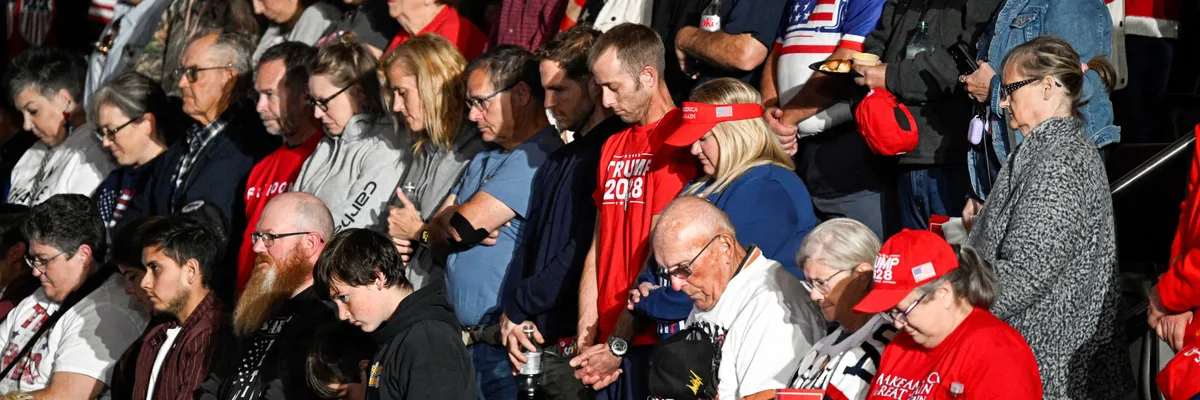
A fringe faction of Christian nationalists is declaring President Donald Trump's "Make America Great Again" movement finished in the wake of the Republican Party's recent midterm losses—and is laying out an aggressive, multi-phase strategy to replace it with a hardline theocratic agenda, the Associated Press reports.
More than 1,000 attendees gathered last week in Irving, Texas, for a three-day conference titled "Christ is King: America After Trump," organized by 40-year-old pastor and podcaster Joel Webbon. Among the speakers was surprise special guest Nick Fuentes, an avowed white nationalist who previously dined with Trump at Mar-a-Lago in 2022. Addressing the convention hall, Fuentes likened the GOP's Election Day defeat to the collapse of a political regime.
"This is like the death of Josef Stalin," Fuentes told the crowd, adding, "And there is nothing that will fill the void right now".
Webbon, however, argued that his movement is prepared to step into that vacuum. Outlining a multi-year blueprint to reshape American politics, he declared that "phase one"—the shattering of Trump's Republican coalition—was already complete. Phase two centers on building political infrastructure by recruiting campaign donors, door-knockers, and phone banks. Phases three and four aim to elect aligned candidates to governorships, the U.S. Senate, and ultimately the presidency, while installing loyalists into broader positions of power. Donor rolls, canvassing operations, and phone banks are the standard building blocks of any electoral campaign, meaning the faction is pursuing a conventional organizing playbook even as its stated ideological goals place it far outside the political mainstream.
The worldview promoted at the gathering extends well beyond traditional conservative politics. Webbon's vision for the United States includes deporting at least 50 million people, making the Apostles' Creed the preamble to the U.S. Constitution, treating interracial marriage as "not normal," and stripping women, Jews, Muslims, and Hindus of the right to vote or hold public office.
Vendor booths outside the main stage echoed that rhetoric, offering T-shirts reading "I'll take the Christian, hold the Judeo" alongside copies of Webbon's book, White Genocide.
Despite Trump's previous outreach to the religious right—and his appointment of Defense Secretary Pete Hegseth, who belongs to a church network co-founded by a Christian nationalist pastor—speakers at the conference expressed widespread disillusionment with the president. Right-wing YouTube comedian JP Sears asked attendees whether they felt misled by Trump's campaign promises to dismantle the "deep state," prompting dozens of hands to go up. "Boy, he was good, he was, I fell for that," Sears said from the stage, before claiming Trump had become "the corruption".
The movement remains on the political fringe: no elected officials appeared onstage, and mainstream Republicans such as Sen. Ted Cruz have warned against rising antisemitism on the right—a rift that highlights the gap between the faction and the party it aims to replace. Still, scholars who track religious extremism caution against writing off its growing reach. Julie Ingersoll, a religious studies professor at the University of North Florida, noted that the faction has steadily gained influence. Similarly, Rice University sociologist Michael Emerson observed that while Webbon frames his ideology around religion rather than race, the movement ultimately demands white dominance.
Both Webbon and Fuentes acknowledged that their views remain toxic to the broader electorate, and they declined to name potential 2028 presidential hopefuls they claim to be speaking with so as not to create a political liability. Even so, Webbon maintained that the boundaries of acceptable political discourse are shifting, telling the AP that his immediate goal is simply to "break containment". The movement's own stated milestones—donor networks, door-knocking operations, and eventually aligned candidates on ballots—offer the most concrete markers for gauging whether the blueprint advances beyond rhetoric as the 2028 cycle approaches.

