Chowdeck Hits 100 Million Items Delivered in Five Years
Key Takeaways
- •Chowdeck has surpassed 100 million items delivered through more than 30 million deliveries as it approaches the fifth anniversary of its October 2021 launch.
- •Co-founder and CEO Femi Aluko stated that 80% of the company's deliveries were completed within the last 20 months.
- •Groceries generated more than ₦1.5 billion in deliveries in June, representing 11% of Chowdeck's total business that month.
- •Chowdeck raised $9 million in a Series A round led by Novastar Ventures and Y Combinator in August 2025 to further enhance its grocery operations.
- •The company has acknowledged operational hurdles, including out-of-stock items and delivery delays, as grocery logistics require different processes from restaurant orders.
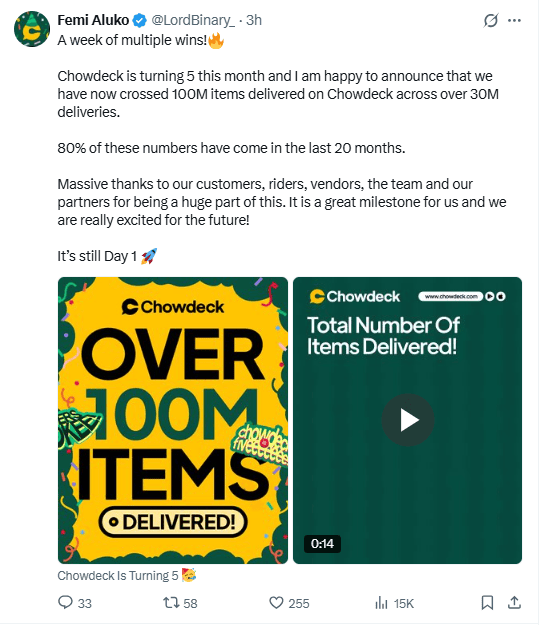
Nigerian delivery startup Chowdeck has surpassed 100 million items delivered, completing the volume through more than 30 million deliveries as the company approaches the fifth anniversary of its launch.
Femi Aluko, the company's co-founder and chief executive, announced the milestone in a post on X, noting that 80% of those deliveries were completed within the last 20 months. That means most of the company's delivered volume has accumulated in less than half of its roughly five years in operation. The share illustrates the speed of Chowdeck's expansion since its launch in October 2021, when it began by delivering restaurant meals. The company has since broadened its catalog to include groceries and other daily essentials, moving well beyond its original offering.
In his message, Aluko expressed gratitude to customers, riders, vendors, employees, and partners for their contributions to the company's progress. He described the past week as a "week of multiple wins," highlighting the collective effort behind the achievement. "It's still Day 1," he added, signaling that Chowdeck considers itself only at the beginning, with significant plans for the future despite the scale it has already reached.
The milestone builds on a series of results reported earlier in the year. In July, Aluko disclosed that Chowdeck delivered more than ₦1.5 billion worth of groceries in June alone. The category accounted for 11% of the company's entire business that month, a share that shows how impactful groceries have become within Chowdeck's overall operations. Aluko initially treated the grocery venture as a "small bet," but it has since transformed the company's proposition, moving Chowdeck beyond prepared meals and into quick commerce — a sector dedicated to delivering groceries and everyday essentials, tapping into a market that values convenience.
The expansion has not been without challenges. Aluko has acknowledged operational hurdles, particularly issues with out-of-stock items and delays in delivery times. The logistics of grocery delivery differ significantly from those of restaurant orders, requiring the company to adapt its processes accordingly.
To support this growth, Chowdeck has made substantial investments in its infrastructure. In August 2025, the company raised $9 million in a Series A funding round led by Novastar Ventures, a venture capital firm focused on African markets, and Y Combinator, the prominent startup accelerator, with the capital set to help enhance its grocery operations further.
Founded by Femi Aluko, Lanre Yusuf, and Olumide Ojo, Chowdeck has evolved into a widely used delivery platform catering to customers in Nigeria and Ghana. Through its app, the company connects users with restaurants, grocery vendors, and various merchants, making it easier for customers to access what they need. Chowdeck has also previously reported surpassing 2 million users, one year after reaching the 1-million mark.
As Chowdeck enters its fifth year, a central task will be sustaining its delivery momentum while ensuring reliable service across an increasingly diverse range of products available to its customers, from prepared meals to groceries and daily essentials. How the company deploys its Series A capital, how it works through the out-of-stock and delivery-time issues it has acknowledged, and whether groceries build on the 11% share of business they represented in June are among the observable signals of how its quick-commerce push develops.
Source: TechNext24

