Chinese Manufacturers Delivered 97% of Global Humanoid Robot Shipments in Early 2026
Key Takeaways
- •Chinese companies shipped more than 18,500 humanoid robots in the first half of 2026, over 97% of the roughly 19,100 units delivered globally and a 272% year-over-year increase from 5,100 units.
- •AgiBot led the market with about 8,400 units shipped for a 44% global share, and Unitree Robotics followed with roughly 5,900 units, together accounting for approximately 75% of worldwide shipments.
- •Smart Analytics Global forecasts global humanoid shipments approaching 60,000 units for full-year 2026 and reaching 500,000 units annually by 2030.
- •China's dominance is attributed to deep component supply chains, strong domestic demand from a manufacturing sector facing labor shortages, and government support including subsidies, grants, and tax breaks.
- •Most shipped humanoids are going to pilot programs and demonstrations rather than autonomous real-world deployments, and both AgiBot and Unitree Robotics are reportedly preparing for potential IPOs.
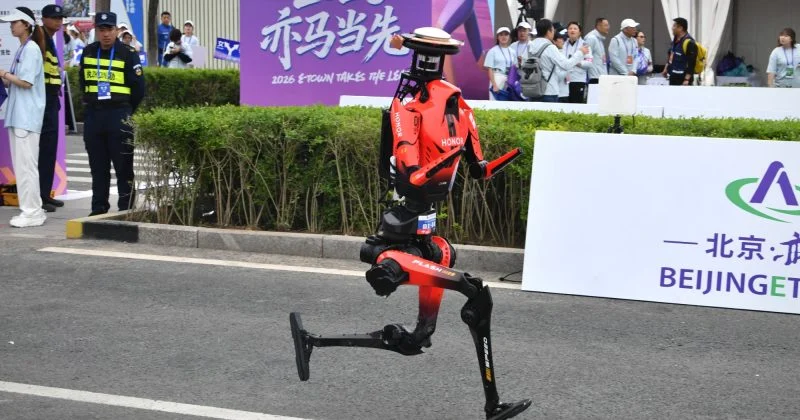
Chinese manufacturers shipped more than 18,500 humanoid robots in the first half of 2026, accounting for over 97% of the roughly 19,100 units delivered worldwide during the period, according to Smart Analytics Global (SAG). The figures mark a sharp acceleration for the industry: global shipments in the first half of 2025 totaled just 5,100 units, making the latest result a 272% year-over-year increase.
Two companies dominate the market
Shanghai-based AgiBot led all vendors with approximately 8,400 units shipped, capturing a 44% share of the global market. Unitree Robotics, headquartered in Hangzhou, ranked second with about 5,900 units, equivalent to 31%.
Together, the two companies accounted for roughly 75% of all humanoid robots shipped globally. The remaining 25% is divided among a long tail of smaller Chinese firms and a handful of American competitors — Tesla, Figure AI, and Agility Robotics — which together represent only a sliver of global volume. The Western players remain focused on proving use cases more than on volume: Figure's robots have been deployed on a trial basis at BMW's Spartanburg plant in South Carolina, while Agility's Digit has been tested in Amazon fulfillment centers.
SAG projects that full-year 2026 shipments will approach 60,000 units worldwide, and the firm expects the annual figure to reach 500,000 by 2030.
Why China, and why now
Three converging factors underpin Chinese manufacturers' commanding position: supply chain depth, domestic demand, and government backing.
China already dominates global manufacturing of the components that go into humanoid robots, from electric motors and sensors to batteries and precision actuators. Building a humanoid robot in Shenzhen or Shanghai means suppliers are a short drive away rather than an ocean freight container away. The dynamic echoes the consumer drone market, where Shenzhen-based DJI turned the same component ecosystem into a commanding global share. China's humanoid lead also extends an existing automation advantage: the country has accounted for more than half of global installations of conventional industrial robots in recent years, according to the International Federation of Robotics.
Domestic demand forms the second pillar. China's manufacturing sector faces a well-documented labor crunch driven by an aging population and declining birth rates; more than 300 million Chinese citizens are now over 60. Factories, warehouses, and logistics hubs constitute a massive addressable market for robots capable of performing repetitive physical tasks.
Beijing has explicitly identified humanoid robotics as a strategic technology, channeling subsidies, research grants, and preferential policies toward domestic developers. Provincial and municipal governments have followed suit, creating robotics industrial parks and offering tax breaks. In the US and Europe, tariffs and industrial policy have entered the debate over how to rebuild domestic robotics supply chains.
Both AgiBot and Unitree Robotics are reportedly preparing for potential IPOs, a move that would give the two firms access to public capital markets and the financial firepower to invest more aggressively in R&D and production capacity.
The 97% number comes with a caveat
Dominating shipments is not the same thing as dominating value creation. The vast majority of units shipped are going to pilot programs, research labs, demonstrations, and early-stage deployments. Very few are operating autonomously in real-world environments, performing tasks that justify their cost relative to simpler alternatives such as robotic arms or wheeled platforms. For scale, annual global installations of conventional industrial robots have run above half a million units, according to the International Federation of Robotics, meaning humanoids still represent a fraction of deployed automation even at the current pace.
Tesla's Optimus program benefits from massive internal demand within Tesla's own factories but has not yet shipped at volumes that register meaningfully against Chinese output.
If SAG's projection of 500,000 annual units by 2030 proves accurate, the humanoid robot market will have grown nearly 100x from its 2025 baseline in just five years. The near-term markers are concrete: whether full-year 2026 shipments approach SAG's 60,000-unit forecast, whether today's pilot deployments convert into repeat commercial orders, whether unit economics close the gap with fixed automation, and whether the reported AgiBot and Unitree listings reach public markets.

