China's Shipbuilding Sector Reports Record Growth, Moves Up Value Chain
Key Takeaways
- •China's shipbuilding output reached 36.5 million DWT in the first half of 2026, up 51.2 percent year-on-year and accounting for 62.2 percent of global production.
- •New orders surged 173.1 percent to 121.06 million DWT, capturing 82.3 percent of the global market, while the order book grew 54.9 percent to 363.25 million DWT.
- •China's ship export value rose 24.9 percent year-on-year to 219.32 billion yuan across 3,412 vessels exported during the January–June period.
- •A private Chinese shipbuilder independently completed its first large LNG carrier with a localization rate exceeding 65 percent, marking significant inroads into a high-value segment long dominated by South Korean builders.
- •Jiangsu province led all provincial-level regions nationwide with 71.86 billion yuan in ship exports during the first six months of 2026.
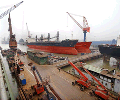
As shipowners worldwide ramp up orders and accelerate fleet decarbonization, China's shipbuilding industry is advancing steadily up the value chain, propelled by technological breakthroughs and the localization of critical marine systems, according to experts and industry insiders.
China's shipbuilding output reached 36.5 million deadweight tons (DWT) in the first half of 2026, representing a 51.2 percent year-on-year increase and 62.2 percent of the global total, according to the Ministry of Industry and Information Technology. New orders surged 173.1 percent to 121.06 million DWT, capturing 82.3 percent of the global market. The sector's order book — a key indicator of long-term market strength — stood at 363.25 million DWT as of the end of June, up 54.9 percent year-on-year and representing 71.2 percent of the worldwide total. The figures underscore China's widening lead over South Korea and Japan, the other two major shipbuilding nations, as global demand shifts toward more fuel-efficient and alternative-fuel vessels.
Li Yanqing, vice-chairman of the China Association of the National Shipbuilding Industry (CANSI), said the majority of new orders came from bulk carriers, container ships, and oil tankers, which together accounted for more than 75 percent of global orders in the first half. Li noted that liquefied natural gas (LNG) carriers made up roughly 14 percent of new orders globally, with Chinese shipyards making significant inroads into this segment — a high-value category long dominated by South Korean builders.
China exported 3,412 vessels during the January–June period, including car carriers, chemical tankers, offshore support vessels, and heavy-lift vessels — a year-on-year increase of 0.7 percent. Export value climbed 24.9 percent year-on-year to 219.32 billion yuan ($32.41 billion), CANSI reported.
Zhang Hongpeng, a professor at Dalian Maritime University in Liaoning province, attributed the industry's profit growth to higher new-build prices, stable steel costs, and improved management efficiency at domestic shipyards. These factors have not only boosted profitability but also raised the value of China's ship exports, as shipyards increasingly deliver high-end vessels rather than prioritizing volume alone, Zhang said.
In Taizhou, Jiangsu province, a large LNG carrier was docked at a shipyard pier in mid-July awaiting its sea trial, while another vessel of the same class had already completed its trial and was ready for delivery and export. The project marked the first large LNG carrier independently built by a private Chinese shipbuilder — Jiangsu Yangzi Xinfu Shipbuilding Co.
Zhou Yong, the shipyard's chief builder, said the company applied its experience in constructing LNG carriers and chemical tanks for other vessel types to the LNG carrier project. "From hull block fabrication to specialized tooling and welding techniques, everything has been integrated into our in-house technology platform," Zhou said, noting that the vessel's localization rate currently exceeds 65 percent.
Green technologies are also adding value to conventional shipbuilding. Nantong Xiangyu Shipbuilding & Offshore Engineering Co., based in Nantong, Jiangsu, has equipped its flagship bulk carriers with vortex-fin devices that convert wake rotation into auxiliary thrust, allowing the vessels to sail approximately 0.5 knots faster without increasing fuel consumption. Such fuel-saving innovations align with tightening international emissions standards set by the International Maritime Organization, which has pushed shipowners to renew aging fleets with more efficient designs.
Qin Weimin, the company's president, said 37 vessels are scheduled for delivery in 2026, most of them destined for overseas markets, with output value expected to exceed 10 billion yuan.
Jiangsu recorded 71.86 billion yuan in ship exports between January and June, the largest export scale among all provincial-level regions nationwide, according to Nanjing Customs.
Source: China Daily

