China Launches Its Largest Hydrogen-Powered Inland Cargo Vessel
Key Takeaways
- •The Yun Tao No 1 has a maximum carrying capacity of 2,000 tonnes and is planned for operations on Guangdong’s Beijiang river network.
- •The vessel uses three domestically produced 260 kW hydrogen fuel-cell generator sets supported by lithium batteries.
- •Yuntao says the ship’s fuel costs could be 25% to 30% lower than those of a comparable diesel-powered vessel.
- •The company plans to deploy 100 standardized hydrogen-powered vessels across the Pearl River system within four years.
- •China is also advancing hydrogen shipping projects in Jiaxing-Hangzhou and Wuhan as part of broader inland freight decarbonization efforts.
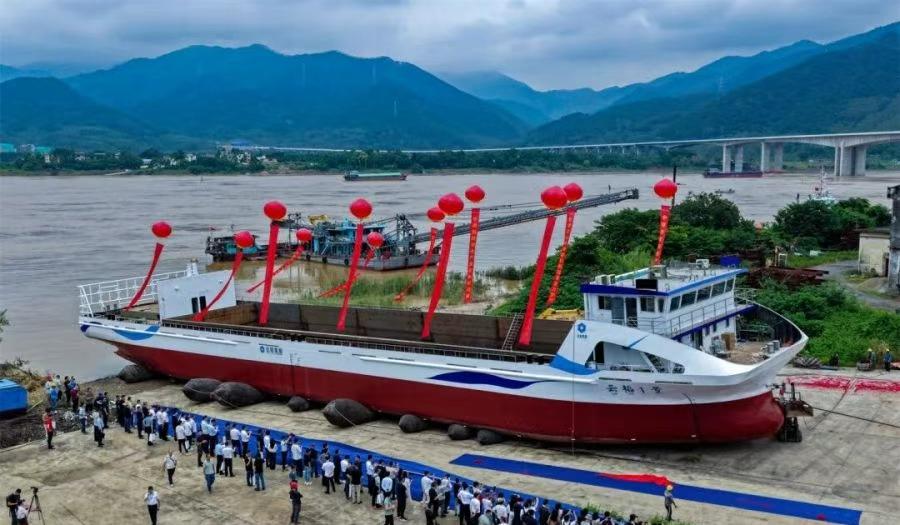
China has launched its largest hydrogen-powered inland cargo vessel, marking a further step by developers from demonstration projects toward a commercial network of zero-emission ships in the Pearl River basin.
The 2,000-tonne Yun Tao No 1 was launched in Zhaoqing, Guangdong province, earlier this month. The vessel was developed by Guangdong Yuntao Hydrogen Energy Technology together with China State Shipbuilding Corporation, with construction carried out by CSSC’s Guangzhou Shipbuilding Industry unit.
Measuring 69.3 m in length, the ship has a maximum carrying capacity of 2,000 tonnes. It can transport about 140 containers or carry bulk cargoes such as ore, grain and coal. The vessel is planned for operations on Guangdong’s Beijiang river network, part of a region where inland waterways link manufacturing and port logistics across the Pearl River Delta.
Its propulsion system is based on three domestically produced 260 kW hydrogen fuel-cell generator sets, supported by lithium batteries. The ship has a reported range of 760 km and is equipped with an intelligent energy-management system designed to allocate power between the fuel cells and batteries. In fuel-cell vessels, hydrogen is used to generate electricity on board, reducing local exhaust emissions compared with diesel propulsion.
Yuntao says fuel costs for the vessel will be 25% to 30% lower than those of a comparable diesel-powered ship. The final operating economics, however, will depend on factors including hydrogen prices, the availability of refuelling facilities and operational reliability.
The company plans to deploy 100 standardised hydrogen-powered vessels across the Pearl River system within four years, alongside new bunkering infrastructure. It is aiming for subsidy-free commercial operations by 2028. Standardised vessel designs and dedicated refuelling points are important for inland shipping because operators typically need predictable turnaround times and consistent route coverage.
China’s hydrogen shipping programme is also developing in other inland regions. The 64 teu Dong Fang Qing Gang entered commercial service between Jiaxing and Hangzhou in May. Separately, a 2,000-tonne hydrogen internal-combustion and electric vessel is scheduled to launch in Wuhan in 2028.
Together, the projects reflect China’s testing of multiple hydrogen technologies while it builds the production, storage and refuelling networks needed to shift inland shipping from prototype vessels to regular freight operations.

