BOFIT Alternative Estimates Show Chinese GDP Growth Slowed to 3.1% in Q2 2026, Well Below Official Figures
Key Takeaways
- •China's official Q2 2026 GDP growth was 4.3% year-on-year, down from 5% in the first quarter and below the government's 4.5–5% annual target range.
- •BOFIT's alternative GDP calculations estimate Q2 2026 growth at just 3.1% year-on-year, significantly below the official figure, with a wide confidence band spanning 1.2% to 4.7%.
- •Weak household demand and lower fixed investment were the primary factors behind the economic deceleration from the first quarter.
- •The San Francisco Fed's China Cyclical Activity Tracker also indicates that China's official GDP figures exceed independent growth estimates.
- •The IMF revised its 2026 China GDP growth forecast upward by 0.2 percentage points to 4.6% and its 2027 forecast to 4.1%.
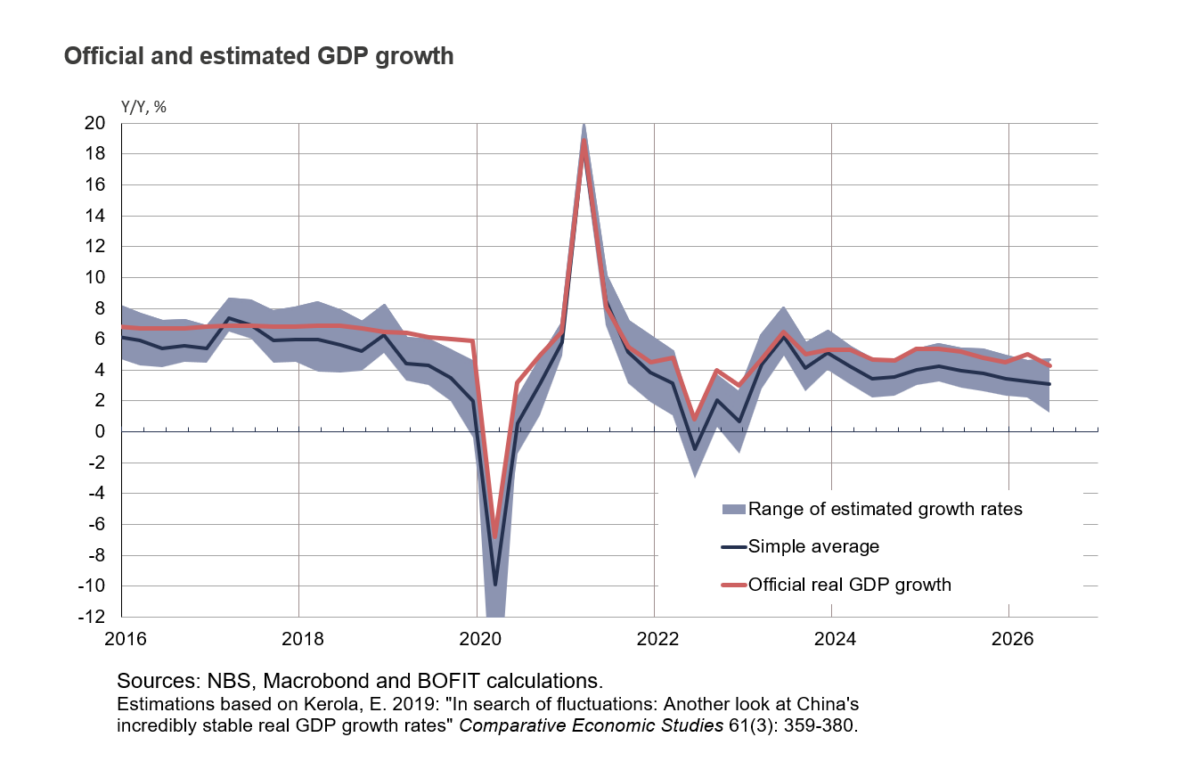
According to BOFIT's latest analysis, official figures indicate the Chinese economy grew by 4.3% year-on-year in the second quarter of 2026 (up 3.6% quarter-on-quarter on an annualized basis), falling short of China's official growth target range of 4.5–5% for the year. The deceleration from the first quarter's 5% year-on-year growth (up 5.3% quarter-on-quarter) was driven by weak household demand and lower fixed investment.
However, BOFIT's alternative GDP calculations paint a considerably different picture. The institute's alternative estimates indicate that Q2 growth slowed to just 3.1% year-on-year, down from 3.2% in the first quarter. BOFIT's estimated alternative GDP growth rate band also widened significantly, ranging from 1.2% to 4.7%. The gap matters because China’s official growth readings are closely watched by policymakers, companies and trade partners as a gauge of domestic demand, investment conditions and the broader momentum of one of the world’s largest economies.
The San Francisco Fed's China Cyclical Activity Tracker (China CAT), which incorporates import data to provide an independent gauge of Chinese economic activity, offers estimates only through the fourth quarter of the prior year. That tracker likewise suggests that official figures sit above alternative estimates of GDP growth, underscoring why analysts often compare official data with independent activity indicators when assessing China’s economic cycle.
Separately, the IMF's updated World Economic Outlook, released earlier this month, raised its Chinese GDP growth forecast for 2026 by 0.2 percentage points to 4.6%, and by 0.1 percentage points to 4.1% for 2027. Against BOFIT’s weaker alternative estimates, upcoming readings on household demand, fixed investment and external activity will remain important for evaluating whether growth is tracking closer to official data or independent measures.

