Sister-Port Ties Underpin Growing China-Egypt Maritime Trade
Key Takeaways
- •Guangzhou Port and Alexandria Port signed an MOU in November 2023 to establish a sister-port relationship covering liner routes, smart and green port construction, and personnel training.
- •Container traffic between Guangzhou and Alexandria reached 19,500 TEUs from January to July, rising more than 165.9 percent year-on-year.
- •Exports to Egypt are mainly Pearl River Delta manufactured goods such as appliances, machinery, vehicles, textiles and steel, while imports from Egypt are largely agricultural products, ores, metals and textile raw materials.
- •The Luban-Mozi College (Shandong Port), unveiled in 2024, is run with the Arab Academy for Science, Technology and Maritime Transport and Alexandria Port to train port-sector professionals.
- •The college has produced 79 full-time master's graduates across two cohorts and developed standards for four majors, 16 core courses and 23 bilingual textbooks, with training resources also introduced in Tanzania and Sudan.
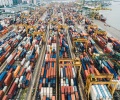
Ports in China and Egypt have deepened cooperation in container transport, vocational education and the broader port industry in recent years, following the establishment of sister-port relationships between major ports of the two countries.
Guangzhou Port, located in South China's Guangdong province, currently operates six container liner routes to and from Alexandria Port, forming a weekly service network with Guangzhou Port as a trading hub and two major Egyptian ports — Alexandria Port and Port Said — as Mediterranean nodes. Egypt's position at the southern entrance of the Suez Canal, the artery linking the Mediterranean to the Red Sea and Asian markets, has long made its ports a transit point for goods moving between Asia and Europe, and sister-port arrangements of this kind are a common way for ports to align operations, share technical expertise and develop routes jointly.
Guangzhou Port and Alexandria Port officially signed a memorandum of understanding in November 2023 to establish a sister-port relationship, marking a new level of partnership. Under the MOU, both sides pledged to pursue exchanges and cooperation across a range of areas, including liner route development, smart port initiatives, green port construction and personnel training.
Since the relationship was established, container transport volume between the two ports has increased steadily, according to Guangzhou Port Group (GPG). From January to July, container traffic between Guangzhou and Alexandria reached 19,500 TEUs, a significant year-on-year increase of more than 165.9 percent, GPG said.
Most of the container traffic consists of exports from Guangzhou Port — primarily appliances, machinery and equipment, vehicles and parts, building materials and home furnishings, textiles and steel products — manufactured in the Pearl River Delta region, one of China's largest manufacturing and export bases. Imports moving in the other direction are mainly agricultural products, ores, metals and textile raw materials, complementing the manufactured goods shipped to Egypt.
In a parallel development, the Luban-Mozi College (Shandong Port) in Egypt has emerged as a model of China-Egypt cooperation in vocational education and port industry matters, helping to address the shortage of skilled professionals at Chinese-invested ports overseas. The college belongs to the broader network of China-backed vocational education projects overseas known as Luban Workshops, which are typically run jointly by Chinese institutions and local partners to train workers in skills tied to Chinese-built infrastructure and industry.
Officially unveiled in 2024, the project focuses on smart-port development and offers full-time post-secondary education, short- and long-term vocational training, teacher exchanges, and the joint development of professional standards and curricula, according to Xu Guowang, Party secretary of Qingdao Harbor Vocational & Technical College.
The Arab Academy for Science, Technology and Maritime Transport oversees the college's local operations, including student recruitment and administration, the delivery of locally based courses and coordination with education authorities. Alexandria Port assesses workforce needs, provides practical training, conducts skills assessments and helps graduates secure employment.
The project has developed standards for four majors and 16 core courses, along with 23 bilingual textbooks, said Zhao Qingsong, president of Qingdao Harbor Vocational & Technical College. These resources have been adopted by some maritime and port-related institutions.
Digital training resources, virtual simulation systems and teaching programs for port equipment developed by Shandong Port Group have also been introduced in Egypt, Tanzania and Sudan.
Since the project's launch, two cohorts totaling 79 full-time master's students have completed the program, with graduates joining major Egyptian port and maritime organizations. The first group of 39 graduates has been particularly sought after by port and maritime companies along the Mediterranean coast.
The college also offers short-term training programs for port and maritime professionals from Egypt, Libya, Yemen and other countries and regions.
Source: China Daily, via Hellenic Shipping News
