China's Economic Slowdown Deepens as Spending, Investment and Property Slump
Key Takeaways
- •Industrial output increased 4.5% year over year in July, below June’s pace and economists’ expectations.
- •Retail sales rose only 0.6% in July, with motor-vehicle sales falling 17% and passenger-car sales dropping 20.9%.
- •Fixed-asset investment declined 6.7% in the January-July period, while non-governmental, manufacturing, and infrastructure investment all weakened.
- •Property investment fell 19.2% in the first seven months of the year, with new construction starts, sales, and developer financing also declining.
- •Exports surged 23.9% in July, led by a 40.7% jump in high-tech shipments, while youth unemployment rose to 17.9%.
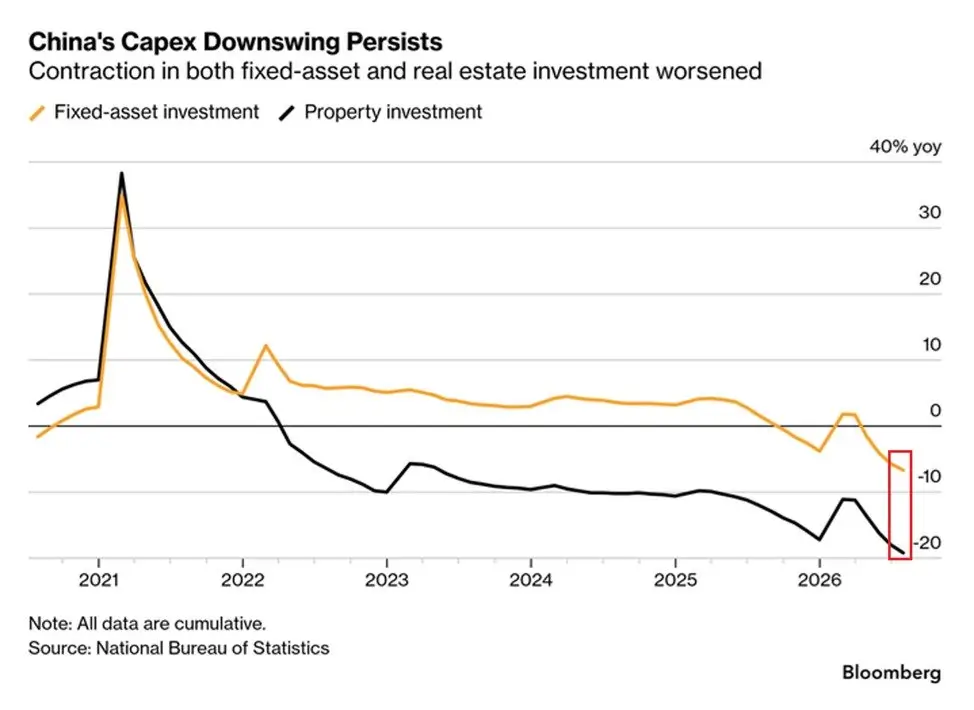
China's economy weakened further in July, as slower factory growth, softer consumer spending, falling investment and a deeper property downturn exposed persistent pressure on domestic demand. Industrial output rose 4.5% year over year, below June's 5.3% increase and the 4.8% expansion economists had expected. Retail sales grew just 0.6%, fixed-asset investment fell 6.7% through July, and property investment dropped 19.2%, while exports surged 23.9% — led by a 40.7% jump in high-tech shipments — to offset weak domestic demand.
The slowdown became more visible across households and businesses, as weaker spending and investment reinforced the pressure from China's property downturn. Retail sales increased only 0.6%, fixed-asset investment contracted further, and several property indicators continued to deteriorate. Exports, meanwhile, remained an important source of support, widening the gap between resilient external demand and weaker domestic activity.
China's economy is struggling: China's industrial production rose +4.5% YoY in July, but posted its first monthly slowdown in 3 months. At the same time, retail sales grew just +0.6% YoY, the 3rd-lowest reading in at least 18 months. This comes as passenger vehicle purchases,… pic.twitter.com/aIxuWEXj1h
— The Kobeissi Letter (@KobeissiLetter), August 22, 2026
Consumer Spending and Investment Lose More Ground
Retail sales growth slowed from 1% in June and missed the 1.5% forecast. Excluding automobiles, sales rose 2.5%, underlining the scale of weakness in vehicle demand. Official data showed motor-vehicle retail sales falling 17% in July.
Passenger-car retail sales dropped 20.9% year over year to 1.461 million units. Sales were also 8.8% lower than in June, while new-energy vehicle penetration reached a record 65.1%.
Investment figures added to the slowdown. Fixed-asset investment excluding rural households fell 6.7% during January through July, compared with a 5.7% decline in the first half of the year. July alone posted a 1.42% seasonally adjusted monthly decline.
Non-governmental investment fell 9.4%, manufacturing investment declined 1.7%, and infrastructure investment dropped 3.6%.
Property Remains the Heaviest Drag
Real estate remained the biggest weight on the economy. Real-estate development investment fell 19.2% to 4.30 trillion yuan during the first seven months of the year. New construction starts dropped 24%, while commercial-building sales by floor area declined 11.8%. Sales value fell 13.1%, and funds available to developers dropped 20.3%. Domestic loans to developers fell 32.1%, highlighting continued financing stress across the sector.
The sector's outsized footprint explains why the downturn keeps dragging on the wider economy: real estate and related industries have by some estimates historically accounted for as much as a quarter of Chinese economic activity, and land sales to developers have long served as a core revenue source for local governments. A prolonged contraction therefore weighs not only on construction and materials demand but also on household wealth tied to housing and on local-government finances.
Exports Surge as Domestic Demand and Youth Employment Weaken
China's export sector provided a sharp contrast to the soft domestic data. Exports surged 23.9% year over year in July as shipments of semiconductors, high-tech products, and vehicles strengthened. High-tech exports rose 40.7%, helping offset weak household spending and subdued private investment.
Online retail sales of goods also increased 4.6% during January through July. Telecommunications-equipment retail sales climbed 15.1%, showing that some technology-related categories continued expanding even as broader consumer demand slowed.
Inflation remained subdued. Consumer prices rose 0.5% year over year in July but slipped 0.1% from June, signaling limited pricing pressure.
Labor conditions also weakened. Urban unemployment among people aged 16 to 24, excluding students, rose to 17.9% from 14.9% in June. The increase marked an 11-month high and added another constraint on consumption. The excluding-students figure is the refined youth unemployment measure the National Bureau of Statistics introduced in early 2024, after the original broader series was suspended in 2023.
Premier Li Qiang acknowledged insufficient domestic demand and called for stronger support. Beijing's past responses to weak data have included cuts to banks' reserve-requirement ratios, reductions in policy lending rates, and targeted fiscal measures. Second-quarter GDP growth had already slowed to 4.3%, below Beijing's 2026 target range of 4.5% to 5%.
A Two-Speed Economy
The July figures showed an economy split between resilient exports and weaker domestic engines. Consumption, private investment, property, and youth employment all deteriorated or remained subdued. Export strength continued to provide support, but the latest data showed that the broader slowdown was rooted mainly in weak spending, investment, and real-estate activity.
The balance matters beyond China's borders: as the world's second-largest economy and one of the largest importers of commodities and industrial inputs, China's mix of strong external shipments and soft domestic demand is closely tracked by trading partners, commodity exporters, and multinationals that rely on the Chinese consumer market.
Source: Blockonomi
