China Seeks to Confiscate 61,896 BTC Worth $5.1B as HSBC Launches RedCoin Stablecoin in Hong Kong
Key Takeaways
- •Chinese prosecutors are seeking to confiscate 61,896 Bitcoin, worth approximately $5.1 billion, that remain in the custody of UK authorities following their fraud investigation.
- •The Bitcoin is tied to Zhimin Qian, who was sentenced to 11 years and eight months in a UK prison in November 2025 after pleading guilty, in a scheme that allegedly raised over 40 billion yuan and caused losses for more than 102,000 investors.
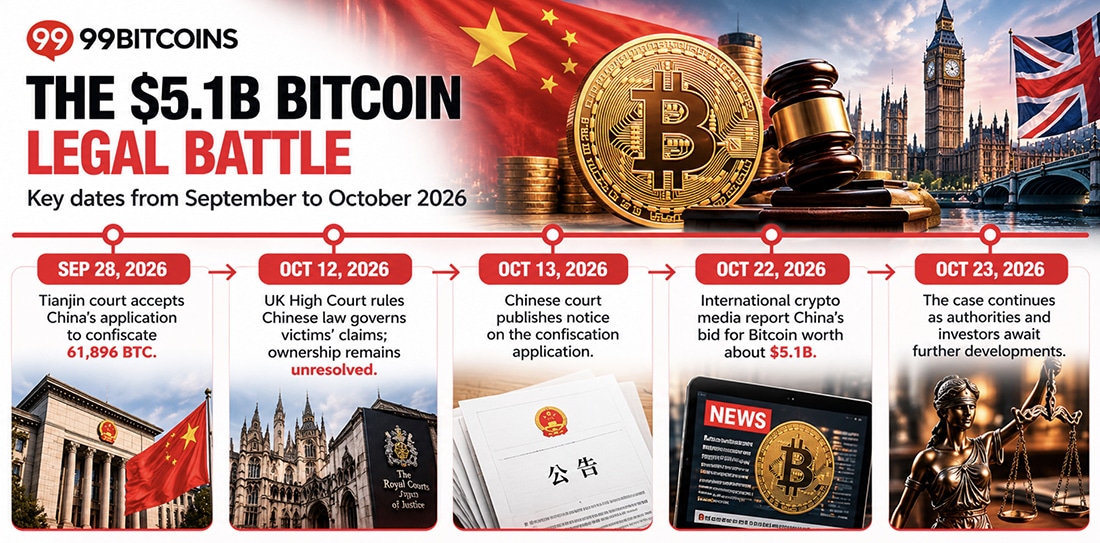
- •The Tianjin No. 2 Intermediate People's Court accepted the confiscation application on September 28, the UK High Court ruled on October 12 that Chinese law governs victims' claims, and claimants' lawyers have reportedly pursued an appeal.
- •HSBC began rolling out its Hong Kong dollar-backed RedCoin stablecoin on October 23 through the PayMe payments app, enabling person-to-person transfers and merchant payments for a user base exceeding 3.3 million.
- •RedCoin is issued under a Hong Kong Monetary Authority license with one-to-one HKD redemption backed by segregated liquid assets, and HSBC plans to add wallet functionality to its banking app and expand into institutional and tokenized investment products.
Chinese prosecutors are seeking to confiscate 61,896 Bitcoin worth approximately $5.1 billion, while banking group HSBC has begun rolling out its Hong Kong dollar-backed RedCoin stablecoin to users in Hong Kong.
The confiscation application targets Bitcoin seized by UK authorities during an investigation into a massive investment fraud. One day after international crypto media reported the Chinese legal move, on October 23, HSBC made RedCoin available through its PayMe payments app, opening access to a potential user base of more than 3.3 million people.
The near-simultaneous developments illustrate two distinct paths now emerging in the digital-asset landscape: governments and courts contesting ownership of disputed cryptocurrency holdings on one side, and a licensed bank introducing regulated digital money inside an established financial framework on the other.
China Seeks Control of 61,896 Bitcoin
The confiscation application concerns Bitcoin linked to Zhimin Qian, who ran a fraudulent investment operation in China between 2014 and 2017. Prosecutors allege the scheme raised more than 40 billion yuan through fraudulent investment products, leaving more than 102,000 investors with losses.
UK authorities seized the cryptocurrency during their investigation. Qian was sentenced to 11 years and eight months in prison in the UK in November 2025 after pleading guilty to acquiring and possessing criminal property.
The latest application marks another stage in the ongoing dispute over who should ultimately receive the assets. For the more than 102,000 investors recorded as victims of the scheme, that dispute determines who can lawfully claim the coins — and, with them, any prospect of recovery.
The Tianjin No. 2 Intermediate People's Court accepted the confiscation application on September 28 and published a notice on October 13. On October 12, the UK High Court ruled that Chinese law should govern victims' claims to the Bitcoin. International crypto media reported the Chinese confiscation bid on October 22.
The UK ruling did not settle ownership of the coins. Investors must still establish their rights under Chinese law, and lawyers representing claimants have reportedly pursued an appeal.
The application does not mean China has taken possession of the coins. The immediate development is a legal claim over assets already held by UK authorities. At approximately $82,000 per Bitcoin, the 61,896 BTC would be worth about $5.1 billion.
HSBC RedCoin Goes Live in Hong Kong
While the Bitcoin dispute moves through the courts, HSBC is introducing a different model of digital money. On October 23, the bank began rolling out HSBC RedCoin through PayMe, its Hong Kong payments platform. According to HSBC's announcement, the stablecoin is designed to maintain a one-to-one redemption value against the Hong Kong dollar and is backed by segregated, liquid assets.
HSBC Launches HKD-Backed RedCoin Stablecoin for 3.3 Million PayMe Users in Hong Kong
According to the South China Morning Post, HSBC is rolling out its Hong Kong dollar-backed stablecoin, RedCoin, to more than 3.3 million PayMe users starting October 23. The initial phase… pic.twitter.com/dGitKCfD8Y
— Wu Blockchain (@WuBlockchain) October 23, 2026
Source: Wu Blockchain on X
The initial rollout focuses on person-to-person transfers and payments to merchants. PayMe has more than 3.3 million users, and the bank plans to add stablecoin wallet functionality to its Hong Kong mobile banking app later this year.
HSBC RedCoin is issued under a license granted by the Hong Kong Monetary Authority, the regulator that oversees the territory's banking and monetary system. The bank has also outlined plans to expand into institutional and corporate use cases, including tokenized investment products.
The launch sits within Hong Kong's broader effort to develop a regulated digital-asset market. Although Hong Kong is a Special Administrative Region of China, it maintains a distinct legal and financial system under the "one country, two systems" framework.
Consequently, the launch should not be interpreted as evidence that mainland China is abandoning its own crypto restrictions. HSBC RedCoin is a Hong Kong dollar-backed stablecoin operating under Hong Kong's regulatory framework — not a Chinese yuan stablecoin issued for mainland circulation.
Bitcoin, HSBC RedCoin, and Digital Money
contrast between Bitcoin and HSBC RedCoin highlights two different questions facing the digital-asset industry: who controls an asset, and how people use it.
Bitcoin operates on a decentralized network, but disputes over stolen or seized holdings can still involve national courts, law enforcement agencies, and competing claims from victims. The Chinese application demonstrates how difficult it can be to establish ownership when cryptocurrency linked to alleged criminal activity crosses borders.
HSBC RedCoin takes a more conventional route. Its value is tied to a national currency, it is issued by a licensed financial institution, and its initial use cases center on payments through established banking infrastructure.
The juxtaposition of the two developments — one unfolding in courts in China and the UK, the other on a mobile payments platform in Hong Kong — shows digital assets being handled in very different settings: as contested property in cross-border litigation, and as a regulated payment instrument issued by a licensed bank. For readers following either thread, the next markers are concrete: further court activity in the claimants' reported appeal and the Tianjin confiscation proceeding on one side, and HSBC's planned banking-app wallet and institutional expansion for RedCoin on the other.

