Cheapest Way to Transfer Crypto Between Wallets: 2026 Fee Statistics
Key Takeaways
- •Solana, Stellar, and the XRP Ledger charge a tiny fraction of a cent in network fees, with documented minimums of 0.000005 SOL, 0.00001 XLM, and 0.00001 XRP per transaction respectively.
- •The lowest blockchain fee does not always produce the lowest total cost, since exchange withdrawal charges, trading spreads, bridging fees, and account funding requirements can exceed the savings.
- •Solana token accounts require upfront storage funding of roughly 0.0029 SOL, about 580 times its base transaction fee, making transfers to existing token accounts cheaper than first-time token receipts.
- •Coinbase charges a 0.2% processing fee for Bitcoin sent through the Lightning Network, meaning a direct on-chain transfer can cost less when network demand is low.
- •Funds sent over an incompatible network may be unrecoverable, so users should verify that both wallets support the exact asset and network and consider a small test transfer before moving large amounts.
The cheapest way to move cryptocurrency between wallets is generally to send the asset already held over a network with low fees. Solana, Stellar and the XRP Ledger charge only a tiny fraction of a cent in network fees. Ethereum Layer 2 networks, including Base and Arbitrum, can also cost less than Ethereum mainnet.
The lowest network fee does not always produce the lowest overall cost. Exchange withdrawal charges, trading spreads and bridging fees can eliminate the savings. Selecting an incompatible network can also result in lost funds.
This article examines cryptocurrency transfer fees as of 27 October 2026. It covers Bitcoin, Ethereum, Solana, XRP, Stellar, the Lightning Network and stablecoins. Figures described as examples are not live quotes.
How Crypto Transfer Fees Work
Cryptocurrency transfer costs generally fall into two categories: the fee paid to the blockchain and any withdrawal fee added by an exchange.
Network Fees
Network fees compensate validators or miners and support the operation and security of a blockchain. On Ethereum, these fees are known as gas fees. Bitcoin fees are based on transaction size and the fee rate selected by the sender.
For most Bitcoin transactions, the amount being sent does not determine the fee. Sending $100 and sending $100,000 can cost approximately the same if the transactions occupy the same amount of block space. Ethereum uses a different model, multiplying the required gas units by the gas price.
Ethereum’s official documentation states that a simple ETH transfer uses 21,000 gas units. Token transfers carried out through smart contracts generally require more.
Exchange Withdrawal Fees
Exchanges can charge withdrawal fees that exceed the underlying blockchain cost. The amount depends on the platform and the selected network. Kraken, for example, publishes withdrawal fees and minimum amounts for each supported asset.
Its fee schedule has listed substantially different charges for USDT withdrawals over Ethereum, Solana, Polygon and TRON. Kraken also warns that fees can change and instructs customers to review the final amount before sending.
As a result, a customer could pay several dollars to withdraw funds from an exchange even when the blockchain itself charges less than one cent.
Bitcoin Fees by Fee Rate
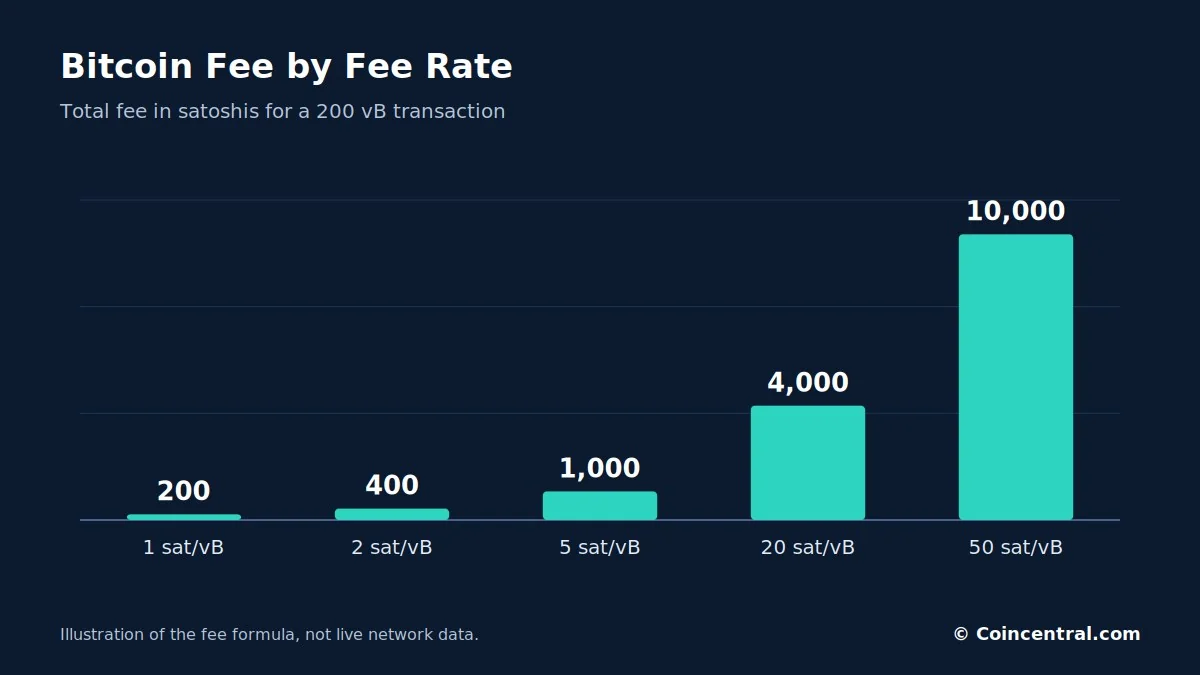
Bitcoin fees are quoted in satoshis per virtual byte, or sat/vB. A satoshi is one hundred-millionth of a Bitcoin. For a transaction occupying 200 virtual bytes, the fee changes according to the selected fee rate.
These figures illustrate the calculation and do not represent current network conditions. Live estimates are available from Bitcoin Mempool.
When demand is low, selecting a lower fee rate can reduce the cost. However, a fee set too low may leave a transaction unconfirmed for an extended period. Wallets that support Replace-by-Fee (RBF) allow users to increase the fee on an eligible pending transaction.
Networks With the Lowest Native Fees
Several networks are designed to support inexpensive transactions. Stellar (XLM), XRP and Solana (SOL) have very low native fees. Ethereum Layer 2 networks also frequently cost less than Ethereum mainnet.
Comparing Network-Level Costs
Network-level costs do not include exchange withdrawal charges. Actual fees vary according to the transaction, wallet, network activity and service provider.
Official documentation confirms the low base fees on several networks. Stellar charges a minimum of 0.00001 XLM per operation. The XRP Ledger sets a standard minimum cost of 10 drops, equal to 0.00001 XRP, although the cost can rise when the network is busy.
Solana charges a base fee of 5,000 lamports per signature. One SOL contains one billion lamports, making the base fee 0.000005 SOL. Solana also supports an optional priority fee.
Account Requirements
Low transaction fees can come with account-related funding requirements. The XRP Ledger generally requires a base reserve of 1 XRP to activate an account. Stellar also applies minimum-balance rules.
These amounts are funding requirements rather than transaction fees. Some exchange deposit addresses also require a destination tag or memo. If the tag or memo is omitted, the deposit may not be credited even if the coins reach the correct address.
Should You Convert Bitcoin to XRP to Save Money?
Not necessarily. Consider someone holding $2,000 in Bitcoin who wants to move the funds to another exchange. Converting the Bitcoin to XRP could reduce the blockchain transfer fee.
However, the person would pay to trade into XRP and might also pay to convert back. Trading fees, bid-ask spreads and price changes could make the process more expensive than a direct Bitcoin transfer. In jurisdictions such as the United States and United Kingdom, the swaps may also have tax consequences.
For someone who already holds XRP or Stellar, the transfer itself is very inexpensive. For everyone else, the full cost requires closer calculation.
Solana: Very Low Fees and One Additional Cost
Solana can be a practical option for transferring supported assets between self-custody wallets. Its standard base fee is 5,000 lamports per signature, or 0.000005 SOL.
The total may include a priority fee. For ordinary transfers, the complete cost is usually very small compared with the value being sent.
Sending USDC on Solana
Suppose an investor wants to send $1,000 in USDC from one Solana wallet to another. If both wallets support native USDC on Solana, the transfer generally does not require a conversion. The sender does need a small SOL balance to pay the fee.
There is an additional cost to consider. Solana token accounts require storage funding, and creating a new receiving token account adds an upfront charge.
Solana’s payment documentation indicates account-creation costs of about 0.0029 SOL. The amount can vary and is generally recoverable when the account is properly closed. Compared with the 0.000005 SOL base fee, the account-creation cost is 580 times higher.
Consequently, sending tokens to an existing account can be cheaper than sending them to a wallet receiving that token for the first time. Solana is a strong low-cost option when both wallets already support the same Solana-based asset.
Layer 2 Networks and Stablecoin Transfers
Base, Arbitrum and Optimism
Ethereum is widely used, but transfers on its main network can cost more than transfers on other networks. Layer 2 networks process transactions separately while using Ethereum for settlement and security. Popular options include Base, Arbitrum and Optimism.
Arbitrum’s documentation says its charges cover the cost of processing transactions on Arbitrum and posting data to the underlying blockchain. Fees vary, but they are generally lower than Ethereum mainnet fees.
The asset must already be available on the Layer 2 network. Someone holding USDC on Ethereum mainnet cannot simply select Base in a self-custody wallet and send those same tokens there. The assets must first be moved through a bridge or a similar tool, which can add fees.
Which Network Is Cheapest for USDT?
No network is permanently the cheapest option for USDT. USDT operates on Ethereum, TRON, Solana and other networks. USDC is available on Ethereum, Base, Solana and additional networks.
Solana and Layer 2 networks can offer inexpensive transfers, but the final charge depends on where the coins are held and what the exchange adds.
TRON is widely used for USDT, but its fee system is often misunderstood. The network uses two resources, bandwidth and energy. Ordinary transactions use bandwidth, while smart-contract actions such as TRC-20 token transfers also use energy.
Users can obtain these resources through staking or delegation, or pay for them with TRX. Therefore, USDT on TRON is not always cheaper than USDT on Solana or a Layer 2 network.
Example: A $1,000 USDT Transfer
Any figures for a $1,000 USDT transfer are illustrative assumptions rather than live quotes. The cheapest option changes with current network fees, exchange charges and wallet support.
Not every exchange supports every stablecoin network. Before sending, confirm that the receiving platform accepts the exact asset on the selected blockchain.
Is Bridging Cheaper?
Bridging moves assets between blockchains, such as USDC from Ethereum to Base. It adds transactions and may also involve service fees. Circle’s Cross-Chain Transfer Protocol (CCTP) moves native USDC through a burn-and-mint process.
Users may still have to pay gas fees. Bridges also introduce risks because transactions can fail or be delayed, and users may interact with compromised applications. If the asset is already on a compatible network with reasonable fees, a direct transfer is generally simpler.
Lightning Network Costs for Bitcoin
The Lightning Network is a payment layer built on Bitcoin. Rather than recording every payment on the main blockchain, it allows users to transact through payment channels. This can make small payments faster and less expensive.
Payments often settle within seconds, although failures and routing limitations can still occur.
How Much Does a Lightning Transfer Cost?
Lightning fees depend on the wallet, routing, liquidity and service provider. Some self-custody Lightning payments cost only a few satoshis, while custodial platforms may add their own charges.
Coinbase’s fee disclosure states that sending Bitcoin through Lightning carries a processing fee of 0.2% of the amount. On a $1,000 transfer, that equals $2. When network demand is low, a direct Bitcoin transaction could cost less.
A percentage-based fee increases with the amount sent, while an on-chain Bitcoin fee is based on transaction size rather than value. Users operating their own Lightning channels must also account for the Bitcoin network costs of opening and closing channels.
Lightning is most suitable for small, frequent payments when both wallets support it and the quoted fee is low.
Hidden Costs That Can Erase Savings
Network fees represent only one part of the total cost. Other charges can be more significant.
Trading Fees and Spreads
Converting an asset before a transfer can add commissions and bid-ask spreads. A combined conversion cost of 0.5% on $5,000 equals $25. A $2 saving in blockchain fees would not offset that cost.
Other Costs to Check
Bridging fees: Moving assets between chains can require several transactions, including smart-contract approvals. A low fee on the destination chain does not eliminate the cost of reaching it.
Withdrawal minimums: Exchanges often impose minimum withdrawal amounts. Small balances may be impossible or uneconomical to move on some networks.
Wallet funding: Some networks require minimum balances, token-account funding or a small amount of the native coin for gas. These requirements can make a nominally cheap transfer more difficult to complete.
Wrong network: Coinbase warns that funds sent over the wrong network may not be recoverable. Avoiding a network-selection error is worth more than saving a few cents.
Can You Transfer Crypto for Free?
Sometimes. Some platforms allow customers to send funds to other users of the same service without a blockchain fee. Coinbase documents fee-free internal transfers between eligible users.
These are off-chain transfers in which the platform updates its own records. They can be almost instant. However, the platform retains custody of the assets until they are withdrawn, so an internal transfer is not the same as moving coins between self-custody wallets.
Batching, Transfer Size and Taxes
Is One Large Transfer Cheaper?
On many blockchains, one large transfer costs less than several smaller transfers. For example, with a hypothetical network fee of $1 per transaction, sending $10,000 once costs $1, while sending it in 10 parts costs $10.
This does not apply in every case. Bitcoin fees depend partly on the number of inputs and outputs, so combining many inputs can increase transaction size and cost. Some exchange and payment fees are percentage-based as well.
Some services support batching, which places multiple recipients in a single transaction. The actual transaction structure should be compared before assuming that a larger transfer will be cheaper.
Taxes on Transfers Between Your Own Wallets
In many jurisdictions, moving cryptocurrency between wallets owned by the same person is not a taxable event. The US Internal Revenue Service generally treats transfers between a person’s own wallets as non-taxable. Crypto used to pay transaction fees may have separate tax consequences.
A swap is different. Trading Bitcoin for XRP before a transfer may create a taxable gain or loss, even if the XRP is later traded back. Tax rules differ by country, so users should check the rules applicable to their tax residence.
How to Move Crypto Between Wallets at the Lowest Cost
Most users can identify a low-cost route by comparing a few basic options. Complex swaps are rarely necessary. The process can be organized into six steps:
-
Identify the asset and network. Check whether the coin is on Bitcoin, Ethereum, Solana, Base or another chain. The asset name alone is insufficient: USDC on Ethereum is not the same on-chain asset as USDC on Solana.
-
Check the receiving wallet. Confirm that it supports the exact coin and network. Similar-looking addresses do not guarantee identical network support.
-
Compare transfer methods. Review direct transfers, internal platform transfers and Layer 2 withdrawals. If an exchange offers several withdrawal networks, compare the final quoted charges.
-
Calculate the total cost. Include exchange fees, blockchain fees, conversion costs and any bridging charges.
-
Send a small test transfer. This creates an additional fee, but for large amounts or unfamiliar networks, the cost may be worthwhile.
-
Send the remaining funds. After the test transfer arrives, check the destination details again. Blockchain transfers generally cannot be reversed after confirmation.
Frequently Asked Questions
What Is the Cheapest Crypto to Send Between Wallets?
XRP, XLM and SOL are among the least expensive major coins to move directly between compatible wallets. Converting another asset into one of them can add costs.
Is Solana Cheaper Than Ethereum for Transfers?
Solana generally has lower fees than Ethereum mainnet for ordinary native transfers. Ethereum Layer 2 networks can also be very inexpensive.
Does Sending More Crypto Raise the Fee?
Not necessarily. Many blockchain fees depend on transaction size or computing requirements rather than the value sent. Exchanges and payment providers may still charge a percentage of the transfer.
How Can I Send Bitcoin Without High Fees?
Use Lightning for compatible payments, or select a lower on-chain fee rate when demand is low. Compare the final quote because some Lightning providers charge a percentage.
Which Is Cheaper: Binance, Coinbase or Kraken?
No exchange is always the cheapest for withdrawals. Fees depend on the asset, network, account and current pricing. Compare the amount the receiving wallet will actually receive.
Can I Send Ethereum Without High Gas Fees?
Yes, if both wallets support ETH on a low-cost Layer 2 network such as Base or Arbitrum. Moving ETH from mainnet to a Layer 2 network can add bridging costs.
Bottom Line
The cheapest way to transfer cryptocurrency between wallets is usually to send the asset directly over a network supported by both wallets. Additional swaps and bridges should be avoided unless the savings are clear.
Solana, Stellar and the XRP Ledger have some of the lowest base fees. Base and Arbitrum are suitable for assets already held on Ethereum Layer 2. For Bitcoin, Lightning can work for frequent payments, although an on-chain transfer may sometimes cost less.
Stablecoin fees vary by network and exchange, so the selected chain matters. Trading spreads, withdrawal charges, bridging fees and taxes can all exceed a saving of a few cents. Compare the final amount received before sending.
Sources
Solana Foundation: Solana Transaction Fees
Solana Foundation: How Payments Work on Solana
Ethereum Foundation: Ethereum Gas Fees Explained
Ethereum Foundation: How to Bridge Tokens to Ethereum Layer 2
XRP Ledger: Transaction Costs
Stellar Development Foundation: Stellar Transaction Fees
TRON Developers: Bandwidth and Energy
Arbitrum Developers: Gas and Fees
Kraken: Cryptocurrency Withdrawal Fees and Minimums
Coinbase: Cryptocurrency Pricing and Fee Disclosures
Coinbase: Sending Cryptocurrency
Circle: How CCTP Bridging Works
Bitcoin Mempool: Bitcoin Transaction Fee Estimates
Internal Revenue Service: Digital Asset Transaction FAQs
Disclaimer: Cryptocurrency transaction fees change with blockchain activity, market prices and exchange policies. Figures are either protocol-level settings or clearly labeled illustrations. Always check live fees and network support before sending funds. This article is not financial or tax advice.

