Chainlink Whales Accumulate $22M in LINK Amid Institutional Silence
Key Takeaways
- •Multiple whale investors have accumulated approximately $22 million in LINK holdings, transferring tokens to self-custody wallets in patterns associated with long-term positioning.
- •Spot Chainlink ETFs recorded zero inflows during the accumulation period, even as Bitcoin and Ethereum ETFs attracted billions in institutional capital.
- •LINK is currently trading within a demand zone established four years ago that previously served as the launch point for three major rallies reaching $22, $29, and $27.
- •The number of addresses holding LINK has grown to 902,203 since early 2023, reflecting broadening participation primarily from retail and whale investors rather than institutions.
- •Chainlink's staking program and continued whale withdrawals from exchanges are reducing circulating supply, which historically correlates with diminished sell-side pressure.
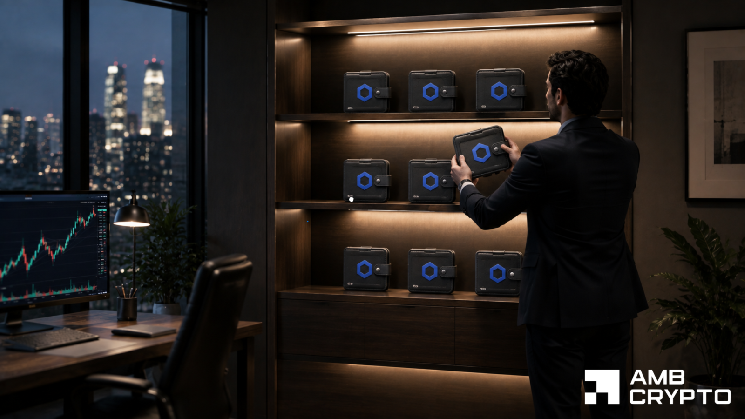
Chainlink Whales Accumulate $22M in LINK Amid Institutional Silence
Chainlink [$LINK] has traded within a narrow range over the past week, maintaining a market capitalization of approximately $6.25 billion. Daily trading volume sits near $215 million, yielding a volume-to-market-cap ratio of 3.36%. These metrics point to routine trading activity and adequate liquidity, driven largely by retail participants and large individual holders rather than institutional players.
Chainlink operates as the dominant decentralized oracle network, supplying real-world data, event outputs, and cross-chain interoperability to smart contracts across more than a dozen blockchains. Its adoption by both DeFi protocols and traditional financial institutions — including SWIFT and several major asset managers exploring tokenized assets through Chainlink's CCIP — positions it as critical infrastructure bridging on-chain and off-chain systems. That context makes the absence of institutional spot ETF flows particularly notable, as it contrasts with the growing enterprise interest in Chainlink's technology stack.
Whale Accumulation Intensifies
Over the past month, at least one notable whale has been steadily withdrawing Chainlink tokens from the Binance exchange through a series of purchases, each valued in the hundreds of thousands of dollars. The most recent acquisition, executed approximately three weeks ago, involved 18,748 $LINK tokens worth $151,486. This transaction brought the whale's total holdings to 266,414.4 $LINK, currently valued at roughly $2.153 million. The full balance was transferred to a Gnosis Safe multisig wallet, a move typically associated with long-term custody rather than short-term trading. Transferring tokens off centralized exchanges into self-custody reduces the liquid supply available for immediate sale, a pattern that historically correlates with reduced sell-side pressure.
A second whale has also been actively purchasing $LINK through Coinbase. Their latest acquisition comprised 163,494 tokens valued at $1.37 million, bringing total holdings to 2.413 million $LINK at an aggregate cost basis of $20.15 million.
This whale activity reinforces broader demand signals. In July, Chainlink Reserve added 706,000 $LINK to its holdings, further reducing available circulating supply on exchanges.
Despite these accumulation trends, spot Chainlink ETFs recorded zero activity during the same period. Spot ETFs for Dogecoin [DOGE] and Avalanche [AVAX] similarly showed no flows, even as interest in altcoins and memecoins has experienced a modest resurgence. This stands in contrast to Bitcoin and Ethereum spot ETFs, which have seen billions in inflows since their respective approvals — highlighting that institutional capital through regulated vehicles has yet to extend broadly to altcoins, including infrastructure tokens like LINK.
LINK Tests Four-Year Demand Zone
On the price charts, $LINK has been trading within a historically significant demand zone ranging from $5.638 to $8.727 — a range that first formed four years ago and persisted for approximately 18 months, spanning from May 2022 through mid-October 2023. This zone previously served as the launch point for three major rallies reaching $22, $29, and $27 respectively.
The Choppiness Index stood at 51, consistent with the ongoing sideways consolidation around the $8 level. Price action remained positioned between the 9-week and 21-week moving averages.
The current retest of this demand zone, however, has been deeper than during any of the three prior rallies — a pattern that some traders suggest could set the stage for a more pronounced upward move if accumulation continues.
On-chain data supports a broadening holder base. The number of addresses holding $LINK has been on an upward trajectory since early 2023 and currently stands at 902,203, indicating that retail and whale participants have been accumulating across multiple cohorts without meaningful institutional involvement. Chainlink's staking program, which launched in late 2022 and has since expanded, provides an additional mechanism reducing circulating supply, as staked tokens are locked to support oracle network security.
If the demand zone continues to hold, $LINK could potentially trade above $20. Conversely, the possibility of a further decline toward the zone's lower boundary at $4.85 cannot be ruled out.
Summary
Chainlink whales continue withdrawing $LINK from exchanges, demonstrating sustained conviction, while spot Chainlink ETFs remain inactive despite the token's role as core infrastructure for both DeFi and institutional cross-chain initiatives. Meanwhile, $LINK continues to trade above a demand zone established four years ago — a level that has historically supported its price.

