Standard Chartered Sets $200 Chainlink Price Target, but LINK Buyers Remain Muted
Key Takeaways
- •LINK was trading around $8.25 and remained trapped between resistance near $8.60 and support near $8.04.
- •Standard Chartered initiated coverage of Chainlink with a $200 target for the end of 2030 and a $13 target for the end of 2026.
- •The bank’s thesis is tied to expected growth in tokenized assets, which it projects could rise from about $340 billion today to $4 trillion by the end of 2028.
- •Standard Chartered said Chainlink already secures more than $110 billion in value and handles roughly 70% of oracle-dependent DeFi activity globally.
- •The market response to the coverage was muted, with LINK trading almost unchanged at about $8.22 to $8.26 after the report circulated.
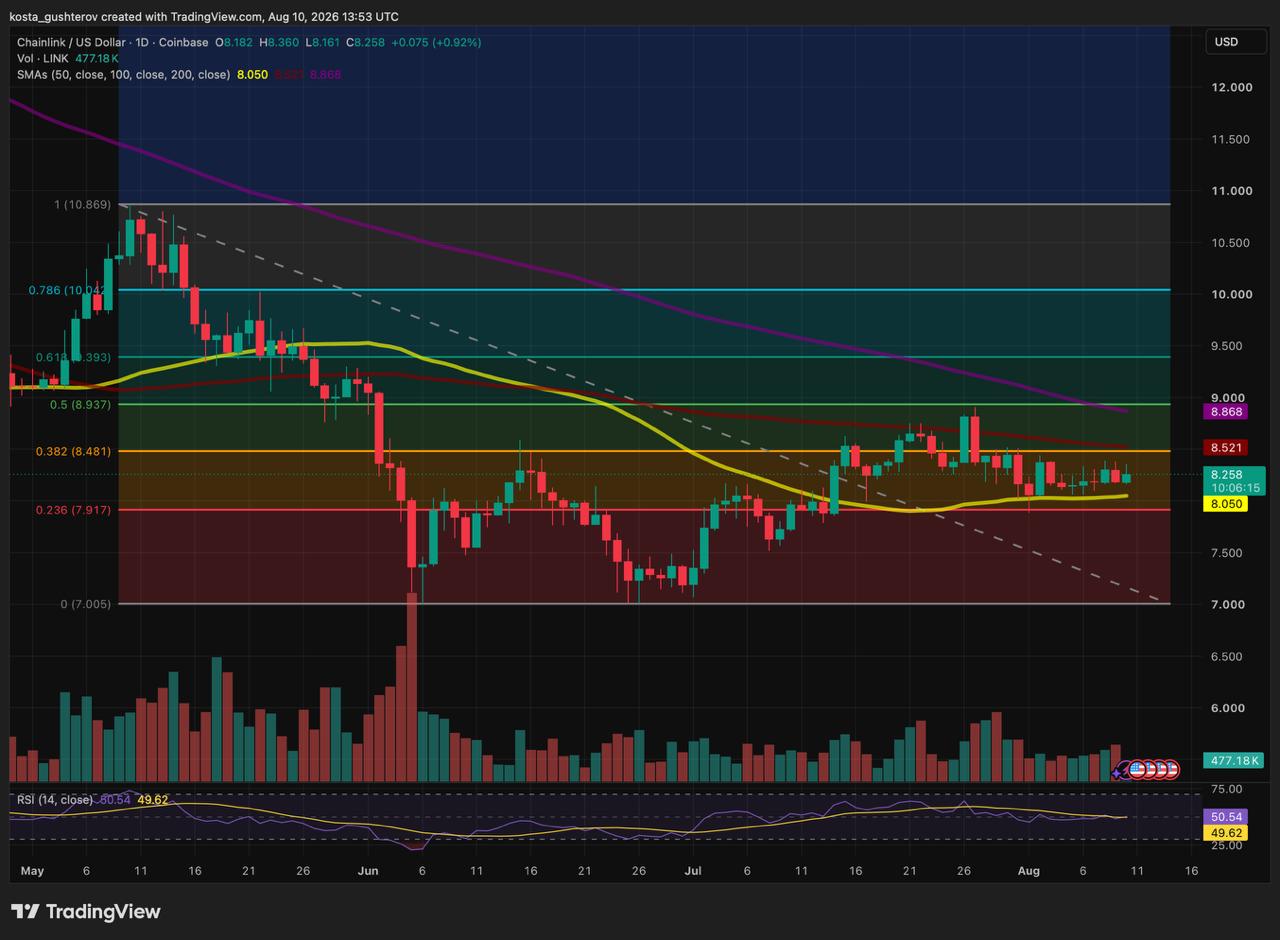
LINK remains confined within a narrowing trading range, with resistance overhead and support below tightening around the token's current price. The 100-day simple moving average near $8.60, combined with the 0.382 Fibonacci retracement level, is capping upside, while the 50-day SMA around $8.04 and the 0.236 Fib define the lower boundary. LINK was trading at approximately $8.25 at the time of writing.
A decisive daily close beyond either boundary would offer a clearer indication of whether buyers or sellers are gaining control of the trend.
Chainlink Faces a Squeeze
For buyers, a brief excursion above the upper boundary would carry limited significance. A daily close through the ceiling—particularly one that holds on a subsequent retest—would provide far stronger evidence that LINK is breaking out of its consolidation phase.
Conversely, a break below the lower boundary would send a bearish signal. Should LINK begin closing beneath the range, the price structure that has contained the token since late July would start to unravel, bringing recent lows back into focus.
With price still suspended between these two scenarios, the timing of Standard Chartered's Monday research report was particularly noteworthy.
Standard Chartered's Tokenization Thesis
Standard Chartered initiated coverage of Chainlink with a long-term price target of $200 by the end of 2030, according to a report shared by The Block. That figure represents roughly 24 to 25 times LINK's trading price at the time the research circulated. The bank also established a nearer-term target of $13 by the end of 2026.
While the headline target is aggressive, the underlying investment thesis rests on a broader wager on the growth of real-world asset tokenization. Standard Chartered projects that tokenized assets on blockchains will expand from approximately $340 billion today to $4 trillion by the end of 2028—a forecast that aligns with projections from other major consultancies, including Boston Consulting Group, which has similarly estimated trillions in tokenized assets by the end of the decade. The trend has already drawn participation from the world's largest asset managers: BlackRock launched a tokenized U.S. Treasury fund (BUIDL) on Ethereum, and Franklin Templeton has maintained an on-chain government money fund, signaling that institutional experimentation is moving beyond proofs of concept.
According to the report, Chainlink already secures more than $110 billion in value and accounts for roughly 70% of oracle-dependent decentralized finance activity globally. The bank's argument is that this position becomes substantially more valuable if tokenized funds, securities, and other financial assets migrate onto blockchains at scale—markets that will require reliable external data feeds and cross-chain infrastructure, two domains where Chainlink already maintains a significant footprint through its Data Feeds and its Cross-Chain Interoperability Protocol (CCIP), a product specifically designed to connect traditional financial systems and on-chain environments.
The valuation model assumes protocol fees could increase approximately 25-fold by 2030, with LINK's price broadly tracking that growth. Realizing such an outcome, however, depends on institutional tokenization advancing beyond pilot programs, Chainlink retaining a leading role in the infrastructure layer, and higher on-chain activity translating into stronger demand for LINK itself.
A Muted Market Response
Despite the bullish call, the market reaction was negligible. Reports published on Monday showed LINK trading between $8.22 and $8.26—virtually unchanged from where it stood when the research first began circulating.
That response is notably weaker than the market reactions that followed some of Standard Chartered's previous DeFi coverage calls. When the bank initiated coverage of Morpho with a $60 target, MORPHO surged more than 13% on the day. Around its $100 Uniswap call, whale transactions reached a seven-month high and active addresses climbed to a four-month high. Standard Chartered has been steadily building out its digital asset research franchise, having also published price targets for bitcoin and ethereum in recent coverage cycles, reflecting a broader pattern of legacy financial institutions expanding into crypto market analysis.
The comparison is imperfect—LINK, UNI, and MORPHO each have distinct liquidity profiles, market positioning, and structural characteristics. Nevertheless, LINK's lack of movement is striking given that the catalyst arrived precisely as buyers were attempting to challenge the upper boundary of the consolidation range.
What the Next Daily Closes Could Reveal
The tepid reaction alone does not signal that sellers are in control. The more meaningful indicator will emerge from how price behaves after failing to capitalize on the headline catalyst.
A breakout above the ceiling would demonstrate that buyers ultimately generated sufficient demand to resolve the consolidation to the upside. A breach of the lower boundary, however, would be harder to dismiss—particularly coming immediately after such an optimistic research call, as it would suggest the catalyst was insufficient to shift short-term demand dynamics in buyers' favor.
The next several daily closes may provide clarity. If buyers manage to force a breakout, Monday's muted response may ultimately be remembered as mere hesitation. If price breaks lower first, the fact that even a $200 long-term target failed to stimulate meaningful demand becomes a far more consequential part of the narrative.
This article is for informational purposes only and does not constitute financial advice.

