LIQUID Aims to Make Multichain Crypto Seamless as Chainlink's LINK Rallies 9%
Key Takeaways
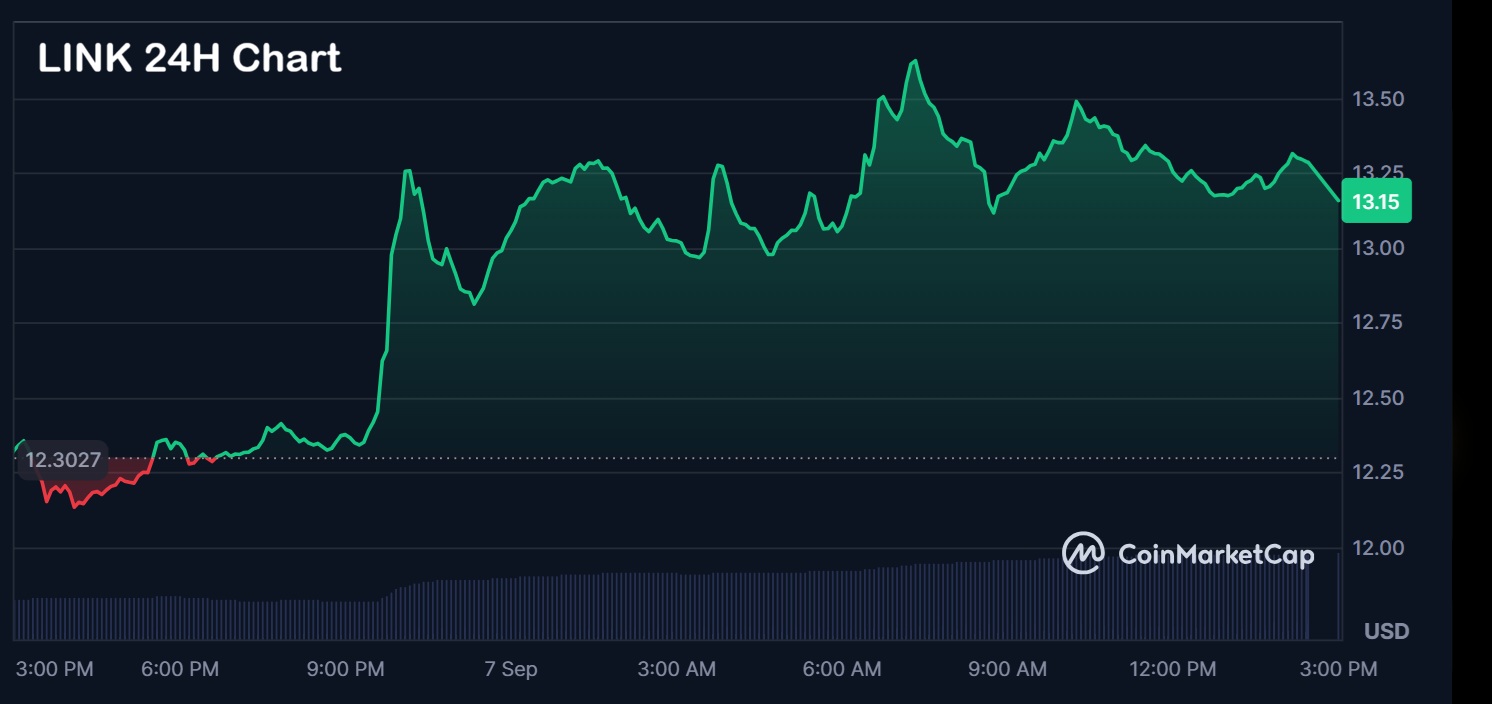
- •Chainlink's LINK token climbed 9% in the past day and 17.92% over the past week to trade at $13.195.
- •More than $15 billion in value is migrating to Chainlink's CCIP, including over $7.7 billion in wrapped assets moved by BitGo and Kraken's adoption for kBTC.
- •Wyoming selected CCIP as the exclusive cross-chain infrastructure for its state-issued FRNT token.
- •Chainlink says its broader oracle infrastructure has enabled more than $33 trillion in transaction value to date.
- •LiquidChain, still in presale with $961,000 raised and LIQUID priced at $0.0149, is building a Layer 3 that unifies Bitcoin, Ethereum, and Solana in a single environment.
Chainlink is enjoying another strong week as investors turn their attention to one of crypto's less glamorous but increasingly important challenges: getting different blockchains to work together.
LINK is trading at $13.195, up 9% over the last day and 17.92% over the past week, amid a rally underpinned by expanding use of Chainlink's infrastructure, including a wave of projects moving onto its Cross-Chain Interoperability Protocol (CCIP).
According to Chainlink, more than $15 billion in value is migrating to CCIP, with BitGo moving over $7.7 billion of wrapped assets and Kraken adopting the technology for kBTC and future wrapped assets. Wyoming has also recently selected CCIP as the exclusive cross-chain infrastructure for its state-issued FRNT token.
LINK is not the only project benefiting from the multichain trend – and it is not particularly controversial to think that crypto's future incorporates many chains. Bitcoin, Ethereum, and Solana continue to grow, as do a host of newer networks. The harder question is how users move through this new financial world without needing to understand every technical detail.
That is where LiquidChain (LIQUID) has found notable traction in recent months, with a Layer 3 that creates a single environment working across Bitcoin, Ethereum, and Solana simultaneously. Still in presale and on track to reach its first $1 million, the project offers a solution aimed at a growing problem.
LINK's Rally Puts Interoperability Back in Focus
A few years ago, the multichain debate often revolved around which blockchain would eventually win – reality has proved messier. Different chains have become good at different things, attracted their own developers, and accumulated billions of dollars in assets. The result is a crypto market where a user might hold BTC, trade on Solana, and keep stablecoins or decentralized finance positions on Ethereum.
While that diversity is useful, moving between networks often is not. Cross-chain bridges have historically been among the most exploited parts of crypto infrastructure – incidents such as the Ronin Network and Wormhole bridge hacks in 2022 each resulted in hundreds of millions of dollars in losses – which has pushed the industry toward more secure interoperability designs. Chainlink has built a major business around solving two parts of the problem – transferring information and assets between networks, and oracle products that bring external data into smart contracts – but there are other ways to simplify the infrastructure.
The institutional uptake is becoming difficult to ignore: Chainlink says its broader oracle infrastructure has now enabled more than $33 trillion in transaction value, while CCIP is increasingly being adopted for tokenized assets that need to exist across more than one network. That dovetails with a broader institutional shift toward tokenizing real-world assets, where issuers such as banks and asset managers need assets to move reliably across multiple networks – a use case where cross-chain infrastructure is a prerequisite rather than an afterthought.
LiquidChain starts from the next question: what if the user did not have to think about individual chains in the first place?
LiquidChain Wants Multichain to Feel Like One Market
LiquidChain is developing a Layer 3 built around Bitcoin, Ethereum, and Solana, where – instead of carrying a message from Chain A to Chain B – LIQUID's cross-chain virtual machine provides a common environment in which applications can work across several networks at once.
Consider a portfolio with BTC on Bitcoin, tokens on Ethereum, and trading positions on Solana. Today, using all three means changing networks, approving bridges, waiting for transfers, and interacting with different versions of the same application – not to mention the gas tax and time tax.
A little of this chain. A little of that chain. Then things get interesting. pic.twitter.com/ybu9a1L0o0 — LiquidChain (@getliquidchain) September 7, 2026
LiquidChain pushes more of those decisions into the infrastructure while shedding most of the costs. Its proof system is designed to read and verify information across different chains, while atomic execution during transfers allows connected steps to be treated as a single operation – meaning a multi-chain transaction either completes in full or does not go through, rather than leaving assets stranded halfway.
In short, BTC, ETH, and SOL act as one ocean of liquidity rather than separate, unconnected pools. Because LiquidChain knows the real-world states of each chain, transactions can work across all of them frictionlessly.
It is also a benefit for developers, who do not need three separate deployments to support customers holding assets on three different networks. By connecting to LIQUID, they can reach three user pools at once.
That is a different definition of interoperability than asking people to bridge assets – users can simply use them, effectively natively, wherever they are.
Is LIQUID the Next Crypto to Explode?
LiquidChain remains much earlier in its development than Chainlink, which is why the comparison is interesting rather than direct. LINK is already a multibillion-dollar asset attached to infrastructure used across DeFi and institutional tokenization.
The project is still in presale, with $961,000 raised and LIQUID currently priced at $0.0149. The project's argument – that interoperability is less about letting networks communicate and more about letting networks directly connect with each other – is compelling.
SpyWolf and CertiK have reviewed the project's code, suggesting that the mainnet launch and the listing of LIQUID on exchanges are not far off. External security reviews are a common prerequisite for exchange listings, though presale-stage projects carry materially higher risk than established infrastructure like Chainlink.
The timing is worth watching. Bitcoin, Ethereum, and Solana have all created massive ecosystems, while Chainlink is attracting billions of dollars in assets to infrastructure designed specifically to cross the boundaries between networks.
It all suggests the market is no longer waiting for one blockchain to win, and that the next era is about making several giants easier to use together. If multichain crypto becomes ordinary, the best infrastructure will be the one that makes boundaries invisible. LIQUID is the first contender of note in this new arena.
Source: ICO Bench
