Chainalysis Challenges $94.66 Million ICE Contract Award to TRM Labs in Federal Court
Key Takeaways
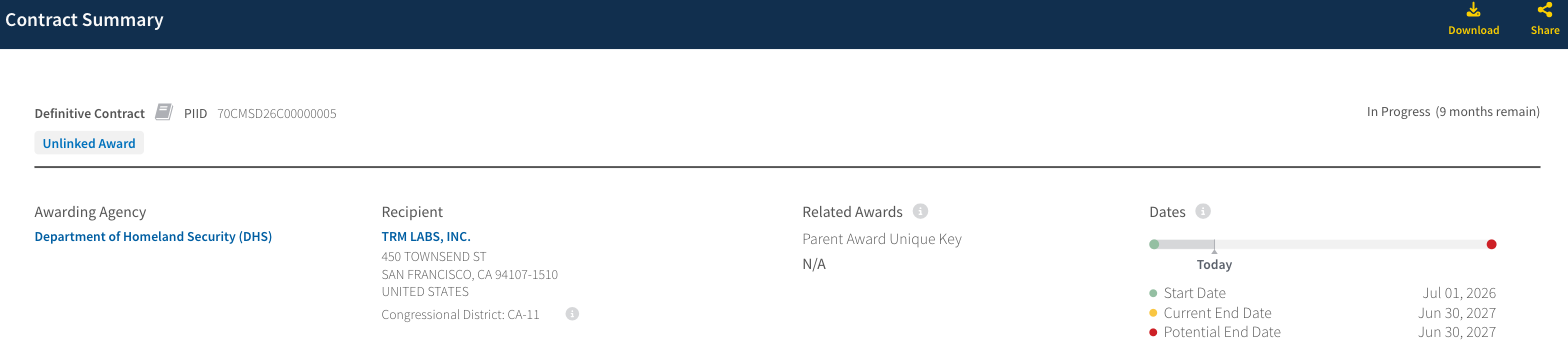
- •The disputed contract is worth $94.66 million and covers one year of forensic software and support for Homeland Security Task Force cases involving scams, cybercrime, and sextortion, running from July 1, 2026 to June 30, 2027.
- •Chainalysis alleges ICE judged vendors against undisclosed criteria and structured requirements, such as a million-record scam-victim database and stablecoin-issuer partnerships, around capabilities only TRM already had.
- •Challengers to the sole-source intent were given three days and a one-page limit to respond, with Chainalysis saying it was the only firm to submit a statement.
- •ICE justified the award by citing TRM's unique features, while noting that TRM's Beacon Network, part of the T3 Financial Crime Unit with Tether and TRON, has helped freeze over $450 million in USDT linked to crime since 2024.
- •The court is moving on an accelerated schedule, with oral arguments set for September 2 and a ruling requested by September 10, because a delay past the contract start would effectively render the protest moot.
Chainalysis has asked a federal court to annul a roughly $95 million award that Immigration and Customs Enforcement (ICE) granted to its rival TRM Labs. According to a recently unsealed complaint, ICE structured the purchasing criteria around capabilities that only TRM already possessed. The dispute highlights how federal procurement rules — which generally require agencies to seek full and open competition unless they can justify a sole-source award — have become a battleground as the government pours money into blockchain-analytics tools for law enforcement.
Rivals were given three days and one page to respond
The $94.66 million contract runs for one year, from July 1, 2026, to June 30, 2027, covering forensic software and support for Homeland Security Task Force cases involving scams, cybercrime, and sextortion. The federal award record lists $94,655,840 obligated, with nothing paid out so far (USAspending record).
ICE issued a Request for Information (RFI) on May 28, with responses due June 2, and followed with a Notice of Intent to sole-source the work to TRM on June 8. Companies seeking to challenge that intent received a separate Statement of Need and were given three days to respond, limited to one page. Chainalysis Government Solutions, the vendor's federal-facing subsidiary, says it submitted its one-page statement on June 11 and was the only firm to do so.
ICE later defended the sole-source approach, saying a six-day market-research window showed that none of the eight responding companies could match TRM.
The May RFI posed 18 questions to vendors, including whether a firm maintained a scam-victim database with more than one million records and an AI platform with "agentic data retrieval and entity resolution." It also asked whether a firm had "an operational partnership with stablecoin issuers" to facilitate coordination of illicit-asset freezes.
According to Chainalysis, many of those items never reappeared in the June Statement of Need, which framed the work around scam disruption, cybercrime disruption, and sextortion disruption. The word "sextortion" did not appear in the earlier RFI at all, the company notes, yet it became a headline requirement.
ICE nonetheless concluded that Chainalysis fell short on automated, real-time disruption, on blending on-chain and off-chain intelligence, and on victim notification at scale, according to the complaint. Chainalysis argues it was judged against thresholds it was never told would determine its eligibility to compete. Specifications that appear tailored to one incumbent's existing capabilities are a recurring complaint in bid protests, where losing vendors often allege agencies wrote requirements around a preferred supplier rather than genuinely surveying the market.
Beacon Network sits inside a T3 unit that froze $450 million
ICE justified the award by citing TRM's unique features, including a large proprietary scam-victim database, an AI-native investigative platform, automated freezes through its Beacon Network, formal ties to stablecoin issuers, and a security-cleared staff. Chainalysis responds that several of those features were not part of the Statement of Need, and some were not exclusive to TRM. It says ICE's own research acknowledged that both vendors had developed AI-enabled platforms and credited Chainalysis with law-enforcement experience and cleared personnel. Both companies are major players in the crypto-intelligence market, and each counts government agencies among its customers — making direct federal competitions between them unusually consequential for their public-sector business.
TRM's Beacon Network operates with Tether and TRON through the T3 Financial Crime Unit, a partnership that Cryptopolitan previously reported had frozen over $450 million worth of USDT connected to criminal activity since 2024 (Cryptopolitan). ICE cited part of that real-world footprint — part of what Chainalysis says was unfairly baked into the requirements.
On July 27, Chainalysis filed the sealed protest, and TRM filed an intervention to defend the award on July 28. A redacted version was filed on Friday, August 28. Judge Stephen Schwartz has scheduled oral arguments for September 2 on an accelerated track, with the government requesting a ruling by September 10.
Chainalysis has asked the court to halt the TRM deal and order a full and open competition. The compressed timeline reflects the expedited schedules common in procurement protests of short-duration contracts, where a ruling delayed past the start of performance would effectively decide nothing. A ruling in Chainalysis's favor would typically force the agency to re-run the competition rather than simply pick a new winner.
