Cha In-pyo Takes Stage Lead in Korea's First Licensed 'Dead Poets Society,' Questions His Own Mentorship Offstage
Key Takeaways
- •Cha In-pyo is making his stage debut at age 59 in the first officially licensed Korean production of "Dead Poets Society," running through September 13 at NOL Theater in Seoul.
- •The veteran actor was the final cast member to join the production, which assembled its company from approximately 1,500 auditioning actors amid growing competition in South Korea's theater industry.
- •Cha transitioned into novel writing in his 50s and has published five books, with "Mermaid Hunt" earning the newcomer prize at the Hwang Sun-won Literary Award in 2022.
- •The actor has expressed a sense of generational responsibility for the economic and social challenges confronting young South Koreans, including youth unemployment above 20 percent and soaring housing costs.
- •Cha is actively promoting opportunities for younger performers by inviting industry producers and directors to observe them and by organizing theater visits for approximately 200 teenagers from children's homes.
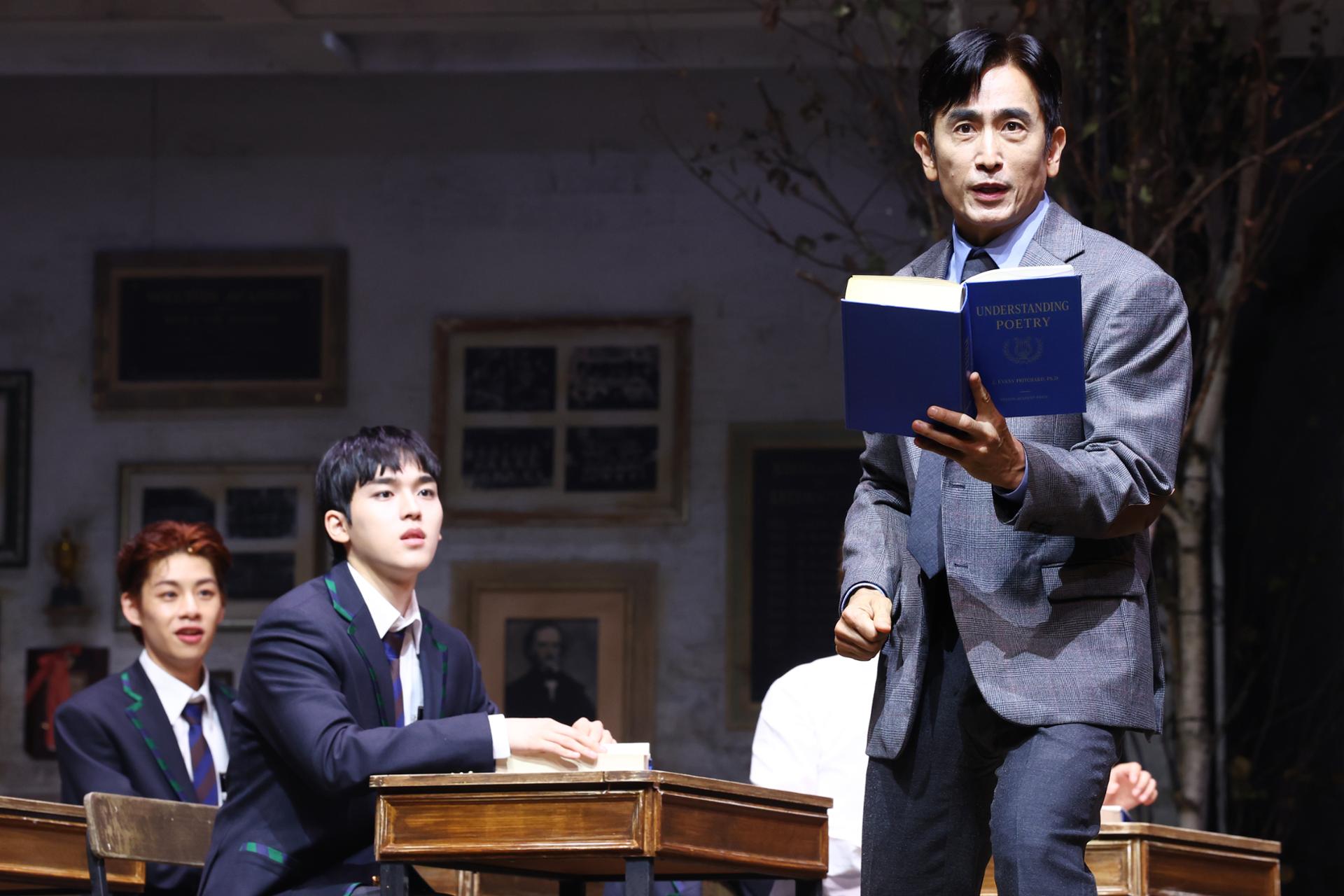
Every night at curtain call, the flowers go to Cha In-pyo. Thirty-three years into an acting career that has made him one of the most recognizable faces in South Korea, that is simply how it works.
Lately, however, the flowers and cheers have started to trouble him.
"I already have fans. When a show ends, I get piles of gifts and bouquets," Cha said at a press conference held Tuesday in a fourth-floor rehearsal room at NOL Theater Daehangno Woori Card Hall in central Seoul. "A lot of the young actors in the team don't. I feel bad about it, and I keep asking myself what I could do to change that."
It is an unusual admission from the man currently playing the lead role in "Dead Poets Society," which runs through Sept. 13 at the venue in Jongno District. Cha portrays John Keating, the English literature instructor who urges the boys of Welton Academy to seize the day and think for themselves. Onstage he is the mentor, but offstage, at 59, he is not convinced he has earned the title.
"The adult I believe in is someone who doesn't take the whole harvest, who stands one step back and shares it with the people coming up," he said. "Working with all these young actors, I kept wondering, am I actually an adult here? What kind of senior am I to them?"
Face of an era
For Korean audiences of a certain generation, Cha is less an actor than a cultural reference point. He debuted in 1993 through broadcaster MBC's open casting call and became a sensation the following year with "Love in Your Arms" (1994), playing a saxophone-wielding department store heir whose romance with a working-class co-worker made him one of the country's first small-screen heartthrobs. He married his co-star, actress Shin Ae-ra, in 1995.
Over three decades, he transitioned into films including "Crossing" (2008) and "The Tower" (2012), built a long public record of humanitarian work, and, in his 50s, reinvented himself as a novelist. He has published five novels; one, "Mermaid Hunt" (2022), received the newcomer prize at the Hwang Sun-won Literary Award.
That second career is precisely why the first stage play of his life arrived when it did. Scripts had come for years, he said, and he always turned them down.
"I came up as a mainstream entertainer, so I chose the life inside the frame," he said. "What changed is that I scaled back that kind of work and started writing. I realized I didn't have to settle into one thing. This isn't a case of getting less afraid with age. If anything, I'm more afraid now."
Last one cast
Cha was also, by a considerable margin, the last actor cast. The rest of the company was finalized in late last year, selected from roughly 1,500 auditioning actors — a figure that reflects the intensifying competition in South Korea's theater scene, where Daehangno has long served as the country's premier stage district and open casting calls for licensed productions routinely draw hundreds of hopefuls. His call came only in April, followed by two months of rehearsals six full days a week. He hesitated, then walked in to find performers decades younger already warmed up and working.
"I decided not to pour cold water on that," he said. "The young actors who went through that grind with me are the ones who put me on this stage."
The apprenticeship has been literal. Director Cho Kwang-hwa, he observed, gave the young cast detailed, unsparing notes while telling the veterans almost nothing beyond blocking — so Cha approached him and asked for more. He also asked the younger actors how his performance was landing. They were baffled at first, then obliged. One night he blanked on a line and someone behind him fed it to him in a whisper. The word he had lost was "awake."
He is currently auditioning for his next role, he added, and not succeeding.
"I keep getting rejected," he said, laughing.
Less advice than declaration
Keating in the film is in his early 30s, Cha noted — young enough to preach conviction he had not yet been tested by. The character, immortalized by Robin Williams in Peter Weir's 1989 film, has become one of cinema's most cited figures in debates about authority, conformity, and the purpose of education.
"I'm an old Keating," he said. "After 30 more years, I can say you don't necessarily have to smash the frame, but there are other options, so lift your head and look."
He is wary, however, of aiming that message at young Koreans without acknowledging who shaped the conditions they inhabit. South Korea's youth unemployment rate has hovered above 20 percent in recent years, and soaring housing costs have deepened a generational divide that policymakers and sociologists have flagged as one of the country's most pressing social fractures.
"The world people in their 20s are living in — those in their 50s and 60s made it," he said. "When I was that age, working hard was enough, and there was hope. It's harder now. I feel responsible, and sorry."
"Carpe diem" survives the apology, he argues, because it is not truly counsel.
"It's less advice than a declaration. You can't choose the past and you can't choose the future. The present is the one thing you can choose. That sentence names exactly what a human being is able to do."
What he can do, he has decided, is smaller and more concrete than a message. He has invited every producer and director he knows to come watch the younger cast members. He is considering running seminars for them. Through organizations supporting children's homes and young adults aging out of state care, approximately 200 teenagers have been brought to the theater; several told him it was the first play they had ever seen.
"Look at it one way and being born as Cha In-pyo is its own kind of prison," he said. "The family, the circumstances, the boundary you're handed. I spent a lot of my life avoiding choices I didn't have to make, and I can barely remember those years. What I remember is quitting a job to audition, or writing a novel. Breaking the frame, over and over, turns out to be the substance of a life."
He is now adapting "Mermaid Hunt" into a play himself. He has no plans to appear in it.
"Dead Poets Society," the first officially licensed Korean production of Tom Schulman's stage adaptation of his Oscar-winning 1989 screenplay, runs through Sept. 13 at NOL Theater Daehangno Woori Card Hall in Jongno District, Seoul.
Source: The Korea Times

