C.H. Robinson Faces Appeal After $600 Million Texas Verdict Raises Broker Liability Concerns
Key Takeaways
- •C.H. Robinson plans to appeal the $600 million Dallas County verdict, a process CEO Dave Bozeman warned could take years, after the company rejected settlement talks on the recommendation of its insurers.
- •The jury found that a carrier with a satisfactory safety rating still exposed the broker to liability and that the driver could be treated as an employee of C.H. Robinson despite being paid by carrier Lupus Superior.
- •The Transportation Intermediaries Association has filed a formal rulemaking request with the Federal Motor Carrier Safety Administration seeking clarity on what constitutes appropriate broker behavior in carrier vetting.
- •If upheld on appeal, the employee classification finding could extend beyond brokerage and affect companies such as Amazon and FedEx that rely on third-party trucking relationships.
- •Citibank characterized the $600 million award as an existential threat to brokers and their business model, and C.H. Robinson's stock declined roughly 20% over five days following the verdict.
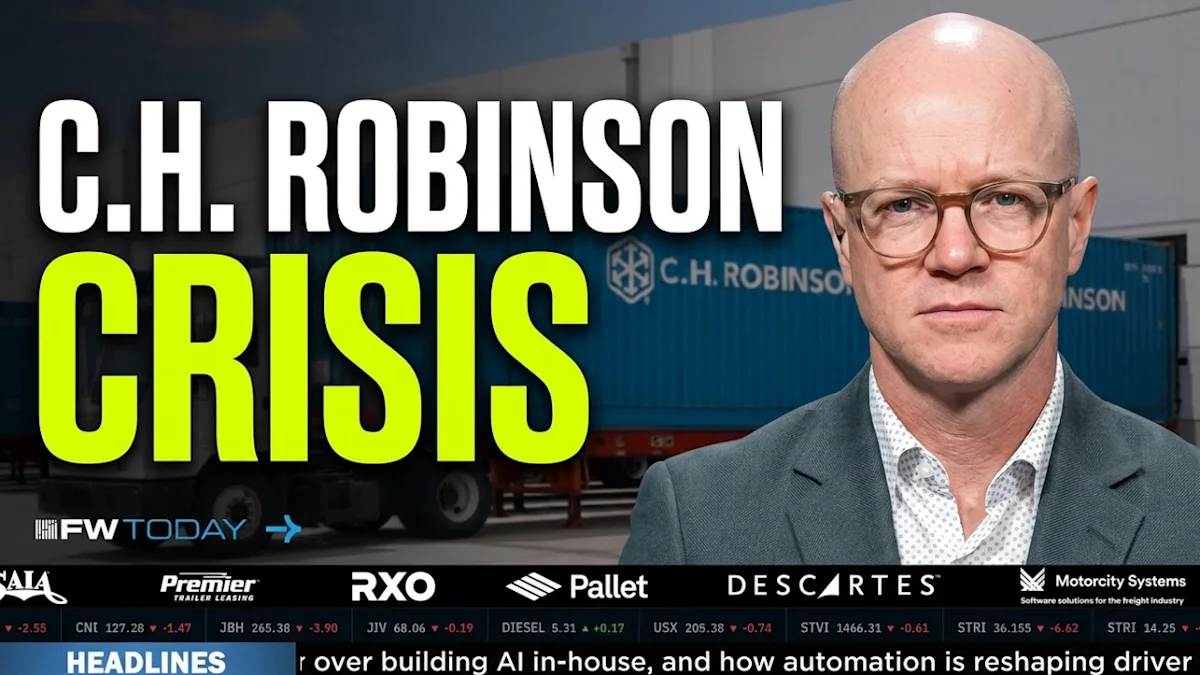
C.H. Robinson, one of the largest freight brokers in North America, saw its earnings call overshadowed by a $600 million Dallas County nuclear verdict that has raised new questions about broker liability, insurance costs and independent contractor classifications in trucking.
Chief Executive Dave Bozeman addressed the verdict directly on the call, defying expectations from some analysts that lawyers would prevent him from discussing it. Bozeman said C.H. Robinson will appeal the ruling and warned that the process "could take years." The company is waiting for the presiding judge to formally affirm the verdict before beginning the appeal.
Bozeman also said settlement talks took place, but the company rejected them on the recommendation of its insurers.
The stock has fallen roughly 20% over the past five days, and Citibank described the $600 million award as an existential threat to brokers and their business model.
FreightWaves Senior Editor John Kingston said rating agencies are a secondary concern at this stage, but added that a $600 million charge would eventually need to be accounted for if the verdict is upheld.
"I've been sort of checking every day… to see if Moody's and/or S&P Global puts them on some credit watch," Kingston said.
He pointed to Wabash National as a precedent. That company faced a St. Louis verdict of more than $400 million, took a charge and eventually settled for more than $100 million.
Kingston also noted that the Texas Supreme Court previously reduced a large Werner judgment to zero, something C.H. Robinson's legal team is likely monitoring closely.
The size of the award is only one part of the issue, Kingston said. More important are the jury's findings that a vetted carrier with a satisfactory safety rating could still expose a broker to liability, and that the driver could be treated as an employee of C.H. Robinson despite being paid by carrier Lupus Superior.
"This was not some fly-by-night carrier. They had a satisfactory rating before the accident. Even after the accident, they had a satisfactory rating," Kingston said. "The jury found that the driver was effectively an employee of C.H. Robinson. And their argument is, we've never employed a driver in our life."
According to the discussion on the broadcast, those findings may have broader implications than the dollar amount itself. The Transportation Intermediaries Association has already filed a formal rulemaking request with the Federal Motor Carrier Safety Administration, the federal agency that regulates commercial motor vehicle safety, seeking clarity on what constitutes appropriate broker behavior in carrier vetting.
C.H. Robinson's position is that it hired a carrier with about 200 power units and a satisfactory safety rating, which raises the question of what more a broker could reasonably be expected to do.
The independent contractor issue could also extend beyond brokerage. If Texas courts uphold a finding that a W-2 employee of a carrier can also be deemed an employee of the hiring broker, the implications could reach companies such as Amazon and FedEx, as well as other businesses that rely on third-party trucking relationships, according to the broadcast. Such a precedent would add to existing legal and regulatory pressure on gig-economy and contractor classification models across multiple industries.
One panelist said he could not imagine the verdict surviving appeal, but noted that plaintiff attorneys will likely be drawn to the size of the award regardless. Nuclear verdicts in trucking litigation have trended upward in recent years, a pattern industry groups including the American Trucking Associations have flagged as a systemic concern for carrier and broker economics.
Kingston said the broader earnings season has reinforced several consistent themes across the trucking and logistics industry: insurance costs are expected to rise, shippers will continue to seek high-quality carrier capacity, and multiple executives have described the current market shift as unlike anything they have seen in their careers.
He cited Covenant Logistics Chief Executive David Parker, who said the structural change in the market was unique in his long experience.
Kingston also pointed to TFI International as another notable earnings call. While the company is often viewed primarily as an LTL carrier, Kingston said its truckload results were strong, particularly in the specialty group built around the former Daseke flatbed unit.
That segment has become an important part of TFI's business, even as its LTL operations tied to the former UPS Freight network continue to lag. Kingston said TFI Chief Executive Alain Bédard appeared eager to highlight the truckload business during the call.
For C.H. Robinson, the verdict has become the central issue in what was otherwise a solid earnings report. Bozeman said the company remains focused on its operating performance, including its lean AI initiatives, but the Dallas County case now looms over the brokerage business model and the wider trucking industry.

