CFTC Extends Broker-Registration Exemption to Passive Crypto Trading Software After CLARITY Act Stalls
Key Takeaways
- •The CFTC's Market Participants Division will not recommend enforcement against eligible passive crypto-trading software providers, or their personnel, for operating without introducing broker or associated person registration.
- •Unlike a March relief that covered only Phantom Technologies, Staff Letter 26-25 extends equivalent protection to any provider that satisfies its stated conditions.
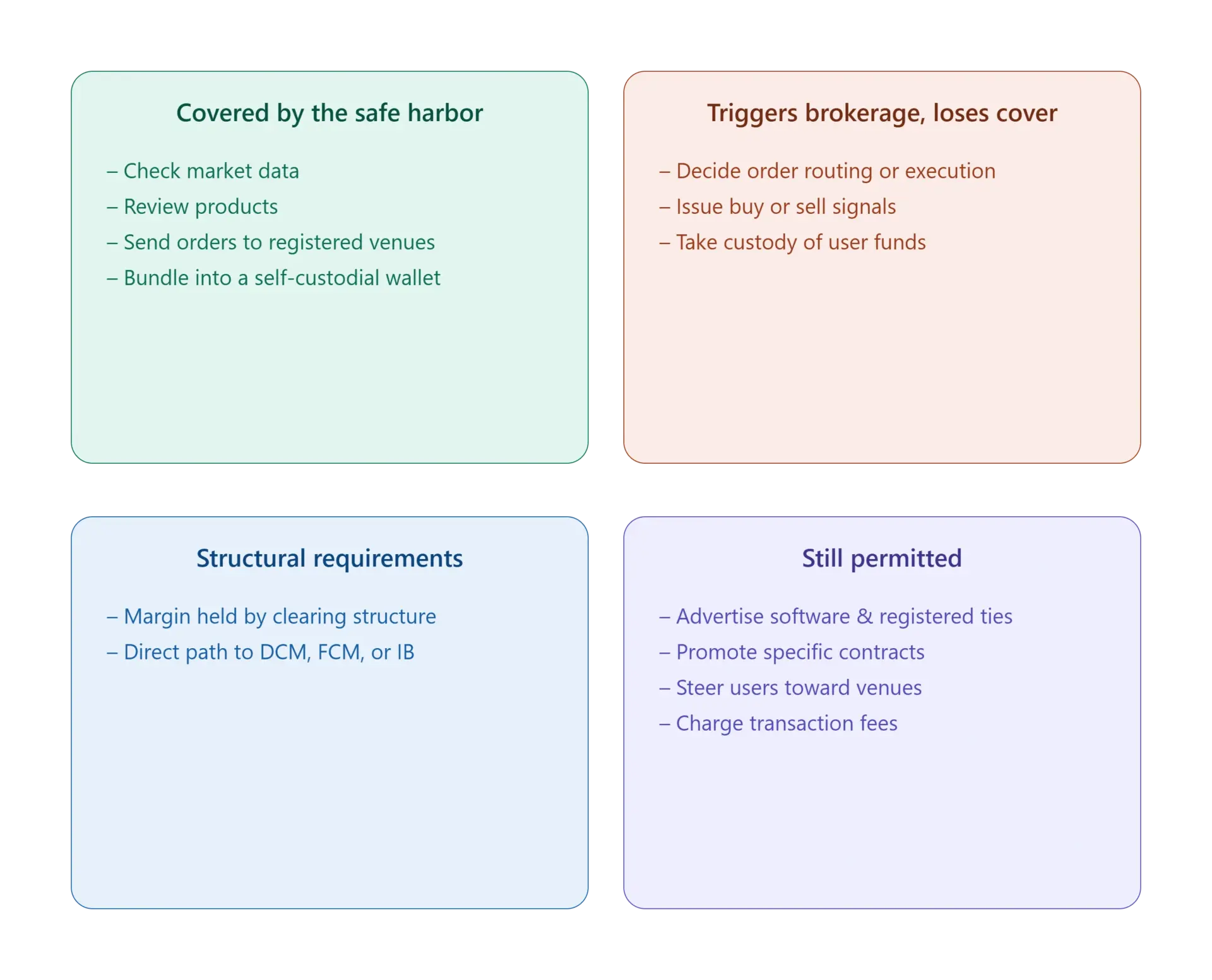
- •Eligibility requires the software to remain passive, meaning providers cannot control order routing or execution, issue buy or sell signals, hold user funds, or block users' direct access to registered venues.
- •Providers must meet obligations including disclosing conflicts and fees, retaining proof of user risk-disclosure acknowledgments, signing joint and several liability agreements with registered partners, and notifying the CFTC of any insolvency.
- •The staff-level relief is not binding on the Commission and arrived two days after the Senate's 49-50 vote failed to advance the CLARITY Act, with Chair Michael Selig's promised broker-registration rulemaking still pending.
The Commodity Futures Trading Commission's Market Participants Division has issued no-action relief to providers of passive crypto-trading software, sparing them from having to register as brokers. The move came two days after the US Senate blocked the Digital Asset Market CLARITY Act, leaving the agency's staff guidance as the principal source of regulatory clarity for the sector.
The relief is set out in CFTC Staff Letter 26-25, signed by division director DJ Hennes. Division staff said they will not recommend enforcement against eligible software providers that fail to register as introducing brokers, nor against their personnel for failing to register as associated persons of an introducing broker. Introducing brokers, in the CFTC's registration framework, are intermediaries that solicit or accept customer orders for futures contracts, with customer funds held by futures commission merchants rather than by the intermediaries themselves.
The agency took a similar step in March on behalf of a single company, Phantom Technologies. That position, however, bound only Phantom, and other developers seeking the same cover had to file their own requests. Staff Letter 26-25 removes that limitation, extending the relief on substantially the same terms to any passive software provider that meets the stated conditions.
Where the Line Falls Between Software and Broker
The relief reaches only software that passively connects users to regulated markets. A provider may build and distribute interfaces that let users check market data, review products, and send orders directly to registered venues. It may also bundle those functions into a self-custodial.
The cover disappears once brokerage enters the picture. Under the conditions, a provider cannot decide how an order is routed or executed. It cannot issue express buy or sell signals, and it cannot take custody of user funds. Money backing a derivatives position must sit with the clearing structure rather than with the software maker. Users must also be able to reach a designated contract market, a futures commission merchant, or an introducing broker without passing through the software at all. The dividing principle is user control: software that leaves routing, execution, and trading decisions entirely to the user stays within the letter's cover, while any function that reaches into order handling or custody steps outside it.
Within those limits, eligible providers may advertise their software and their ties to registered firms, promote specific derivatives contracts, and steer users toward particular venues. They may collect fees from registered counterparties and charge users per transaction.
Ten Conditions and a Caveat
The staff letter detailed ten covered activities and the limits attached to them. Among other points, a provider and its principal must not be subject to statutory disqualification. Providers must disclose conflicts and fees, and must retain evidence that users acknowledged risk disclosures. They must sign written agreements with each registered partner covering joint and several liability. They must also notify the CFTC of any insolvency and file a notice accepting the agency's jurisdiction.
The relief carries an important caveat: it originates from the Market Participants Division, which wrote that it does "not necessarily represent the position or view of the Commission or of any other office or division of the Commission." It is therefore not binding on the CFTC. That is the nature of staff-level no-action relief: it steers enforcement priorities rather than rewriting registration rules. The letter states that the division may modify, suspend, or end the relief, and that it would lapse if the CFTC ever adopts formal guidance on how broker registration applies to software developers.
CFTC Chair Michael Selig said in May, at Consensus Miami, that he wanted to codify the Phantom position into rules "very soon," describing the sequence as a "crawl, walk, run" approach. To date, that rulemaking has not arrived.
A Workaround While CLARITY Sits Stalled
The staff letter arrived roughly two days after the US Senate rejected cloture on the Digital Asset Market CLARITY Act by a vote of 49 to 50, eleven short of the 60 votes needed. Four Republicans were among the no votes, and no Democrat voted in favor.
Responding to the outcome, Selig called the vote unfortunate. In a post on X, he wrote, "Americans deserve regulatory clarity, legal certainty, and consumer protections in crypto asset markets." He said the CFTC was committed to helping President Trump deliver on his promise of "a future-proof crypto asset regulatory market structure," adding, "One way or the other, and we will help him get the job done using our existing statutory authorities." With the legislative route blocked, those existing authorities are carrying work a market-structure statute would otherwise set down, and staff guidance is filling the gap in the interim.
The SEC moved on the same day, releasing a long-awaited innovation exemption. Uniswap founder Hayden Adams pointed on X to an accompanying comment letter from SEC Commissioner Hester Peirce, quoting her line that "Truly decentralized systems that are driven by autonomous software… do not need an exemption." For software developers, that leaves the text of Staff Letter 26-25 — and the rulemaking Selig has promised but not yet delivered — as the documents to watch.

