CFTC Opens Rulemaking to Bring Offshore Crypto Trading Back to the US Through Federal Retail Leverage
Key Takeaways
- •The CFTC initiated rulemaking on Oct. 5 for Regulation Crypto Asset Transactions (CTX) and Regulation Crypto Asset (CAM), which would establish a national framework for retail margined and leveraged crypto trading.
- •Participation would remain optional for ordinary spot exchanges, with access to federally regulated retail leverage positioned as the primary incentive to enter the regime.
- •Chairman Michael Selig framed the initiative around lessons from the 2022 FTX collapse, and platforms holding customer property in omnibus accounts could face proof-of-reserves requirements.
- •Customer leveraged trades would be intermediated through registered futures commission merchants, bringing accounts under capital, segregation, and Bank Secrecy Act anti-money-laundering obligations.
- •The proposal clarifies that transfers to a customer's non-custodial wallet within 28 days generally satisfy the Commodity Exchange Act's 'actual delivery' exception for certain leveraged retail commodity transactions.
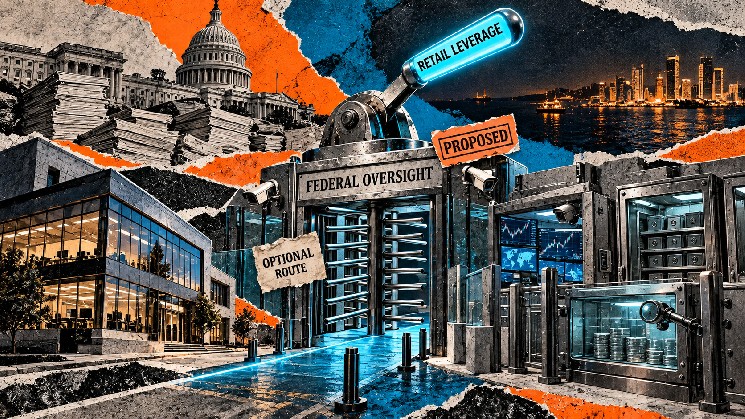
The Commodity Futures Trading Commission (CFTC), the federal agency that oversees US derivatives markets, has opened its most significant pathway yet for drawing offshore crypto trading back to the United States, proposing a federal route to retail leverage for US exchanges as Congress remains stalled on market-structure legislation.
On Oct. 5, the financial regulator initiated rulemaking for Regulation Crypto Asset Transactions (CTX) and Regulation Crypto Asset Markets (CAM), two measures that would create a national framework for platforms offering retail customers margined, leveraged, or financed crypto trading. Retail leveraged crypto products of this kind have been largely unavailable from domestic US platforms, leaving much of that trading activity on offshore venues.
Participation would remain optional for exchanges handling ordinary spot trading, because the agency acknowledges it cannot compel the broader crypto market onto CFTC-regulated venues without congressional action. The incentive is access to leveraged products that state money-transmitter licensing alone does not provide; US spot crypto platforms have historically operated under a patchwork of state-by-state licenses rather than a single federal regime.
The initiative gives the CFTC a way to use authority it says already exists under the Commodity Exchange Act, the decades-old federal statute governing commodity and derivatives trading, while Congress has yet to enact comprehensive legislation governing crypto spot markets.
Leverage as the regulatory carrot
The framework would effectively create three regulatory paths, depending on what an exchange wants to offer US customers.
Ordinary spot exchanges could remain primarily under state licensing regimes, supplemented by the CFTC's existing anti-fraud and anti-manipulation authority. Platforms offering leveraged or financed retail crypto transactions could seek federal registration under the new framework, while venues trading futures, perpetuals and other derivatives would stay within the agency's existing designated contract market regime, the registration category the CFTC has long used for US futures and options venues.
CAM would sit in that middle category. The structure would allow existing designated contract markets to offer CTXs under tailored rules while giving crypto platforms another route into federal supervision without requiring them to operate as conventional derivatives exchanges.
The CFTC is relying on Section 2(c)(2)(D) of the Commodity Exchange Act, which covers certain leveraged retail commodity transactions.
Hyperliquid Policy Center said the resulting structure could give market participants a clearer regulatory ladder: state licensing would cover ordinary spot activity, federal CFTC oversight would apply where leverage is introduced, and the existing derivatives framework would cover futures and perpetual contracts.
The proposal could also narrow one of the biggest product gaps between US exchanges and offshore rivals. Leveraged trading and perpetual contracts — a derivatives format widely traded on offshore platforms but generally unavailable to US retail customers on regulated domestic venues — have helped offshore venues attract active traders and generate substantial volumes, while US platforms have generally operated with a narrower product menu because of regulatory constraints.
That creates the central commercial bargain. Federal registration could give exchanges access to products that have historically strengthened the economics of offshore competitors, but accepting CFTC oversight could also force changes to the vertically integrated model through which many crypto venues combine exchange, brokerage and custody functions.
Larry Florio, deputy general counsel at synthetic-dollar developer Ethena Labs, described retail leverage as the proposal's central attraction, arguing that could be enough to draw exchanges voluntarily into a single federal framework. Whether leverage generates enough additional volume and revenue to justify those constraints may determine how many major platforms enter the regime.
FTX shapes the cost of opting in
The regulatory bargain would extend well beyond permission to offer leverage.
CFTC Chairman Michael Selig framed the initiative around lessons from FTX's bankruptcy — the November 2022 collapse of what was then one of the world's largest crypto exchanges, which left a multibillion-dollar shortfall in customer funds — arguing that regulators should establish preventive safeguards rather than rely primarily on enforcement after customers have suffered losses. Selig said on Oct. 5 that "the lesson from FTX's failure should have been obvious," adding that protecting customers from fraud should coexist with responsible crypto innovation.
CAM operators would face core requirements already associated with designated contract markets, including rules governing financial integrity, surveillance, conflicts of interest and operational safeguards.
The agency is also considering crypto-specific requirements. Exchanges could have to assess token concentration, distribution methods, vesting schedules, lockups, programmatic issuance and buybacks when determining whether an asset can be traded without being readily susceptible to manipulation. Platforms holding customer property in omnibus accounts could also face proof-of-reserves requirements, a safeguard Selig directly linked to risks exposed by FTX.
Customer CTX trades would meanwhile be intermediated through registered futures commission merchants (FCMs), the licensed intermediaries that hold and clear customer funds in traditional US futures markets, bringing customer accounts and property under requirements covering capital, disclosures and segregation. FCM involvement would also bring customer-facing activity within applicable Bank Secrecy Act obligations, including anti-money laundering controls, customer identification and suspicious-activity reporting.
Those provisions raise the cost of opting into the federal framework beyond registration fees or compliance staffing. Exchanges could gain access to leverage while surrendering some of the structural flexibility that has allowed crypto platforms to keep trading, brokerage and custody under one roof. That trade-off will be central to whether the framework attracts the large US exchanges whose participation would give it meaningful scale.
Drawing a boundary around onchain markets
The commission is also beginning to define where decentralized markets and software developers fit within federal commodities law, although that effort sits partly outside the CTX and CAM initiative.
The CTX proposal would clarify the Commodity Exchange Act's "actual delivery" exception by treating transfers to a customer's external non-custodial wallet — one whose keys are controlled by the user rather than a platform — within 28 days as generally satisfying the exemption from exchange-trading requirements for certain leveraged retail commodity transactions.
Separately, Selig said the agency is considering how to treat developers who publish software without taking customer orders, controlling execution or holding customer assets.
"A person should not have to register as an introducing broker simply because that person shipped code," he said.
The CFTC is consulting developers about where control resides in onchain venues and when software activity begins to resemble regulated financial intermediation.
Key elements remain unresolved
For centralized exchanges, however, the more immediate question is economic. The Oct. 5 action is an advance notice of proposed rulemaking — the earliest formal step in US federal rulemaking, in which an agency solicits public comment before proposing binding rules — and the agency is seeking public input before drafting detailed rules covering leverage, asset eligibility, custody, reserves and intermediary requirements.
That leaves major elements of the framework unresolved, including leverage limits, capital standards and the extent to which FCM intermediation could reshape existing exchange business models. Agency rules also remain less durable than legislation, and a future commission could revise them.
The CFTC is testing a relatively simple proposition: whether access to federally regulated retail leverage is valuable enough to persuade crypto exchanges to accept substantially deeper oversight. If major platforms decide that it is, the agency could begin pulling trading activity now concentrated on offshore venues into regulated US markets without waiting for Congress to settle the broader fight over crypto spot-market jurisdiction, a long-running dispute over how oversight of those markets is divided between the CFTC and the Securities and Exchange Commission.

