CFTC Approves Coinbase Clearing as Registered Derivatives Clearinghouse
Key Takeaways
- •The CFTC has added Coinbase Clearing LLC to its official list of registered derivatives clearing organizations, authorizing it to operate as a clearinghouse for derivatives contracts.
- •Coinbase Clearing LLC is a separate legal entity from Coinbase's main consumer-facing exchange, so the approval does not change the day-to-day experience for retail customers.
- •Clearinghouse status lets Coinbase control settlement, collateral, and default-handling processes internally under continuous CFTC supervision instead of relying on external clearing facilities.
- •Coinbase has filed with U.S. regulators to offer single-stock and ETF perpetual futures, products that require clearing infrastructure to operate within federal rules.
- •Any derivatives products or services launched using the clearing approval would require additional regulatory steps and public announcements before becoming available.
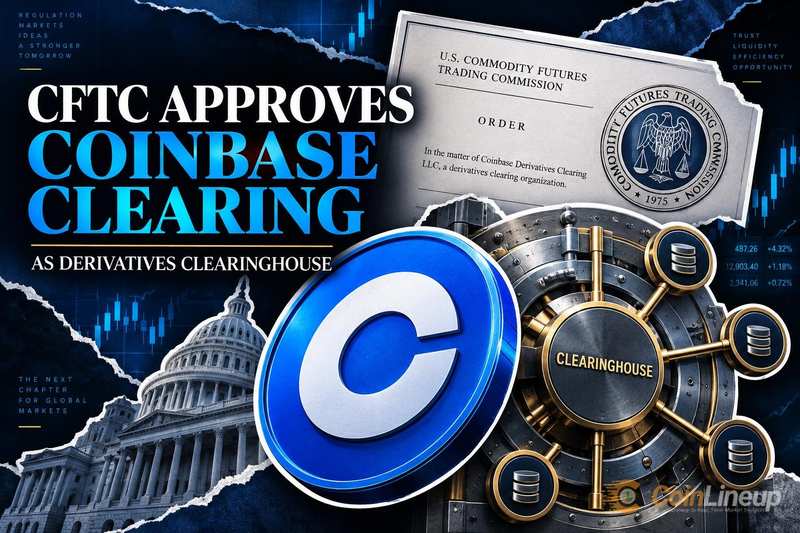
The U.S. Commodity Futures Trading Commission (CFTC) has approved Coinbase Clearing LLC as a registered derivatives clearinghouse, marking a significant regulatory milestone in the crypto exchange's push into institutional derivatives markets.
The approval adds Coinbase Clearing LLC to the CFTC's official list of registered derivatives clearing organizations. That list is maintained by the CFTC and comprises entities that have met federal requirements to operate as clearinghouses for derivatives contracts.
Coinbase Clearing LLC is a separate legal entity from Coinbase's main consumer-facing exchange. Most Coinbase customers buy and sell crypto directly on the exchange; this approval covers a different part of the business — one that sits behind derivatives trades and handles settlement.
What a derivatives clearinghouse actually does
A clearinghouse acts as the middleman in a financial transaction. When two parties trade a derivatives contract, such as a futures agreement, the clearinghouse steps in between them and guarantees that both sides meet their obligations, even if one party defaultsn
It functions much like an escrow service for complex financial bets: the clearinghouse holds collateral, tracks positions, and ensures the losing side pays the winning side. Without a clearinghouse, every trade carries the risk that a counterparty simply fails to pay.
That middleman role is a large part of why regulators value clearinghouses: after the 2008 financial crisis, U.S. authorities required many standardized derivatives to be cleared through registered intermediaries precisely because a guaranteed counterparty limits the damage when a single trader fails.
For crypto, this infrastructure has historically existed mainly in traditional finance. Obtaining CFTC approval to operate a clearinghouse means Coinbase can now provide this function under U.S. federal oversight, rather than relying on external clearing facilities. Registration is also not a one-time sign-off: registered clearinghouses must continuously meet CFTC requirements on risk controls, financial safeguards, and default handling, keeping the operator under ongoing federal supervision.
What it means for Coinbase's derivatives ambitions
Coinbase has been building toward a larger role in regulated U.S. derivatives markets. The company has filed with U.S. regulators to offer single-stock and ETF perpetual futures, products that would require clearing infrastructure to operate within federal rules. Perpetual futures, unlike conventional futures contracts, carry no expiration date — a structure that has made them a staple of crypto derivatives trading.
Clearinghouse status gives Coinbase direct control over how its derivatives products settle, including the collateral and settlement rules that apply to trades. That matters for institutional clients, such as hedge funds and asset managers, who require certainty about settlement before entering large positions.
The CFTC and the Securities and Exchange Commission (SEC) have also been developing broader frameworks for digital assets. Earlier this year, the two regulators outlined a five-year path for tokenized U.S. stocks, signaling that regulated digital asset infrastructure is increasingly a priority in Washington.
Any specific products or services Coinbase plans to launch using the clearing approval would require additional regulatory steps and public announcements. The clearinghouse approval enables the infrastructure; it does not, by itself, launch new trading products.
What regular Coinbase users should know
For customers who buy Bitcoin or other tokens on Coinbase, the approval does not change the day-to-day experience. The clearing entity operates separately from the retail exchange most people use.
The longer-term significance is that Coinbase is building the kind of regulated back-end infrastructure that large financial institutions require. That could eventually bring more institutional money and liquidity into the crypto markets where users hold assets, though the timing and scale of any such effect are not yet established.
The clearest signal of what this regulatory milestone means in practice will come if and when Coinbase announces specific derivatives products or services that the clearinghouse approval enables.
Disclaimer: This article is for informational purposes only and does not constitute financial or investment advice. Cryptocurrency and digital asset markets carry significant risk. Always do your own research before making decisions.

