AI and Employment: So Far, So Good
Key Takeaways
- •AI adoption in the Census Bureau’s business survey increased from 3.7% in September 2023 to about 10% by late 2025, then to about 18% after a broader question was introduced in November 2025.
- •In the latest survey supplement, 95.7% of firms said AI had not changed total employment, while 2.3% reported increases and 2.0% reported decreases.
- •Among firms using AI, 44% said it supplemented existing employee work, while smaller shares said it replaced old tasks or created new ones.
- •Generative AI was used mainly for writing or editing documents and email, followed by searching for information and summarizing documents.
- •Most adopters reported making no business changes to use AI, and only a small share hired workers with AI skills or changed workflows.
In September 2023, the Census Bureau added questions about AI to its Business Trends and Outlook Survey. Census asked hundreds of thousands of businesses whether they had used AI in the previous two weeks to produce goods and services. At that time, 3.7% said yes; by late 2025, the figure had reached about 10%. In November 2025, Census broadened the question to ask about AI use in any business function, producing a jump in measured adoption to about 18%.
Twice, the Bureau has asked a key question:
In the last six months, how did the use of Artificial Intelligence affect this business’s total employment?
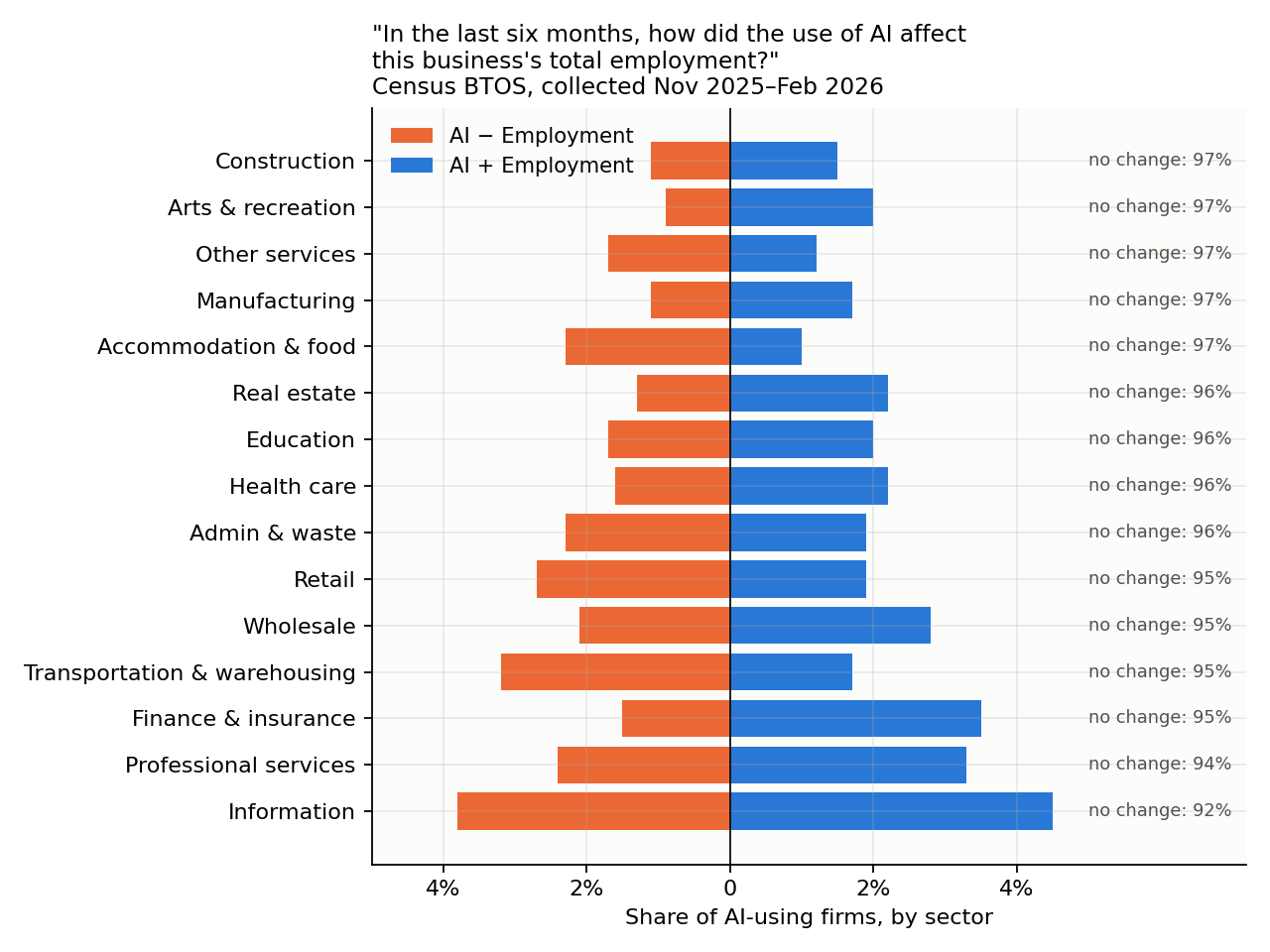
In December 2023 to February 2024, when about 5% of firms were using AI, the answers were 2.8% increased, 2.6% decreased, and 94.6% reported no change. Two years later, in the November 2025 to February 2026 supplement, the answers were 2.3% increased, 2.0% decreased, and 95.7% reported no change. The results were similar by firm size.
Some sectors reported more activity. Information is the one sector where fewer than 92% reported no change. But overall, almost all firms reported no change, and among those reporting a change, the effect was about evenly divided between increasing and decreasing employment. That matters because the Census measure is based on a very large business sample, so it offers a broad snapshot of how adoption is showing up in reported staffing decisions rather than in anecdotes about specific companies.
The supplement also asked about tasks. Among firms using AI, 44% said it supplemented or enhanced work an employee already does. Ten percent said it performed a task an employee used to do. Eleven percent said it introduced a task no one had been doing.
Among firms using generative AI, 85% cited writing or editing documents and email as the biggest uses, half cited searching for information, 45% cited summarizing documents, and 13% cited coding. Sixty-four percent of adopters said they changed nothing about the business in order to use AI, 15% trained existing staff, another 15% built new workflows, and just over 1% hired anyone with AI skills. Those responses suggest that, for now, adoption is mostly being absorbed into existing operations rather than accompanied by broad organizational change.
Among firms where AI has taken over some employee tasks, the degree of substitution is growing. The share reporting that AI took over “a large number” of tasks rose from 2.4% to 7.1%, while the share reporting “a moderate number” rose from 13% to 22%. But this group remains small: only about a tenth of AI adopters, who themselves make up about a fifth of firms.
The estimates are firm-weighted, though employment-weighting gives essentially the same result. The evidence, from a very large sample, suggests that the overwhelming majority of firms using AI do not yet report any effect on total employment. That is very consistent with what Tyler and I said in our talk to OpenAI.
The Census data are available here. The talk to OpenAI is available here. This post also notes that the author used Fable and ChatGPT Sol in producing it.
